10 surprising squirrel facts for children (perfect for Squirrel Appreciation Day)
20th January 2026
Written by Lee Peckover
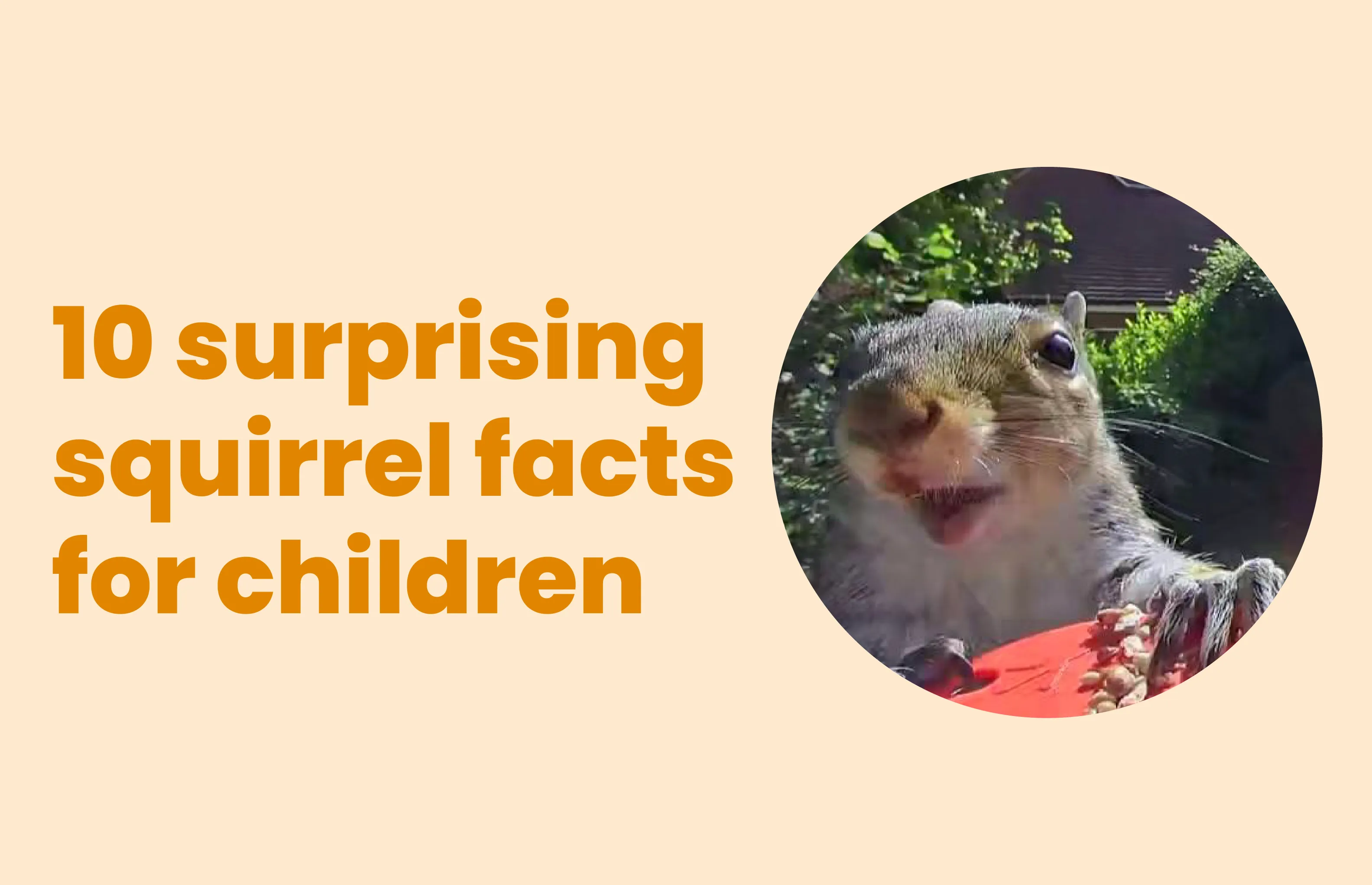
Squirrels are one of those animals children think they already know.
“They like nuts.”
“They climb trees.”
“They run away when you get close.”
Then you tell them squirrels fake-bury food to trick thieves, organise their snacks using memory tricks, and use landmarks like a living map… and suddenly everyone is staring out of the classroom window like it is a nature documentary.
Each fact below is written to work as a quick classroom moment: a surprising fact, followed by a question to spark talk, thinking, or debate.
1) Squirrels sometimes pretend to bury food to trick other animals
When squirrels know they are being watched, they may dig a hole, cover it up, and walk away… without leaving anything behind. Later, they hide the food somewhere else. Scientists call this deceptive caching (The Humane Society of the United States, n.d.).
Class discussion: Does your behaviour change when no one is watching you? (we’re thinking more like dance like no one is watching here rather than doing the wrong thing!)
2) Squirrels use landmarks like a living GPS
Squirrels remember where food is hidden by using nearby objects such as trees, bushes, and logs. They are not just guessing. They are using memory and location together (Scientific American, 2023).
Class discussion: What landmarks would you use to find something you buried in the playground?
3) Squirrels are brilliant eco-warriors (even by accident)
Squirrels remember many of their food hiding places, but not all of them. For a long time, people claimed squirrels “forget half” their food. Research shows this is an oversimplification. Some food stashes are genuinely forgotten about, others are squirrels seem to decide are not worth going back for (Britannica, 2025; Scientific American, 2023).
Those forgotten nuts can grow into trees or feed other animals, helping the ecosystem.
Class discussion: Can you think of ways we could help nature like squirrels do?
4) Their front teeth never stop growing
Squirrels’ front teeth grow continuously (which sort of grosses me out a bit to be honest). They can grow by around 14 cm per year. That is why they have to gnaw on things all the time. If they didn’t, their teeth would grow too long to use properly (BBC Earth, n.d.).
Class discussion: What would you choose to chew if your teeth never stopped growing?
5) Squirrels organise food using a memory trick called “chunking”
Some squirrels group similar foods together when they hide them, and this can help them remember it by the type of cache they have chunked into each area. This is sort of similar to how humans remember information more easily when it is sorted into groups like spelling patterns (Delgado & Jacobs, 2017).
Class discussion: How do you remember where you left things? Do you know any good memory tricks?
6) A squirrel can hide thousands of nuts in a year
In some cases, a single squirrel can hide around 10,000 nuts in one year (BBC Earth, n.d.). That is not about forgetting. It is about planning ahead for winter.
Class discussion: Would it be easier to hide lots of food all at once, or a little bit each day?
7) Squirrels run in zigzags to escape danger
When a squirrel is chased, it often changes direction suddenly. This zigzag running makes it harder for predators to predict where the squirrel will go next (BBC Earth, n.d.).
Class discussion: What else could squirrels do to evade predators? Do you know any other animals that have special skills they use to evade predators?
8) A squirrel’s tail is a piece of survival equipment
A squirrel’s tail helps with balance, communication, and warmth. In some squirrel species, the tail is even used as shade to keep cool in hot conditions (Bennett et al., 1984).
Class discussion: If you had a tail, what would you use it for?
9) Squirrels can smell buried food through snow
Even when food is hidden underground or covered by snow, squirrels can often find it again using their sense of smell as well as memory (Scientific American, 2023).
Class discussion: Which sense would you trust most if you were looking for hidden food? Fun bonus fact, humans have a better sense of smell than dogs, but only when it comes to sniffing out fruit! Bananas, right?
10) Squirrels can run down trees head-first because their ankles rotate
Squirrels have a special ankle joint that can rotate up to 180 degrees, allowing their back feet to grip tree bark when going down a tree. Most animals can climb up easily, but squirrels are unusually good at climbing down safely (BBC Earth, n.d.).
This is why they can sprint down tree trunks head-first without falling.
Class discussion: Why is climbing down harder than climbing up? How would this ability help a squirrel escape danger?
What next?
The next time you see a squirrel, pause before you dismiss it as “just a squirrel”. Watch how it moves, where it stops, what it seems to notice. These tiny moments are where curiosity starts.
If your class wants to go further, organisations like the British Wildlife Centre, Wildlife Trusts, and RSPCA have simple guidance on how to protect wildlife and habitats close to home.
Science does not always start in a lab. Sometimes, it starts under a tree.
References
BBC Earth. (n.d.). Squirrel facts. https://www.bbcearth.com/factfiles/animals/mammals/squirrel
Bennett, A. F., Huey, R. B., John-Alder, H., & Nagy, K. A. (1984). The parasol tail and thermoregulatory behavior of the Cape ground squirrel Xerus inauris. Physiology & Behavior, 32(3), 509–513. https://faculty.washington.edu/hueyrb/Bennett%20EA%2084%20Parasol.pdf
Britannica. (2025). Is it true that squirrels forget where they bury about half of their food? https://www.britannica.com/story/is-it-true-that-squirrels-forget-where-they-bury-about-half-of-the…
Delgado, M. M., & Jacobs, L. F. (2017). Caching for where and what: Evidence for a mnemonic strategy in a scatter-hoarder. Royal Society Open Science, 4(9), 170958. https://pmc.ncbi.nlm.nih.gov/articles/PMC5627128/
Jacobs, L. F. (1991). Grey squirrels remember the locations of buried nuts. Animal Behaviour, 41(6), 103–110. https://www.sciencedirect.com/science/article/abs/pii/S0003347205805068
Scientific American. (2023, November 20). Do squirrels remember where they buried their nuts? https://www.scientificamerican.com/article/do-squirrels-remember-where-they-buried-their-nuts/
The Humane Society of the United States. (n.d.). Squirrels: They’re no nuts. https://www.humaneworld.org/en/all-animals/squirrels-theyre-no-nuts


Try us today!