Adaptive Teaching vs Differentiation: Should You Still Differentiate in Primary Maths?
21st August 2026
Written by Lee Peckover
So, should teachers still differentiate?
An oversimplified answer first: Yes. Children are different, so teaching has to respond to those differences.
Then a little more nuanced: What needs to change is the idea that differentiation means planning three versions of every maths lesson in advance.
For years, that was common in primary classrooms. A Developing (or Working Towards) task, an Expected task and a Greater Depth task. At times, the same children ended up doing the same level of work lesson after lesson.
Holding our own hands up now… we did it too.
The problem is not that children sometimes need different work. We know they do. The problem comes when different work is decided by a fixed group or attainment label rather than by what a child actually needs in that lesson.
The Department for Education’s Initial Teacher Training and Early Career Framework cautions against adaptations that create artificially distinct tasks for different groups or lower expectations for particular pupils. This type of adaptation is, oddly, exactly the opposite of what adaptive maths should be. Adaptive maths is responsive, in-the-moment work that meets children where they are. The Initial Teacher Training and Early Career Framework also stresses the need to meet individual needs without creating unnecessary workload (Department for Education [DfE], 2024). The tricky part is finding a way to meet every child with what they need, whilst avoiding too much extra work.
Sometimes a child needs an easier task for a while. They may need more practice, another worked example, or a step broken down further. Planning for all of this is a lot of prep work, and it is understandable that 3-way differentiation sheets seemed such a solution. They offer something different, without too much extra work. Trouble is…
Three-way differentiation can go wrong
Ofsted’s 2023 mathematics subject report describes a shift away from the previously widespread use of “3 levels of differentiation”, where pupils were assigned, or chose, tasks at different levels (Ofsted, 2023).
One concern was that some pupils could spend much of their time completing basic work while others reached reasoning and problem solving. Repeated over time, that can reinforce the differences teachers are trying to address.
That does not mean every child should always do the same thing.
Some pupils need more time. Some need more practice. A child may need a less demanding task temporarily so they can secure a missing piece of knowledge before returning to the main learning. Pupils working significantly below age-related expectations may sometimes need different content altogether (Ofsted, 2023).
The issue is not different work. It is when and why that work has been chosen.
A broad attainment label cannot tell you exactly what a child needs in every maths lesson.
What adaptive teaching looks like
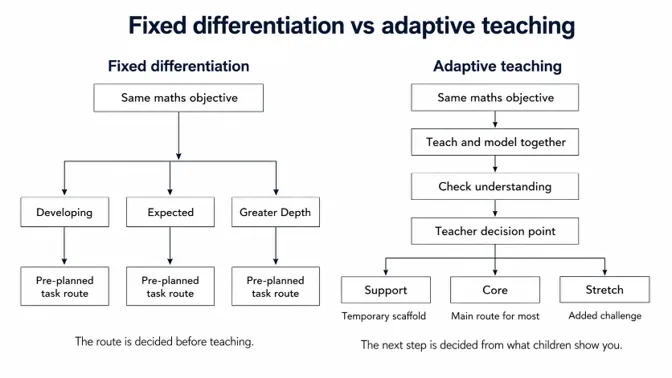
Imagine you teach a new concept, model it and then ask children to have a go.
You notice that a few children have misunderstood an important step.
You might model it again. You might use a different representation. You might give them scaffolded examples or a few simpler questions before they return to the main task.
Meanwhile, other children continue independently, while some may already be ready for greater complexity.
The children are doing different things, but the difference has come from what you have seen in the lesson, not what you planned for ahead of time.
The EEF places checking for understanding at the heart of adaptive teaching. Teachers use what they find out to decide whether to explain something again, add or remove support, provide further practice or move the learning on (Settle, 2026).
Formative assessment tells you what is happening. Adaptive teaching is what you do about it.
It looks a little like this when compared to fixed differentiation:
What about Working Towards, Expected and Greater Depth?
Same thing. Some call it developing, some say working towards.
‘Working towards’ along with ‘expected’ and ‘greater depth’ describe attainment, not a level of worksheet.
A child who is working towards the expected standard overall may be secure in the particular mathematics being taught today. A child who usually attains highly may need much more support with a new concept.
All of this needs fixing and replacing with high-quality adaptive teaching. Let the labels be what they should be: a statement of attainment.
What this looks like with Classroom Secrets Maths
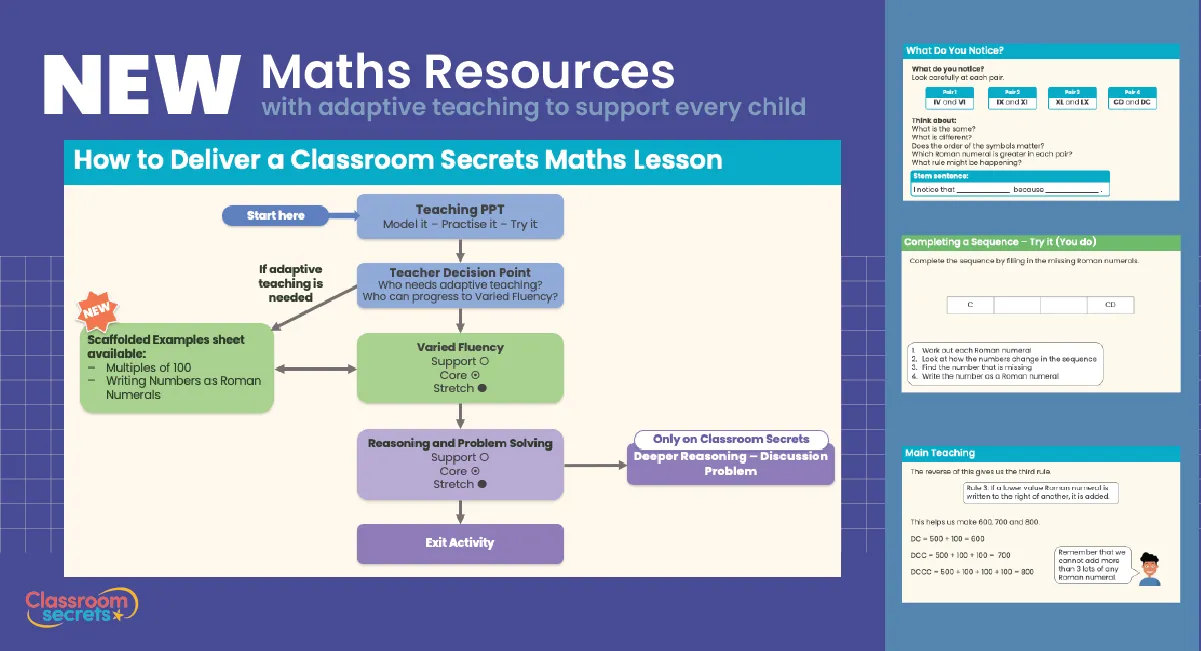
A bit like this really (taken from our new maths lessons):
We have changed the way we organise our own maths resources.
Our new Teaching PPT moves through Model it, Practise it and Try it, with a Teacher Decision Point before independent Varied Fluency.
For most children, Core is the main route.
If a child needs more help, the teacher can use Scaffolded Examples, the Knowledge Organiser or selected questions from Support. Sometimes Support will reduce the demand temporarily (this word being crucial here, it’s there while they need it, to get them to core) so a child can secure the learning they need before moving back into the main task.
Stretch is there when the important knowledge is secure and greater complexity is appropriate.
The same idea carries into Reasoning and Problem Solving.
Support, Core and Stretch describe the resource, not the child.
We do not expect a “Support child” to use Support every lesson. That would simply be the old model with different names.
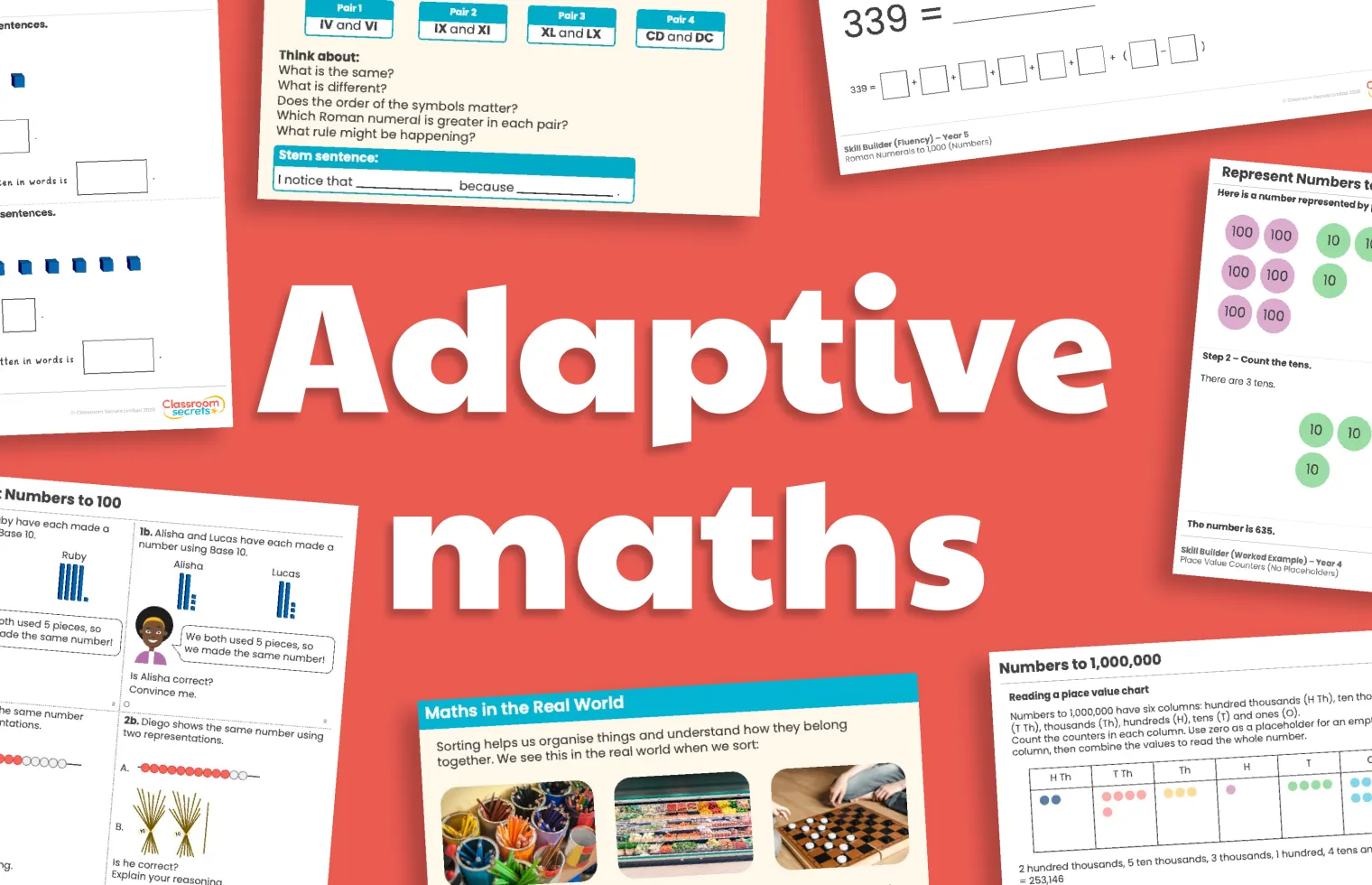
You can see some of the new resources here: https://classroomsecrets.co.uk/campaign/new-adaptive-maths
A useful rule:
Differentiate the response, not the expectation.
If a child needs more modelling, model again. If they need an easier task for a while, give them one. If they need more practice, provide it. If they are secure, increase the challenge.
Adaptive teaching does not mean every child always does the same work.
It means we stop deciding in advance that the same children always need the same level of work.
References
Department for Education. (2024). Initial teacher training and early career framework. Department for Education.
Education Endowment Foundation. (n.d.). Five a day: Supporting high-quality teaching for pupils with SEND. Education Endowment Foundation.
Eaton, J. (2022, October 19). Moving from ‘differentiation’ to ‘adaptive teaching’. Education Endowment Foundation.
Ofsted. (2023). Coordinating mathematical success: The mathematics subject report. Ofsted.
Settle, C. (2026, January 7). Adaptive teaching in practice: Using feedback to check understanding. Education Endowment Foundation.

Try us today!