Making the Small Gaps in the School Day Count
23rd September 2026
Written by Lee Peckover
Not every part of the school day needs a full lesson. Sometimes you have ten minutes while everyone settles in, five minutes at the start of maths or a small gap before assembly. Sometimes you simply know that something taught last half term could do with coming back before children start to forget it.
Those moments might be small, but across a week, a term and a whole school year, there are a lot of them. Used well, they can give children regular opportunities to revisit prior learning, practise important skills and keep knowledge accessible over time.
That is the thinking behind our shorter retrieval and practice resources.
Why revisit learning regularly?
Understanding something when it is first taught does not mean it will remain equally easy to remember several weeks later.
Research into retrieval practice shows that asking children to bring previously learned information back to mind can strengthen long-term retention (Agarwal et al., 2021). Spacing those opportunities over time can help too, rather than concentrating all the practice around the point when something is first taught (Cepeda et al., 2006).
This connects with the familiar idea of the forgetting curve. It should not be interpreted as children forgetting a fixed percentage of their learning after a certain number of hours, but the broader principle is sound: access to learning can weaken over time if there are no opportunities to revisit it (Murre & Dros, 2015).
Regular retrieval therefore helps keep important knowledge accessible, ready for children to use again and connect with new learning. This is why we offer…
Different resources for different types of practice
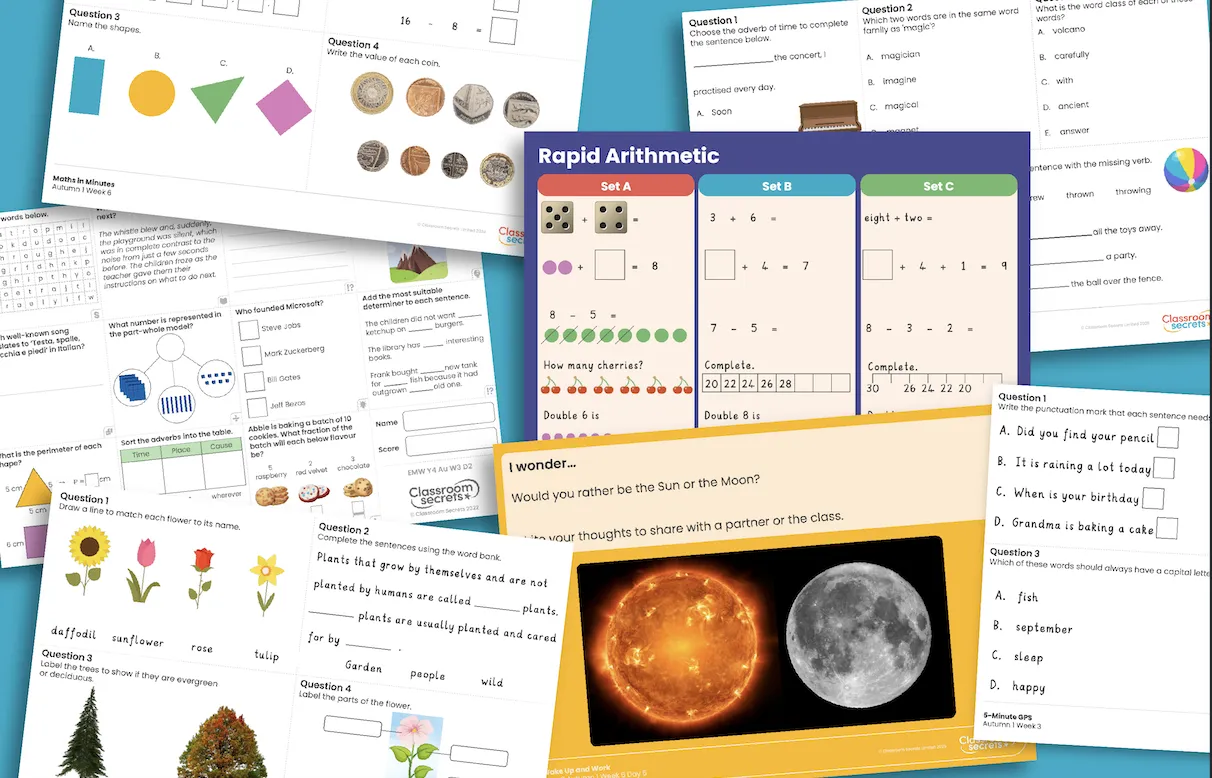
5-Minute GPS revisits grammar, punctuation and spelling throughout the year. The content is sequenced so children begin by retrieving relevant prior learning, with newly taught content introduced and revisited as the year progresses. See a Year 1 Autumn 1 Week 1 example.
Maths in Minutes draws on different areas of previously taught mathematics, helping to keep knowledge from across the curriculum in use even when the current unit has moved elsewhere. See a Year 1 Autumn Week 1 example.
Rapid Arithmetic has a more focused role, providing repeated practice in areas such as calculation, fractions and place value. See the first week of Year 1 resources.
5-Minute Science and 5-Minute History work at subject level, giving children opportunities to retrieve important knowledge after a unit has finished. This can be particularly useful in foundation subjects, where children may otherwise go several months without encountering a topic again. Explore 5-Minute Science.
Early Morning Work offers a broader mix of curriculum areas for the start of the day, while Wake Up and Work provides a consistent daily routine across areas including spelling, maths, reading and arithmetic. See Early Morning Work. See Wake Up and Work.
Short activities still need careful planning
The value of a five-minute activity depends on what children are being asked to retrieve and when.
These resources are therefore planned with curriculum progression in mind. Our subject specialists consider what children are likely to have been taught already, which knowledge is worth revisiting and how that learning develops over time.
Some resources provide broad retrieval across a subject. Others focus more closely on fluency or bring learning back from an earlier unit. The aim is the same: to make those small parts of the school day useful opportunities to strengthen prior learning.
Five minutes will never replace good teaching. Used regularly and thoughtfully, though, it can help make sure more of that teaching is still accessible weeks and months later.
References


Try us today!