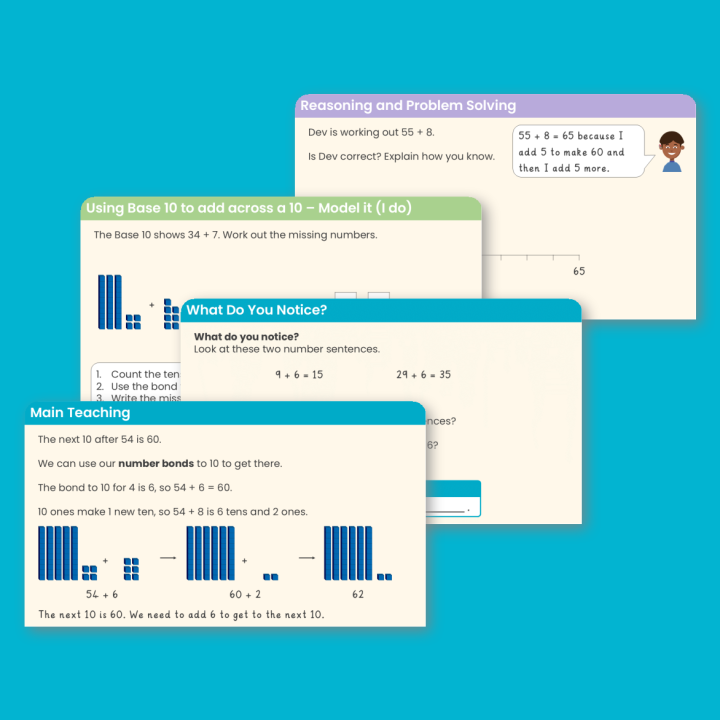
The Year 2 Add Across a 10 PowerPoint guides both teachers and children through the lesson, including use of the varied fluency, reasoning and problem solving, deeper reasoning and scaffolded resources. Key learning information about this step:
Key Vocabulary
tens: A group of 10 ones together is the same as 1 ten.
number bonds: Two numbers that join together to make a different whole number.
partition: When we partition, we split a number into smaller numbers. The larger number is the whole and the smaller numbers are the parts. Numbers can be partitioned in different ways, for example into tens and ones.
part-whole model: A representation that shows the whole number and the parts it has been split into.
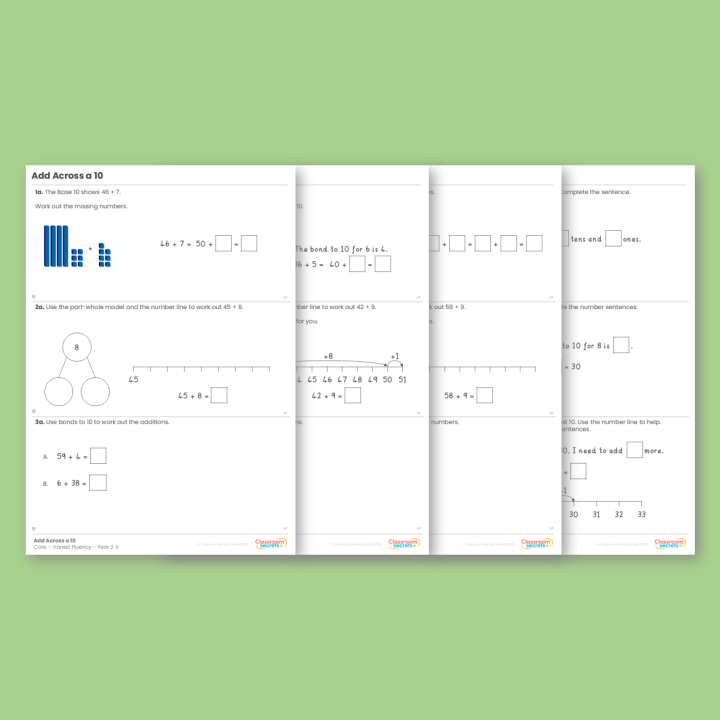
Varied Fluency
Knowledge Organiser
• Designed to support all children via key information and examples.
Scaffolded Examples
• Counting tens and ones in Base 10; finding the bond to 10 and partitioning the ones with a number line.
Support
• Q1: Add using Base 10; the ones are split and the bond to 10 is given.
• Q2: Use a part-whole model and number line; one part and jumps are given.
• Q3: Use bonds to 10 to add; a helpful fact or the reordered addition is given.
Core
• Q1: Add using Base 10; the next 10 is given in the number sentence.
• Q2: Partition the ones and use a number line; start number is labelled
• Q3: Use bonds to 10 to add; one addition has the smaller number first.
Stretch
• Q1: Write the addition shown by the Base 10; find the next 10 and the total.
• Q2: Complete a blank part-whole model; label the line and draw both jumps.
• Q3: Use bonds to 10 to add and to find a missing number in an addition.
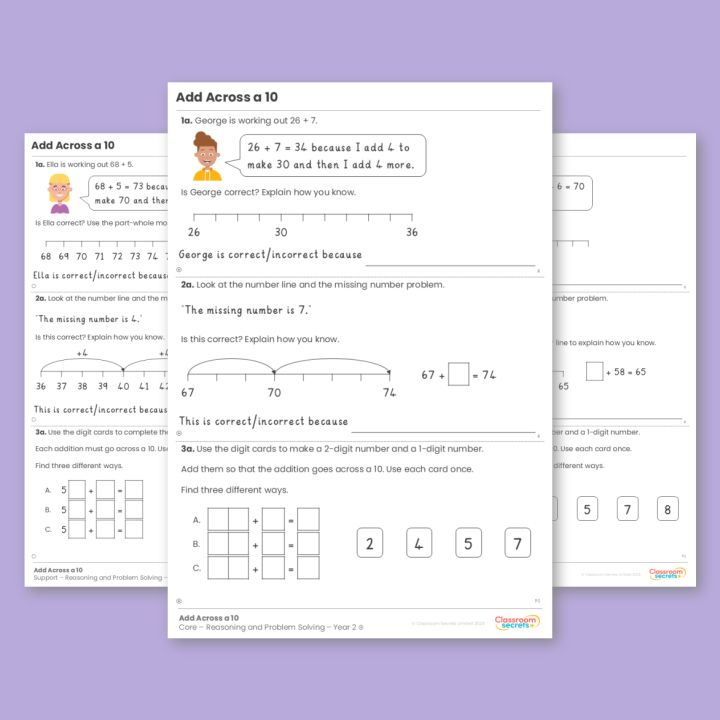
Reasoning and Problem Solving
Support
• Q1: Reasoning – explain whether a character has partitioned the ones correctly to add across a 10, with a part-whole model and a fully labelled number line.
• Q2: Reasoning – explain whether a missing number is correct, with both jumps drawn and labelled on a number line.
• Q3: Problem Solving – complete additions that go across a 10 using digit cards, with the tens digit given.
Core
• Q1: Reasoning – explain whether a character has partitioned the ones correctly to add across a 10, with a number line to help.
• Q2: Reasoning – explain whether a missing number is correct, with the jumps drawn on a number line.
• Q3: Problem Solving – make additions that go across a 10 from four digit cards.
Stretch
• Q1: Reasoning – explain whether a character has added across a 10 correctly when the smaller number is first; only the start of the number line is labelled.
• Q2: Reasoning – explain whether a missing number is correct; draw the jumps on a number line with only its ends labelled.
• Q3: Problem Solving – make additions that go across a 10 from four digit cards, with an odd or even total.
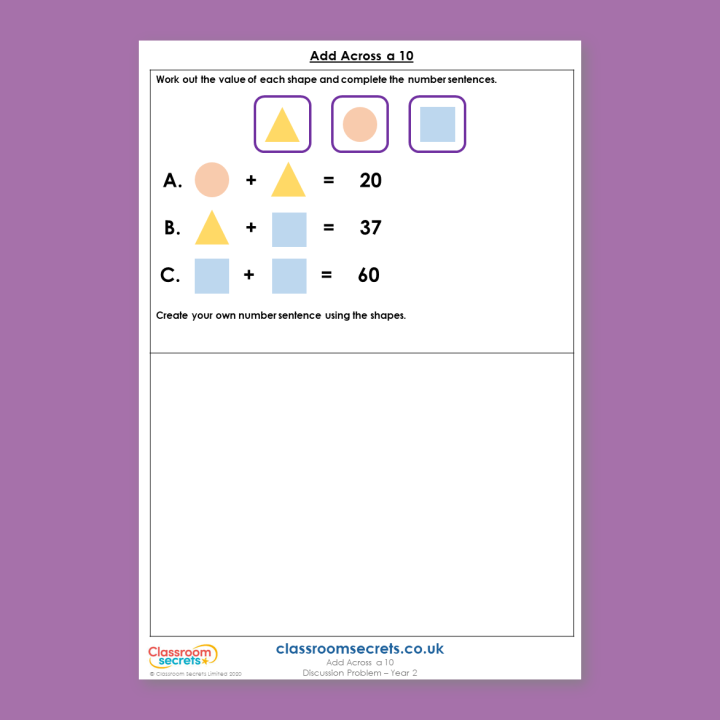
Deeper Reasoning
The questions in this set focuses on problem solving by working out missing values and using them to complete addition number sentences, to deepen understanding in adding numbers using concrete objects and pictorial representations, including a two-digit number and ones.