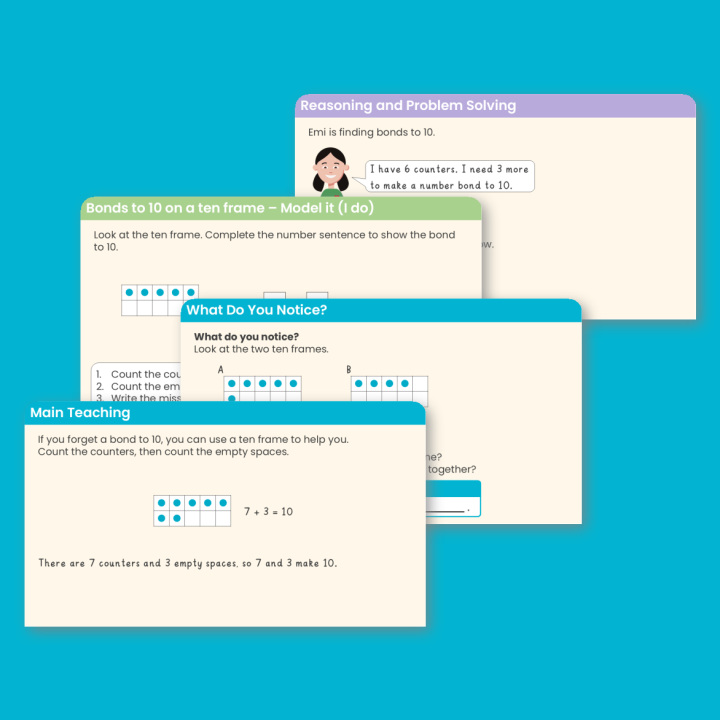
The Year 2 Bonds to 10 PowerPoint guides both teachers and children through the lesson, including use of the varied fluency, reasoning and problem solving, deeper reasoning and scaffolded resources. Key learning information about this step:
Key Vocabulary
number bonds: Two numbers that join together to make a different whole number.
ten frame: A representation to help us count and make groups of 10.
part-whole model: A representation that shows the whole number and the parts it has been split into.
number sentence: A sentence written using numbers and symbols, such as +, –, x, ÷ and =. For example: 2 + 2 = 4.
Varied Fluency
Knowledge Organiser
• Designed to support all children via key information and examples.
For the purple sections of the four levels, copy and paste these from the first sheet of the varied fluency resource.
Scaffolded Examples
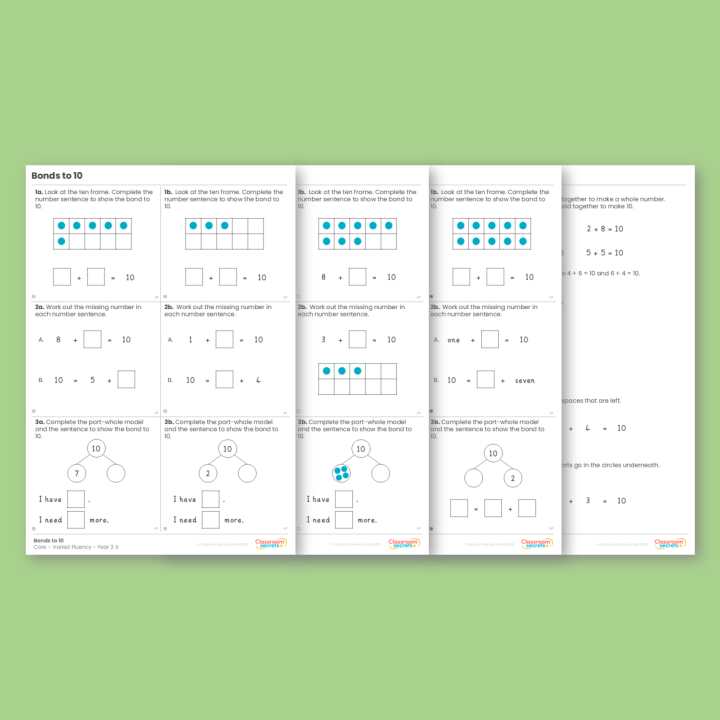
• Counting counters and empty spaces on a ten frame to find a missing part of 10, then completing a part-whole model and a sentence.
Support
• Q1: complete a number sentence for a bond to 10 using a ten frame; the first part is given.
• Q2: one number sentence with a ten frame to support it; the first part is given.
• Q3: complete a part-whole model and a sentence; any bond to 10 can be used.
Core
• Q1: complete a number sentence for a bond to 10 using a ten frame; the first part is given.
• Q2: one number sentence with a ten frame to support it; the first part is given.
• Q3: complete a part-whole model and a sentence; any bond to 10 can be used.
Stretch
• Q1: complete a number sentence for a bond to 10 using a ten frame; the first part is given.
• Q2: one number sentence with a ten frame to support it; the first part is given.
• Q3: complete a part-whole model and a sentence; any bond to 10 can be used.
Reasoning and Problem Solving
Support
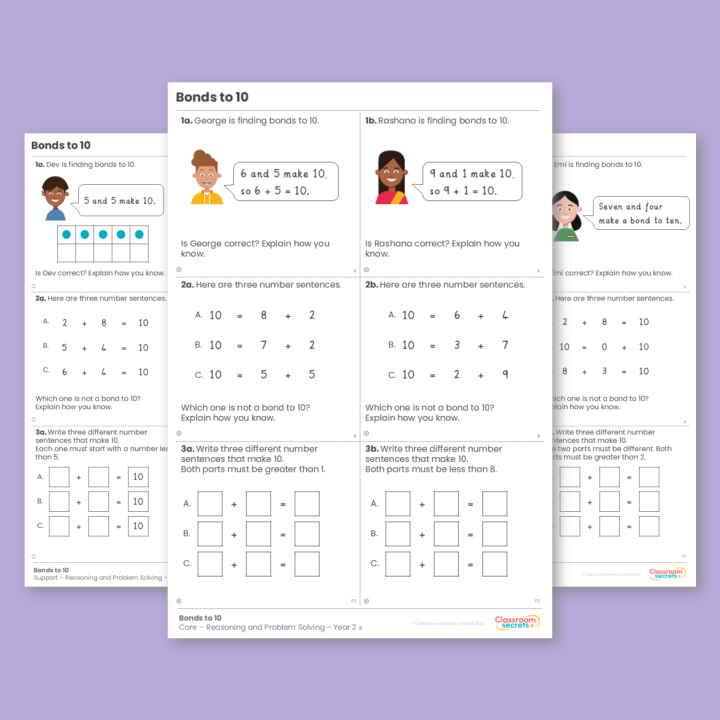
• Q1: Reasoning - decide whether a character is correct about a pair of numbers that make 10, with a ten frame to support.
• Q2: Reasoning – identify the number sentence that is not a bond to 10.
• Q3: Problem Solving - write three number sentences that make 10, with one condition on the first number.
Core
• Q1: Reasoning - decide whether a character is correct about a bond to 10 written as a number sentence.
• Q2: Reasoning - identify the number sentence that is not a bond to 10, bonds written with the whole first.
• Q3: Problem Solving - write three number sentences that make 10, with one condition on both parts.
Stretch
• Q1: Reasoning - decide whether a character is correct about a bond to 10 written in words.
• Q2: Reasoning - identify the number sentence that is not a bond to 10, some bonds written with the whole first.
• Q3: Problem Solving - write three number sentences that make 10, with two conditions.
Deeper Reasoning
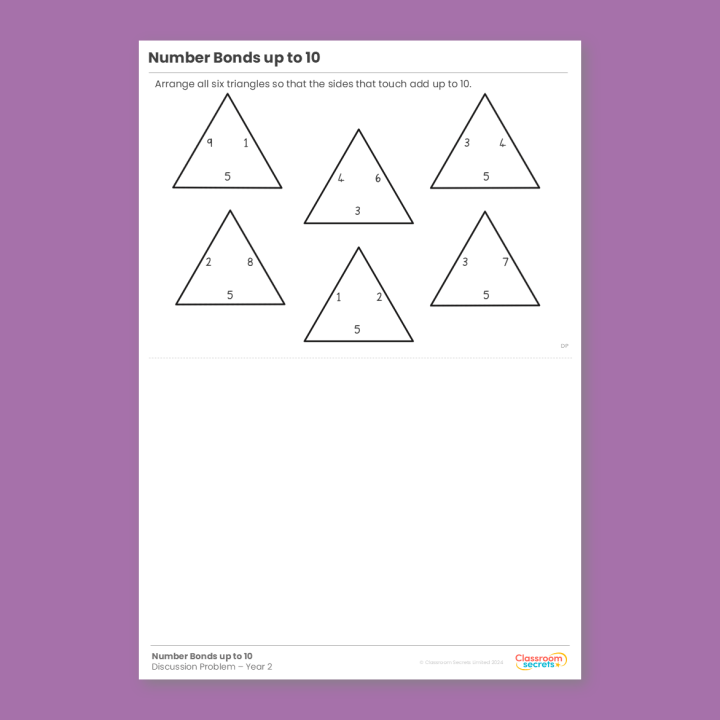
The question in this set focuses on arranging triangles so that touching sides add up to 10 to deepen understanding in representing and using number bonds and related subtraction facts within 20.