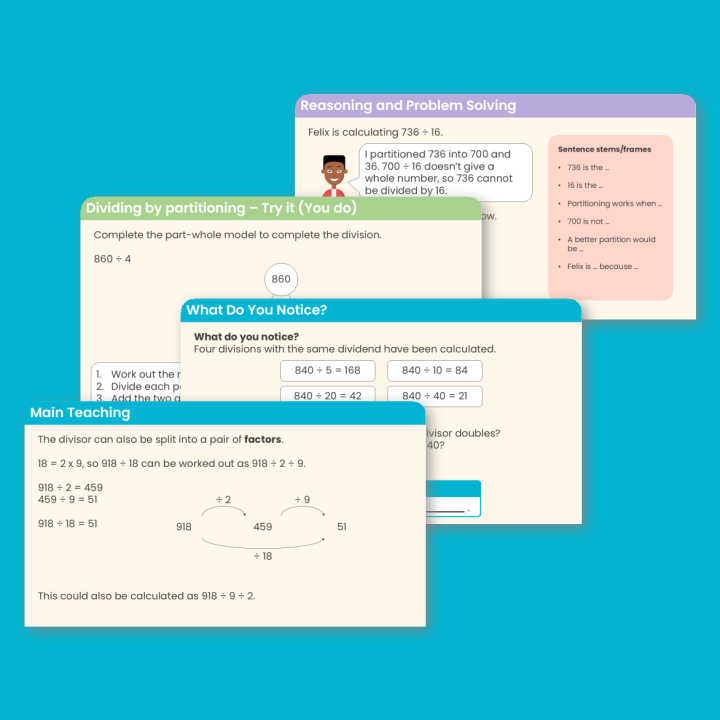
The Year 6 Solve Problems with Division PowerPoint guides both teachers and children through the lesson, including use of the varied fluency, reasoning and problem solving, deeper reasoning and scaffolded resources. Key learning information about this step:
Key Vocabulary
efficient: Working in a way that is quick and accurate, such as choosing the best method for the numbers.
partitioning: The splitting of a number into different parts. For example: the number 547 can be partitioned into 500, 40 and 7.
multiple: The result of multiplying a number by a whole number. For example: multiples of 10 are the products of numbers multiplied by 10.
factors: Numbers we can multiply together to get another number. For example: 2 and 3 are factors of 6 because 2 x 3 = 6.
Varied Fluency
Knowledge Organiser
• Designed to support all children via key information and examples.
Scaffolded Examples
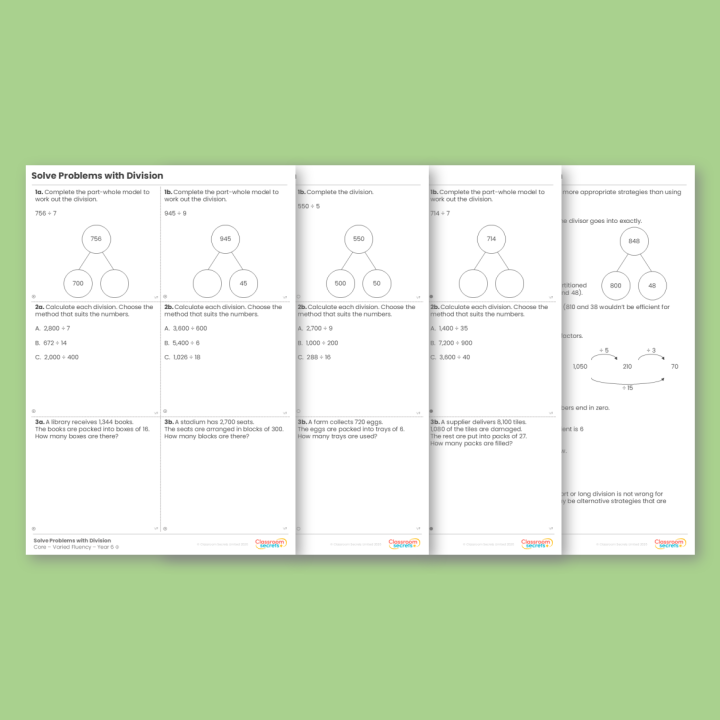
• Partitioning a 3-digit number into parts the divisor goes into exactly.
Support
• Q1: Complete a part-whole model. 3-digit dividend; familiar divisor; parts given.
• Q2: Calculate three divisions. 1-digit, hundreds and easily halved divisors.
• Q3: Solve a one-step word problem. 3-digit amount, 1-digit divisor.
Core
• Q1: Complete a part-whole model. 3-digit dividend; one part given.
• Q2: Calculate three divisions. 2-digit divisors halve to the 7 or 9 times table.
• Q3: Solve a one-step word problem. 4-digit amount, 2- or 3-digit divisor.
Stretch
• Q1: Complete a part-whole model. 3-digit dividend; neither part given.
• Q2: Calculate three divisions. One divisor has no even factor.
• Q3: Solve a two-step word problem. Subtract then divide efficiently.
Reasoning and Problem Solving
Support
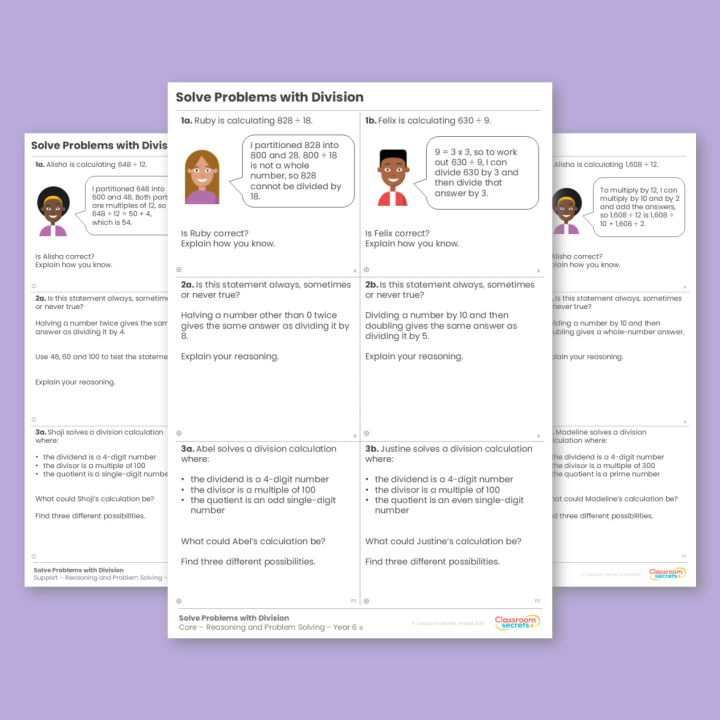
• Q1: Reasoning - explaining whether a character has partitioned correctly, or has wrongly treated division as commutative.
• Q2: Reasoning - deciding whether a halving or doubling strategy is always, sometimes or never true; numbers given to test.
• Q3: Problem Solving - creating divisions with a 4-digit dividend, a divisor that is a multiple of 100 or 200 and a single-digit answer.
Core
• Q1: Reasoning - explaining whether a character has partitioned correctly, or has used a factor pair of the divisor correctly.
• Q2: Reasoning - deciding whether a halving or doubling strategy is always, sometimes or never true; no numbers given.
• Q3: Problem Solving - creating divisions with a 4-digit dividend, a divisor that is a multiple of 100 and an odd or even single-digit answer.
Stretch
• Q1: Reasoning - explaining whether a character has partitioned the dividend correctly, or has wrongly partitioned the divisor.
• Q2: Reasoning - deciding whether a division strategy is always, sometimes or never true, requiring a counter-example.
• Q3: Problem Solving - creating divisions with a 4-digit dividend, a divisor that is a multiple of 300 or 400 and a prime answer.
Deeper Reasoning
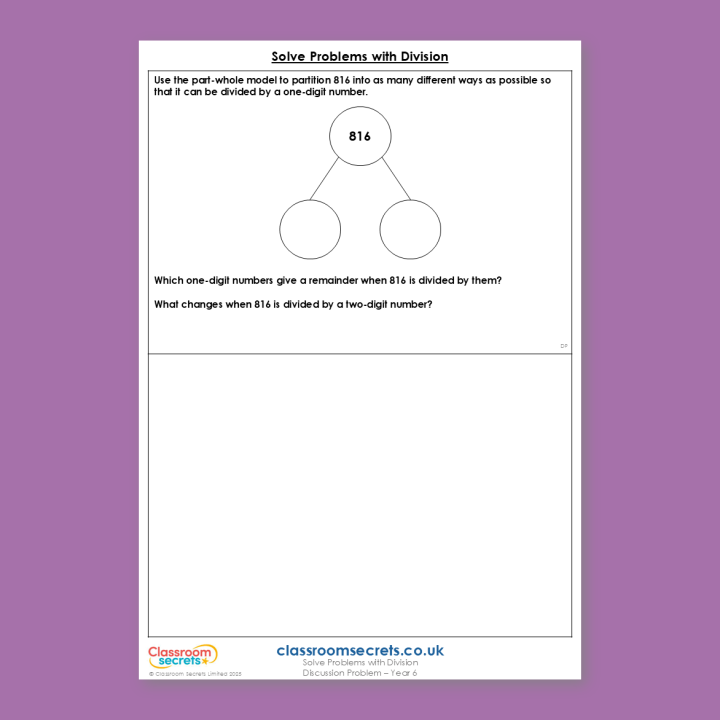
The question in this set focuses on problem solving with division to deepen understanding in performing mental calculations, including with mixed operations and large numbers, and solving problems involving addition, subtraction, multiplication and division.