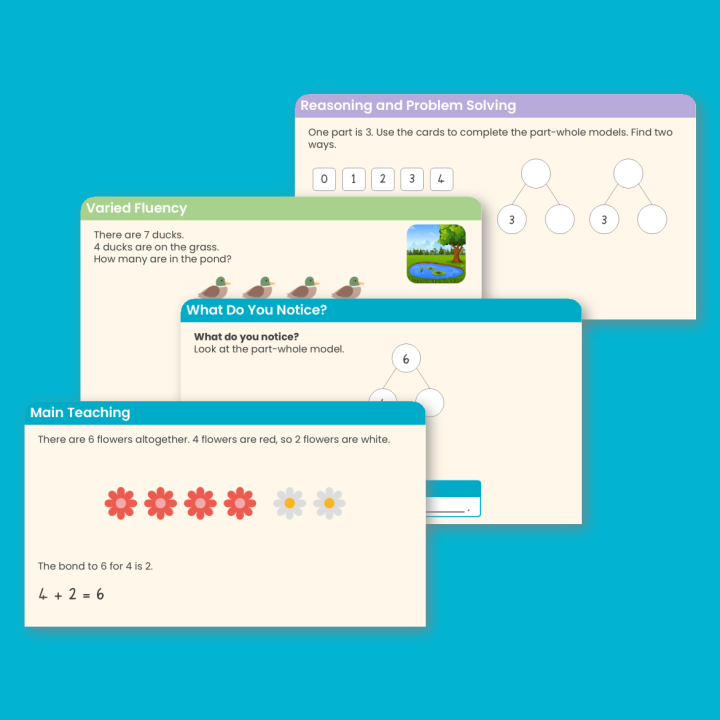
The Year 1 Find a Part PowerPoint guides both teachers and children through the lesson, including use of the varied fluency, reasoning and problem solving, practical activities and continuous provision resources. Key learning information about this step:
Key Vocabulary
whole: Altogether means how many there are when we add the groups.
part: An addition sentence uses + and = to show adding.
missing: We start on the first number and count on to add more.
number bond: A number bond is two parts that make a whole.
Adult-Led Practical Activities
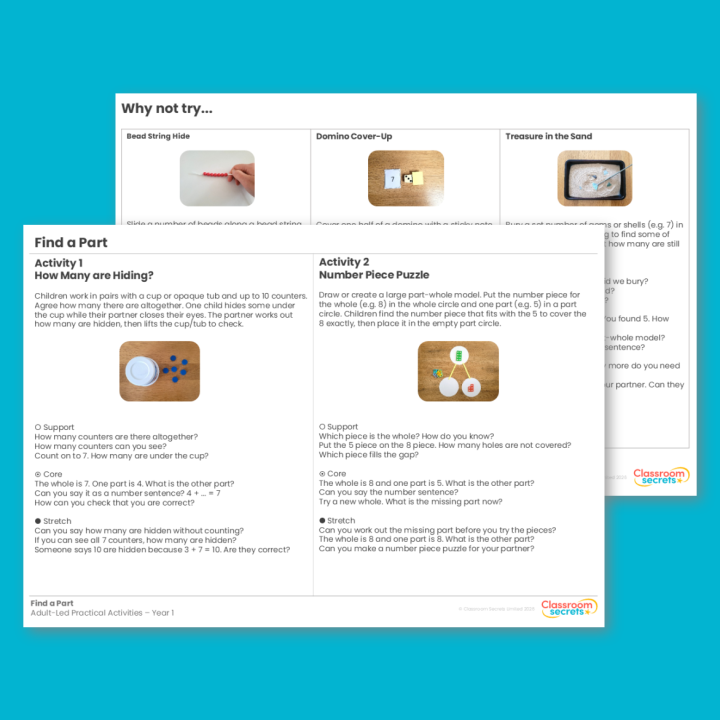
• Activity 1: How Many are Hiding? Children work out how many counters are hidden under a cup.
• Activity 2: Number Piece Puzzle. Children find the number piece that completes the whole.
You will need:
• counters or cubes and a plastic cup for each pair
• number pieces (1 to 10)
• a large part-whole model (drawn on paper or a whiteboard)
Why not try…
• Bead String Hide - Cover a few beads on a string with a hand. Children work out how many beads are hidden.
• Domino Cover-Up - Cover one half of a domino with a sticky note. Children work out how many dots are under the note.
• Treasure in the Sand - Bury a set number of gems/shells in the sand. Children find some of them and work out how many are still buried.
Varied Fluency
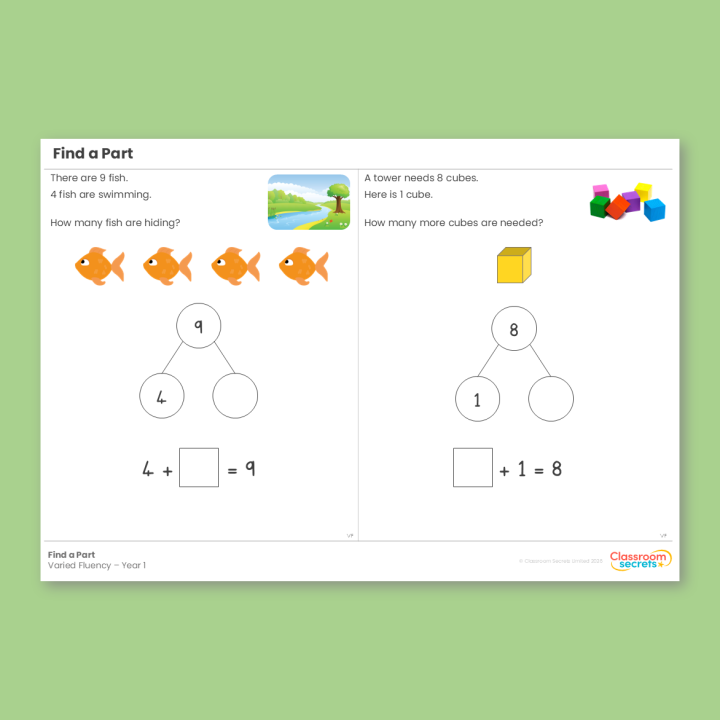
• Q1: find the missing part of a group of fish to complete a part-whole model and a number sentence.
• Q2: find how many more cubes are needed to build a tower and complete a part-whole model and a number sentence.
Reasoning and Problem Solving
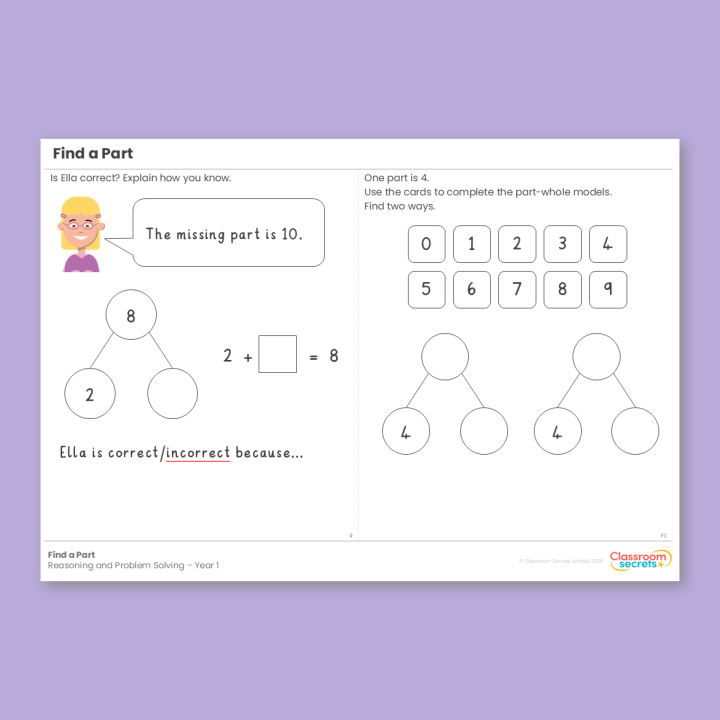
• Q1: Reasoning – spot and explain that Ella has added the numbers together instead of finding the missing part.
• Q2: Problem Solving – use number cards to complete two part-whole models where one part is 4.
Continuous Provision
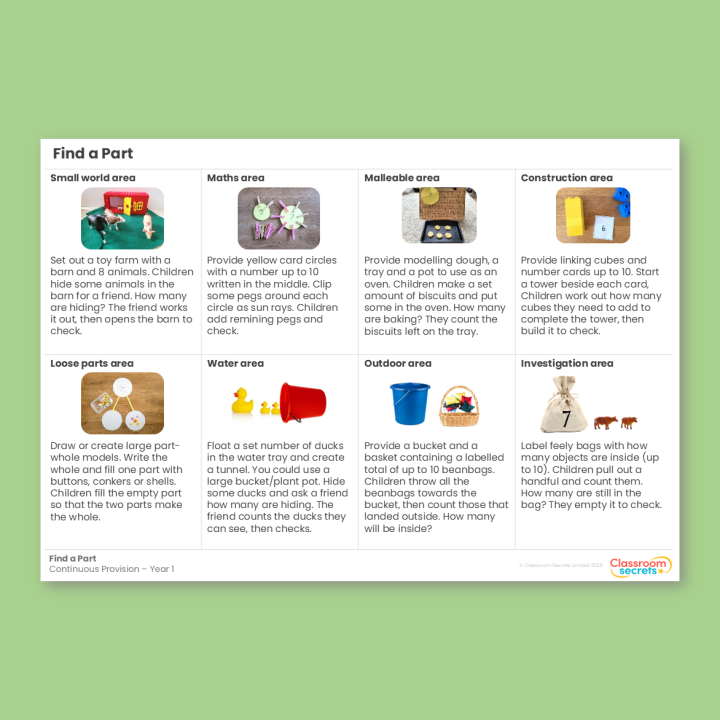
• Small world area – find how many animals are hiding in the barn.
• Maths area – add pegs to a sun to make its number.
• Malleable area – work out how many dough biscuits are in the oven.
• Construction area – work out how many more cubes complete a tower.
• Loose parts area – fill the missing part on a part-whole model.
• Water area – work out how many ducks are hiding.
• Outdoor area – work out how many beanbags landed in the bucket.
• Investigation area – work out how many objects are still in a feely bag.