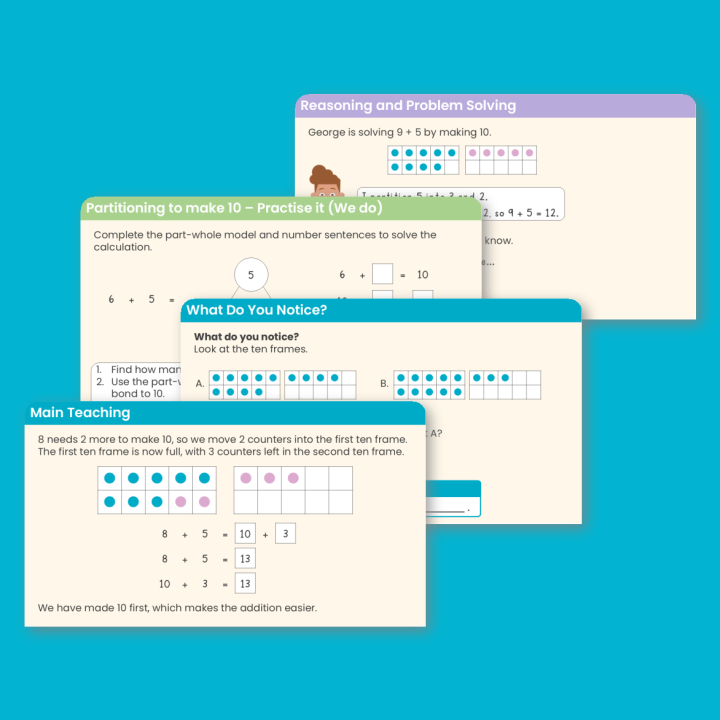
The Year 2 Add by Making 10 PowerPoint guides both teachers and children through the lesson, including use of the varied fluency, reasoning and problem solving, deeper reasoning and scaffolded resources. Key learning information about this step:
Key Vocabulary
number bonds: Two numbers that join together to make a different whole number.
ten frame: A representation to help us count and make groups of 10.
partitioning: The splitting of a number into different parts. For example: the number 23 can be partitioned into 20 and 3.
number line: A straight line which has numbers placed at equal points. Most number lines begin at 0, although this is not always the case.
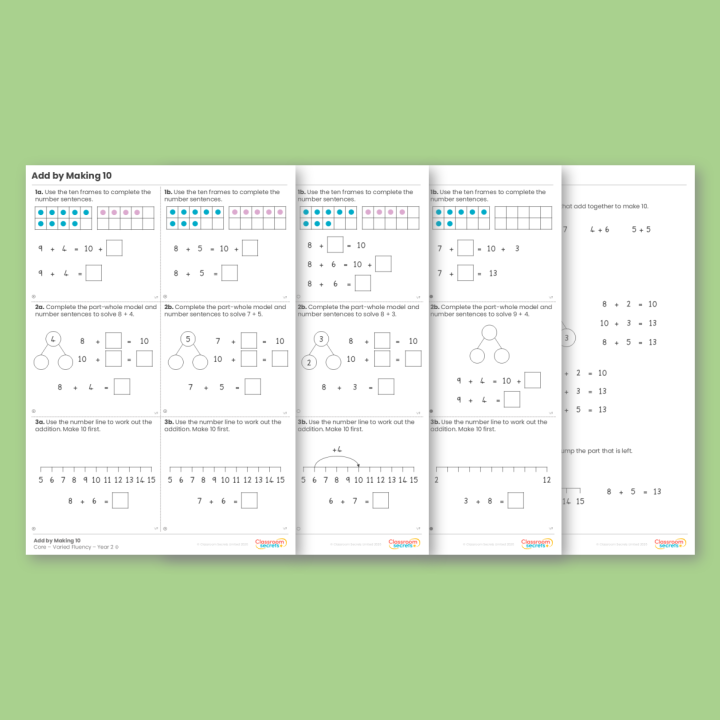
Varied Fluency
Knowledge Organiser
• Designed to support all children via key information and examples.
For the purple sections of the four levels, copy and paste these from the first sheet of the varied fluency resource.
Scaffolded Examples
• Counting counters on ten frames to find the bond to 10; partitioning a number with a part-whole model; completing sentence stems to add by making 10.
Support
• Q1: Use ten frames to add by making 10; number sentence to find the bond to 10 given. Completed ten frames given.
• Q2: Partition the second number in a part-whole model; one part is given. Complete the number sentences.
• Q3: Add by making 10 on a labelled number line; the jump to 10 is drawn.
Core
• Q1: Use ten frames to add by making 10; the larger number comes first. Completed ten frames given.
• Q2: Partition the second number in a part-whole model to make 10. Complete the number sentences.
• Q3: Add by making 10 on a labelled number line; draw both jumps.
Stretch
• Q1: Use ten frames to solve missing-addend calculations by making 10. Partially completed ten frames given.
• Q2: Partition the second number independently. Complete the number sentences.
• Q3: Add by making 10 on a number line with only the start and end point labelled.
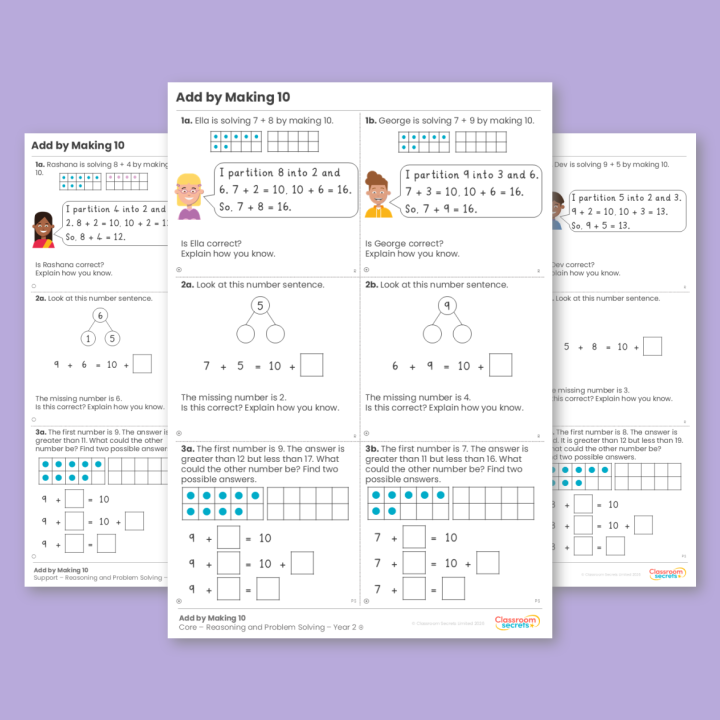
Reasoning and Problem Solving
Support
• Q1: Reasoning – judge if a character has added by making ten correctly, 2 completed ten frames given.
• Q2: Reasoning – complete missing number from calculation, completed part-whole model given.
• Q3: Problem Solving – find two additions from a fixed first number; one condition.
Core
• Q1: Reasoning – judge if a character has added by making ten correctly, one completed ten frame given.
• Q2: Reasoning – complete missing number from calculation, part-filled part-whole model given.
• Q3: Problem Solving – find two additions from a fixed first number; two conditions.
Stretch
• Q1: Reasoning – judge if a character has added by making ten correctly.
• Q2: Reasoning – complete missing number from calculation.
• Q3: Problem Solving – find two additions from a fixed first number; the total follows a range and odd or even rule.
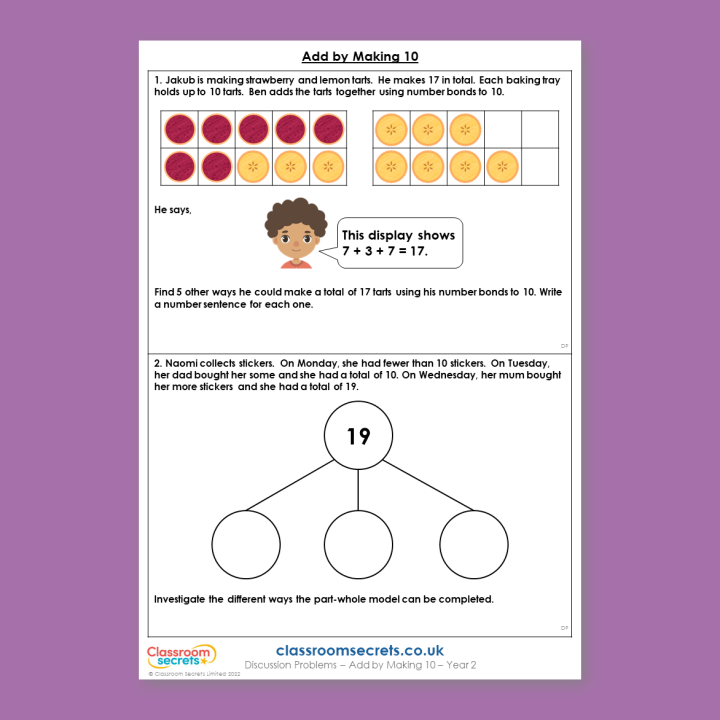
Deeper Reasoning
The questions in this set focus on problem solving with adding to make 10 to deepen understanding in adding by making 10 by adding numbers using concrete objects, pictorial help representations, and mentally.