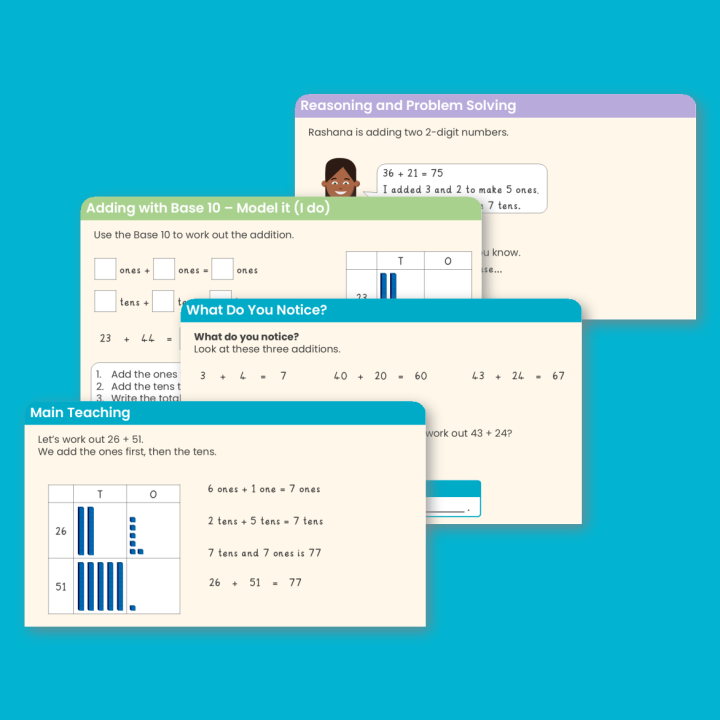
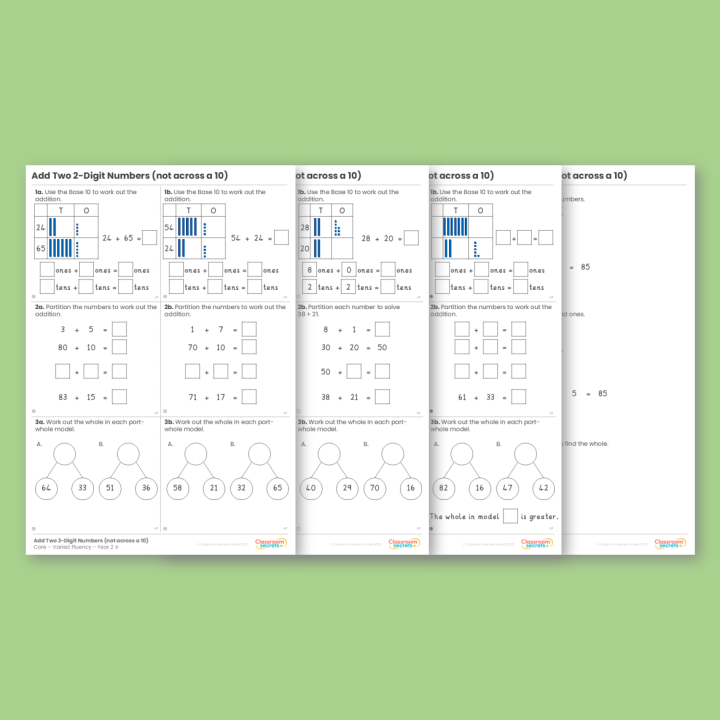
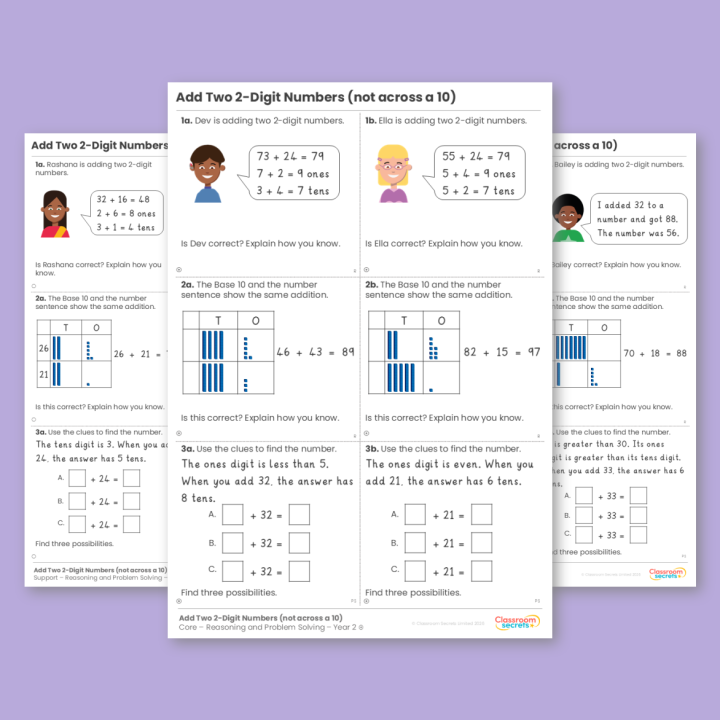
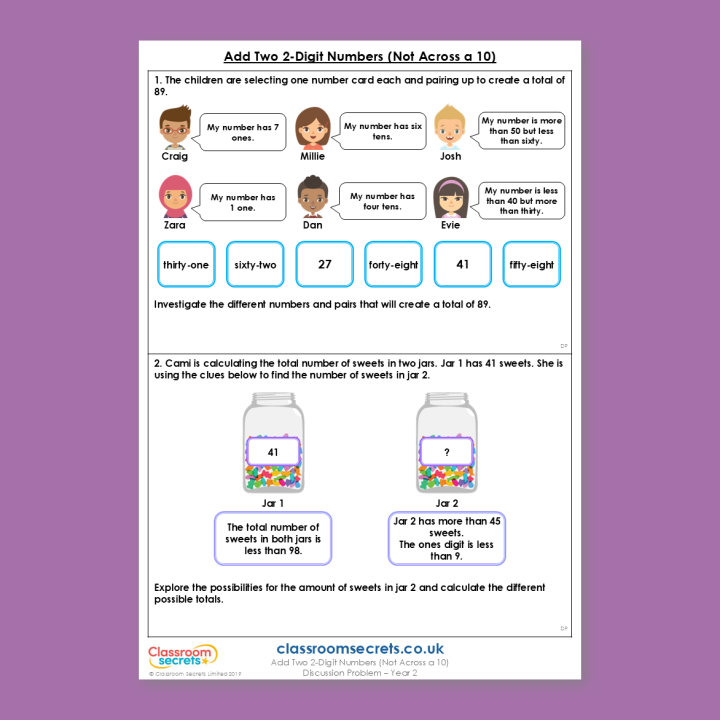
The Year 2 Add Two 2-Digit Numbers (Not Across a 10) PowerPoint guides both teachers and children through the lesson, including use of the varied fluency, reasoning and problem solving, deeper reasoning and scaffolded resources. Key learning information about this step:
Key Vocabulary
ones: Individual units that make up a whole number.
tens: A group of 10 ones together is the same as 1 ten.
partitioning: The splitting of a number into different parts, usually into tens and ones. For example: the number 23 can be partitioned into 20 and 3.
total/altogether: Describes the new whole number that is created by adding parts together.
Varied Fluency
Knowledge Organiser
• Designed to support all children via key information and examples.
Scaffolded Examples
• Counting the tens and ones in Base 10; adding the ones, then the tens; putting the tens and ones together to find the total.
Support
• Q1: Add two 2-digit numbers using Base 10; filled sentence stems given.
• Q2: Partition to add two 2-digit numbers; the tens have been added.
• Q3: Find the whole in two part-whole models; one part is a multiple of 10.
Core
• Q1: Add two 2-digit numbers using Base 10; complete sentence stems.
• Q2: Partition to add two 2-digit numbers; numbers are partitioned.
• Q3: Find the whole in two part-whole models with 2-digit parts.
Stretch
• Q1: Work out the addition shown by Base 10; no numbers are given.
• Q2: Partition two numbers, then add the tens and ones.
• Q3: Find the whole in two part-whole models, say which whole is greater.
Reasoning and Problem Solving
Support
• Q1: Reasoning – explain whether a character has added two 2-digit numbers; the ones and tens are shown in steps.
• Q2: Reasoning – check whether labelled Base 10 and a number sentence show the same addition.
• Q3: Problem Solving – use two clues to find numbers; the tens digit is given.
Core
• Q1: Reasoning – explain whether a character has added the tens and ones of two 2-digit numbers correctly.
• Q2: Reasoning – check whether unlabelled Base 10 and a number sentence show the same addition.
• Q3: Problem Solving – use a ones digit clue and the tens of the answer to find numbers.
Stretch
• Q1: Reasoning – judge a partitioning method (ones first) with a place value slip, and a missing number claim.
• Q2: Reasoning – compare unlabelled Base 10 with a number sentence; one is in a different order and one has a changed digit.
• Q3: Problem Solving – use a lower limit, an odd or digit clue and the tens of the answer to find numbers.
Deeper Reasoning
The questions in this set focus on exploring number combinations and calculating possible totals using given clues to deepen understanding in adding and subtracting numbers using concrete objects and pictorial representations, including: a two-digit number and ones; a two-digit number and tens and two two-digit numbers.