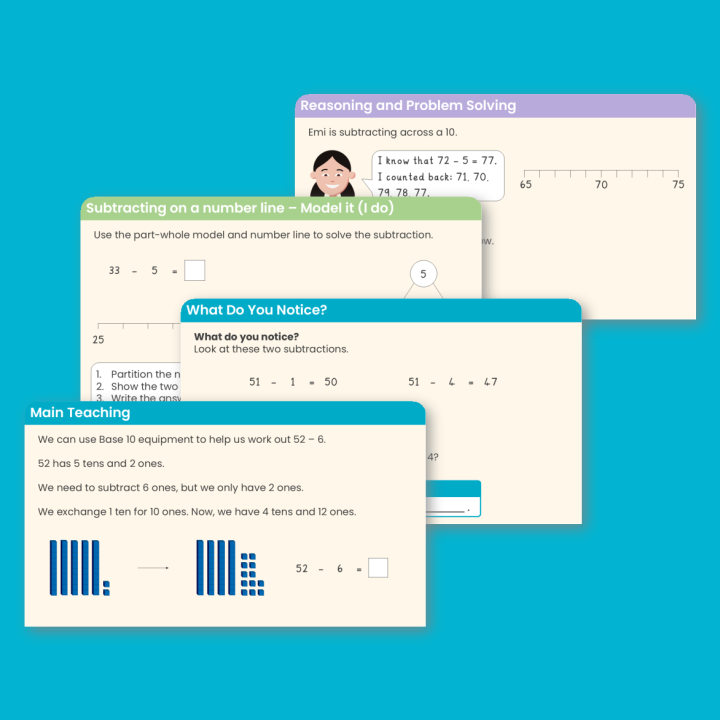
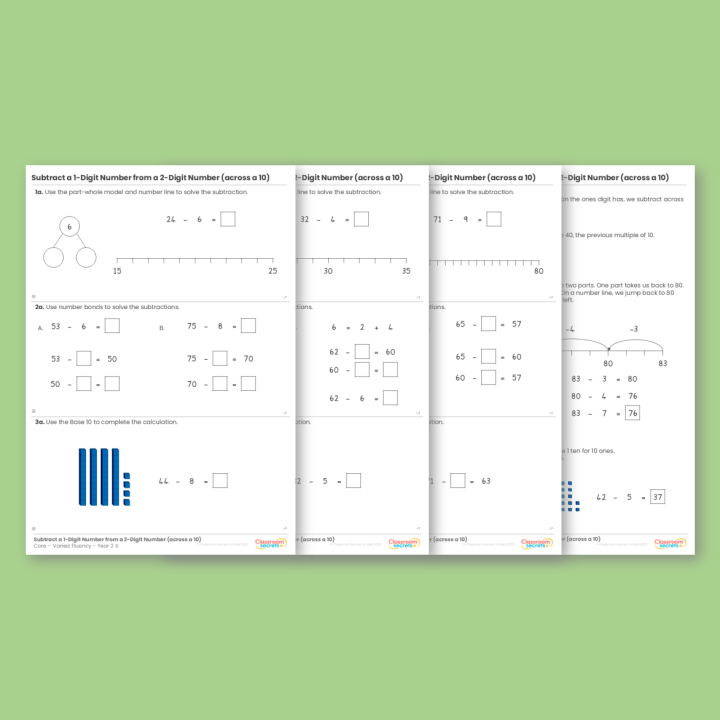
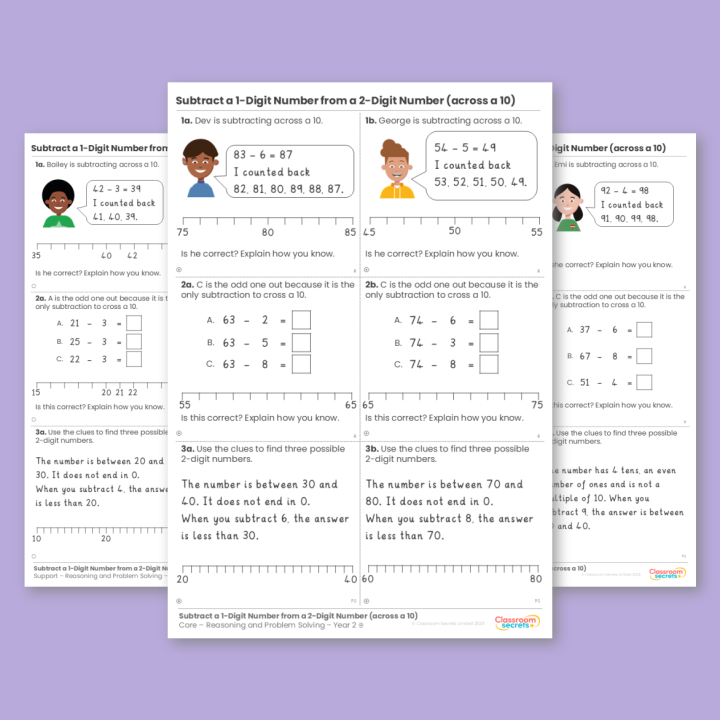
The Year 2 Subtract a 1-Digit Number From a 2-Digit Number (Across a 10) PowerPoint guides both teachers and children through the lesson, including use of the varied fluency, reasoning and problem solving, deeper reasoning and scaffolded resources. Key learning information about this step:
Key Vocabulary
multiples of 10: Counting in groups of 10. The ones digit will always be a 0.
partition: When we partition, we split a number into smaller numbers.
The larger number is the whole and the smaller numbers are the parts. Numbers can be partitioned in different ways, for example into tens and ones.
part-whole model: A representation that shows the whole number and the parts it has been split into.
number line: A straight line which has numbers placed at equal points. Most number lines begin at 0, although this is not always the case.
Varied Fluency
Knowledge Organiser
• Designed to support all children via key information and examples.
Scaffolded Examples
• Partitioning with stems; showing two jumps on a number line; using bonds to 10.
Support
• Q1: Use a part-whole model and number line; one part is given.
• Q2: Use number bonds to 10 to subtract; the numbers in each step are given.
• Q3: Use Base 10 to subtract; 1 ten has already been exchanged for 10 ones.
Core
• Q1: Use a part-whole model and number line; only the ends are labelled.
• Q2: Use number bonds to 10 to subtract; find the missing number in each step.
• Q3: Use Base 10 to subtract; exchange 1 ten for 10 ones yourself.
Stretch
• Q1: Use a blank part-whole model; only two multiples of 10 are labelled.
• Q2: Use number bonds to 10 to find the number taken away.
• Q3: Use Base 10 to find the missing number taken away.
Reasoning and Problem Solving
Support
• Q1: Reasoning – decide whether a character has counted back correctly; labelled number line given.
• Q2: Reasoning – judge an odd-one-out claim about which subtractions cross a 10; labelled number line given.
• Q3: Problem Solving – use range, digit and subtraction clues to find numbers; number line with mid and endpoints given.
Core
• Q1: Reasoning – decide whether a character has counted back 5 or 6 correctly; number line with mid and endpoints given.
• Q2: Reasoning – judge an odd-one-out claim about which subtractions cross a 10; number line with endpoints given.
• Q3: Problem Solving – use range, digit and subtraction clues to find numbers; number line with endpoints given.
Stretch
• Q1: Reasoning – decide whether a character has counted back correctly.
• Q2: Reasoning – judge an odd-one-out claim about which subtractions cross a 10.
• Q3: Problem Solving – use tens, ones and subtraction clues to find numbers.
Deeper Reasoning
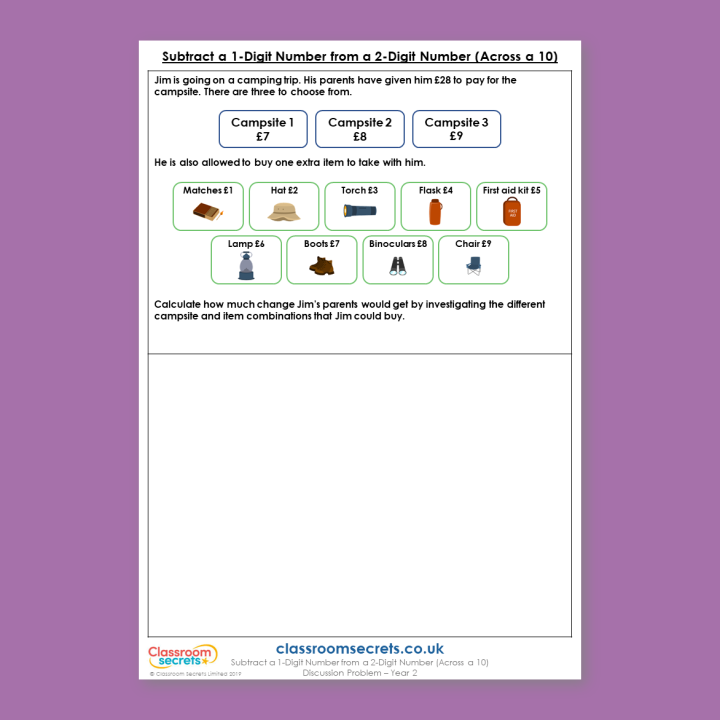
The question in this set focuses on calculating change by investigating different combinations of money to deepen understanding in subtracting numbers using concrete objects and pictorial representations, including: a two-digit number and ones; a two-digit number and tens and two two-digit numbers.