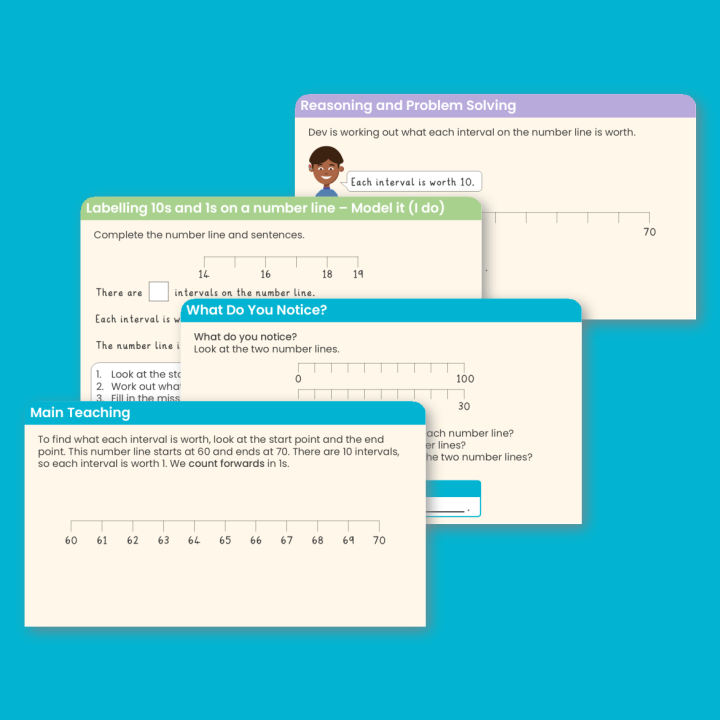
The Year 2 10s and 1s on the Number Line to 100 PowerPoint guides both teachers and children through the lesson, including use of the varied fluency, reasoning and problem solving, deeper reasoning and scaffolded resources. Key learning information about this step:
Key Vocabulary
number line: A straight line which has numbers placed at equal points. Most number lines begin at 0, although this is not always the case.
interval: The space between two divisions on a number line. Every interval on a number line is worth the same amount.
count forwards: To count on. The numbers will get bigger or greater (0, 1, 2, 3, 4).
tens: A group of 10 ones together is the same as 1 ten.
ones: Individual units that make up a whole number.
Varied Fluency
Knowledge Organiser
• Designed to support all children via key information and examples.
For the purple sections of the four levels, copy and paste these from the first sheet of the varied fluency resource.
Scaffolded Examples
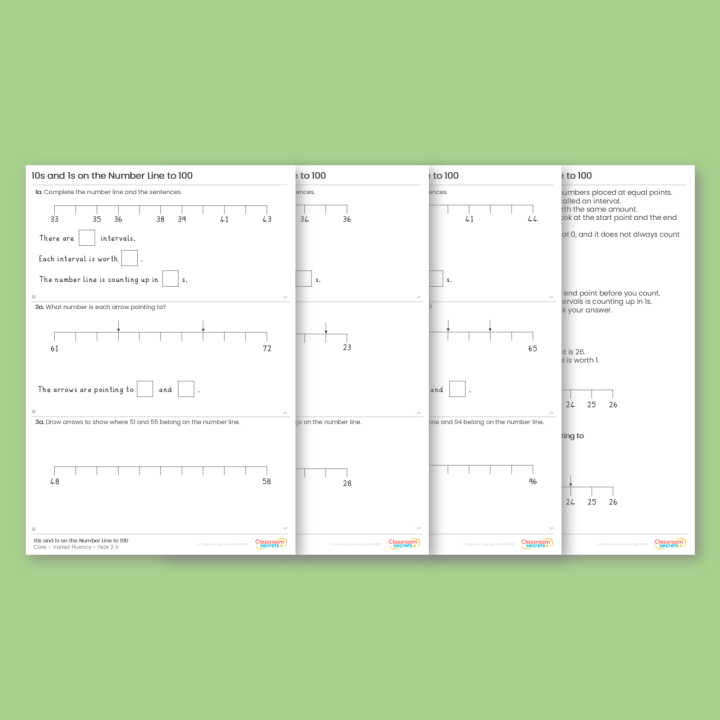
• Completing a number line by counting on in 1s, finding what each interval is worth, then reading the number an arrow is pointing to.
Support
• Q1: complete a number line with two missing 1s; the number of intervals is given.
• Q2: read one arrow, with a middle value given.
• Q3: draw one arrow, with a middle value given.
Core
• Q1: complete a number line with four missing 1s.
• Q2: read two arrows, with only the end points given.
• Q3: draw two arrows, with only the end points given.
Stretch
• Q1: complete a number line with eight missing 1s.
• Q2: read three arrows, with only the end points given.
• Q3: draw three arrows, with one number given in words.
Reasoning and Problem Solving
Support
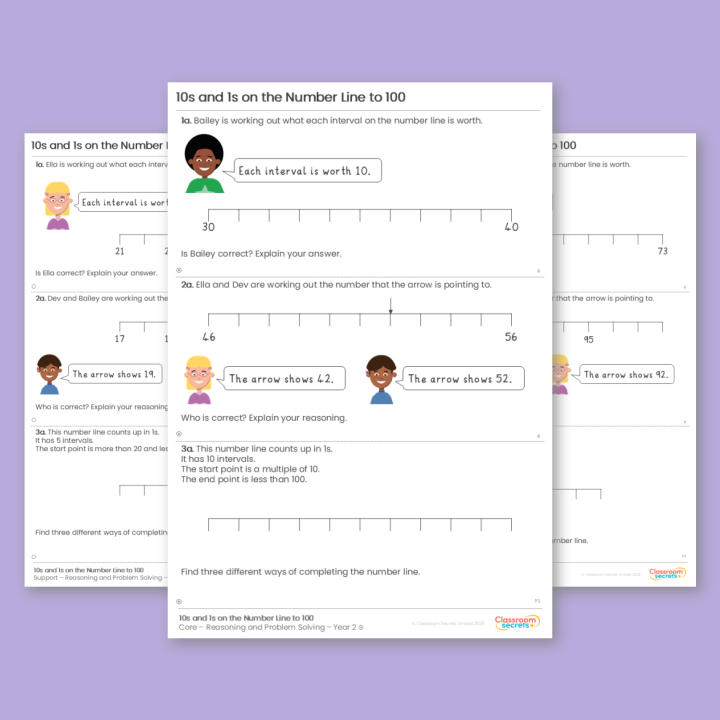
• Q1: Reasoning - explain whether the value of each interval is correct, with a middle value given.
• Q2: Reasoning - decide which of two children has read an arrow correctly, with a middle value given.
• Q3: Problem Solving - find three ways of completing a number line from one condition
Core
• Q1: Reasoning - explain whether the value of each interval is correct, with only the end points given.
• Q2: Reasoning - decide which of two children has read an arrow correctly, with only the end points given.
• Q3: Problem Solving - find three ways of completing a number line from two conditions.
Stretch
• Q1: Reasoning - explain whether the value of each interval is correct, with the start point missing.
• Q2: Reasoning - decide which of two children has read an arrow correctly, with neither end point given.
• Q3: Problem Solving - find three ways of completing a number line using tens and ones conditions.
Deeper Reasoning
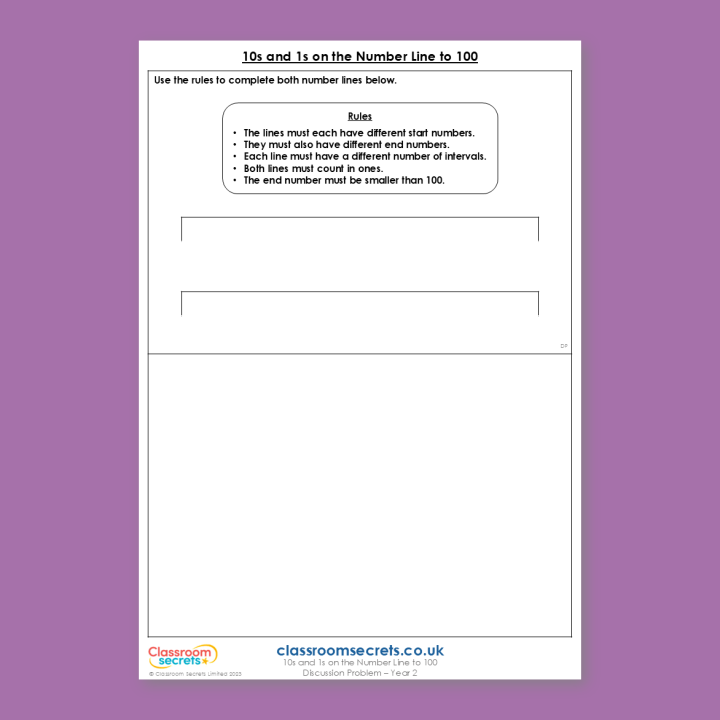
The question focuses on problem solving with number lines to deepen understanding of identifying, representing and estimating numbers using different representations, including the number line.