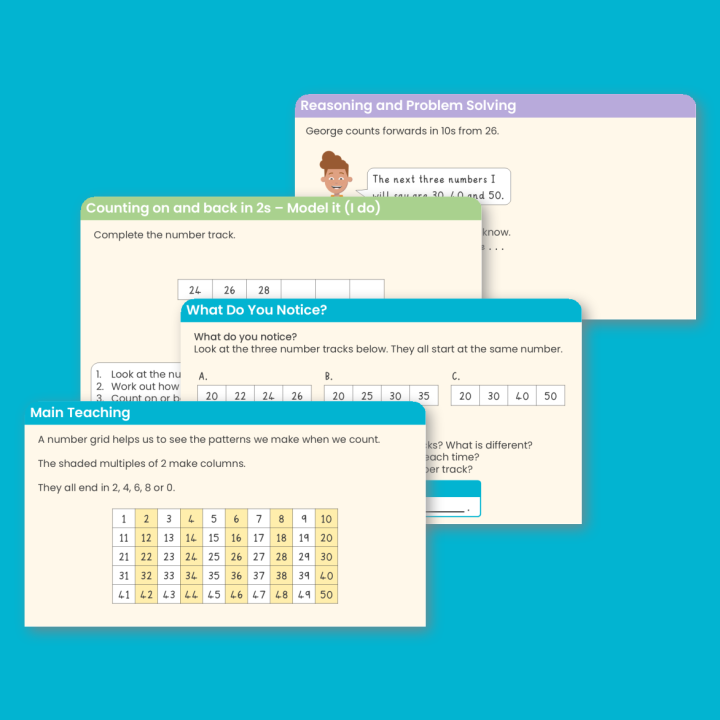
The Year 2 Count in 2s, 5s and 10s PowerPoint guides both teachers and children through the lesson, including use of the varied fluency, reasoning and problem solving, deeper reasoning and scaffolded resources. Key learning information about this step:
Key Vocabulary
counting forwards: When we count forwards, the number always gets bigger.
counting back/backwards: When we count backwards, the number always gets smaller.
multiples of 2: Counting in groups of 2. The ones digit will always be one of 0, 2, 4, 6 or 8.
multiples of 5: Counting in groups of 5. The ones digit will always be either a 5 or a 0.
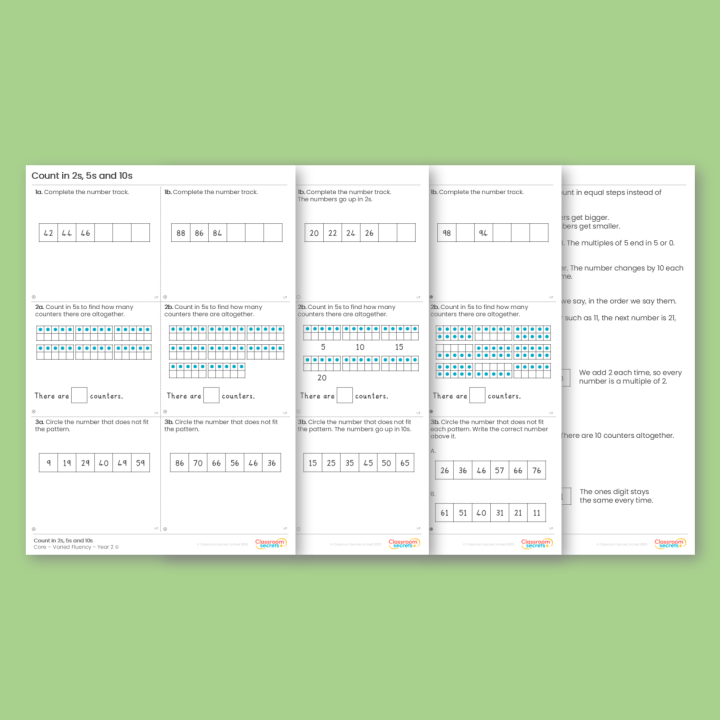
Varied Fluency
Knowledge Organiser
• Designed to support all children via key information and examples.
For the purple sections of the four levels, copy and paste these from the first sheet of the varied fluency resource.
Scaffolded Examples
• Completing a number track forwards and backwards in 2s, then counting in 5s.
Support
• Q1: complete a number track counting in 2s, with four numbers given.
• Q2: count in 5s using ten frames of five counters, with running totals given.
• Q3: circle the number that does not fit a pattern in 10s, with the step given.
Core
• Q1: complete a number track counting in 2s, with three numbers given.
• Q2: count in 5s using more ten frames, each showing five counters.
• Q3: circle the number that does not fit a pattern in 10s from any number.
Stretch
• Q1: complete a number track counting in 2s, with two numbers given.
• Q2: count in 5s using full and half-filled ten frames in a mixed order.
• Q3: circle the number that does not fit and give the correction in two patterns counting in 10s.
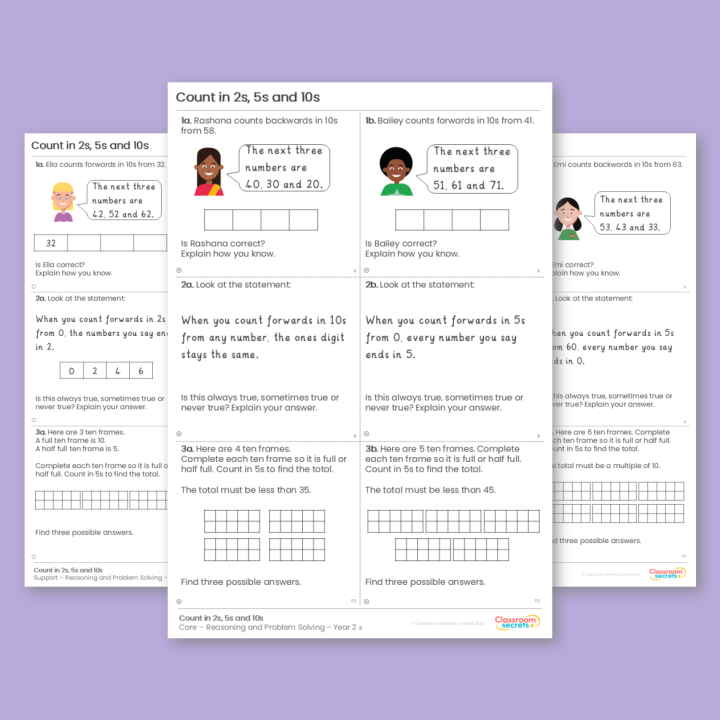
Reasoning and Problem Solving
Support
• Q1: Reasoning - decide whether a character is right about counting in 10s.
• Q2: Reasoning - decide whether a statement about counting in 2s or 10s is always, sometimes or never true.
• Q3: Problem Solving - fill three or four ten frames and count in 5s to find a total.
Core
• Q1: Reasoning - decide whether a character is correct when counting forwards or backwards in 10s.
• Q2: Reasoning - decide whether a statement about the ones digit is always, sometimes or never true.
• Q3: Problem Solving - fill four or five ten frames to make a total that follows a rule.
Stretch
• Q1: Reasoning - decide whether a character is right when counting forwards in 2s or backwards in 10s.
• Q2: Reasoning - decide whether a statement about counting in 10s or 5s is always, sometimes or never true.
• Q3: Problem Solving - fill six ten frames to make a total that follows a rule.
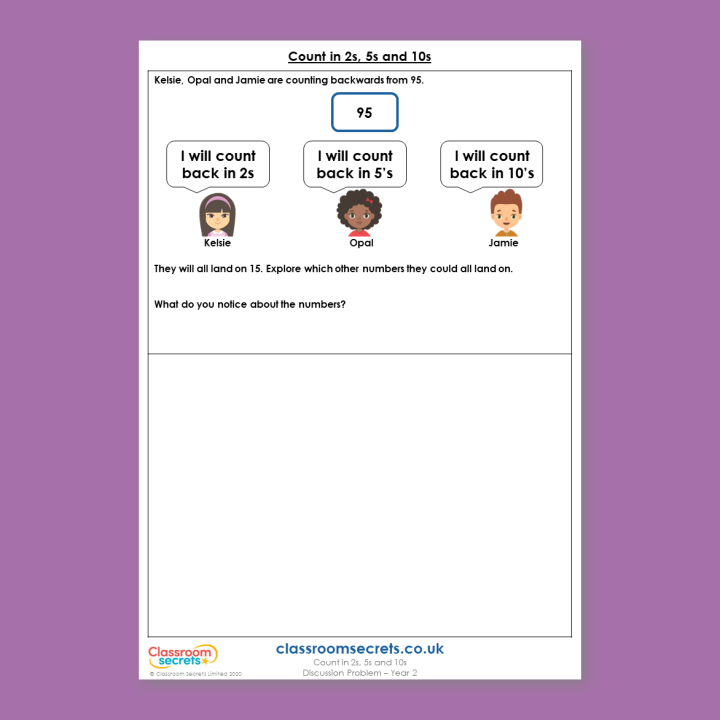
Deeper Reasoning
The question in this set focuses on counting backwards and identifying patterns in number sequences, to deepen understanding in counting forward or backward in steps of 2 and 5 from 0, and in tens from any number.