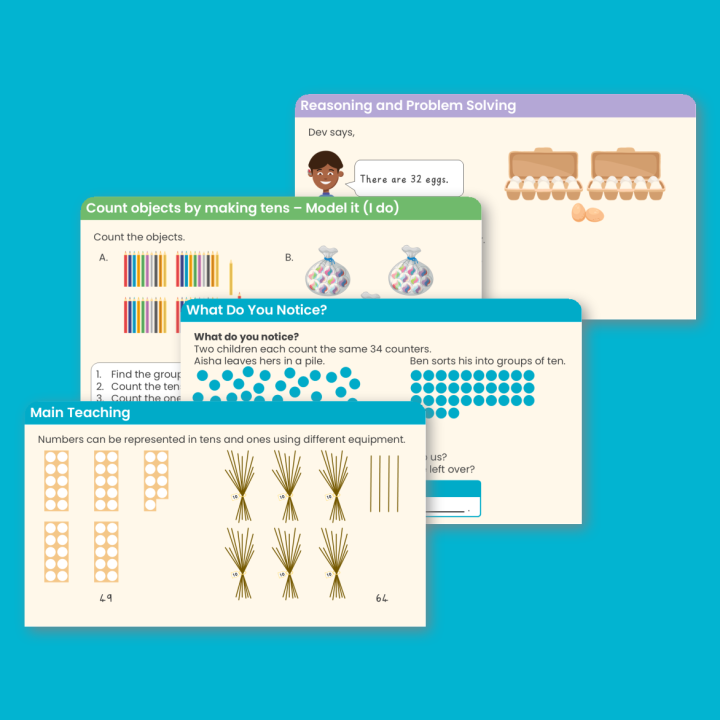
The Year 2 Count Objects to 100 by Making 10s PowerPoint guides both teachers and children through the lesson, including use of the varied fluency, reasoning and problem solving, deeper reasoning and scaffolded resources. Key learning information about this step:
Key Vocabulary
representation: A number that has been shown in different ways. For example, in numerals, words or using equipment such as Base 10 or a place value chart.
Varied Fluency
Knowledge Organiser
• Designed to support all children via key information and examples.
Scaffolded Examples
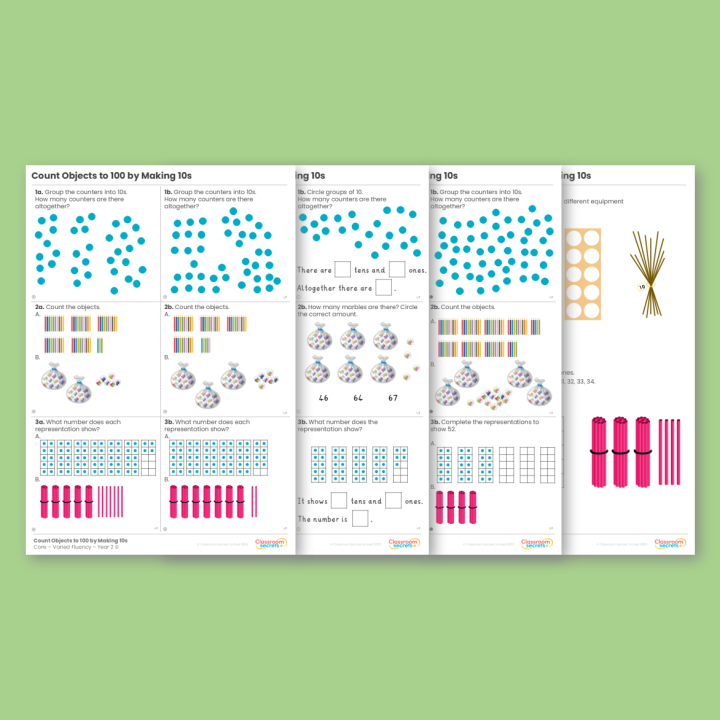
Guided practice for grouping and counting. Children circle groups of ten, then combine the tens and ones to count amounts to 100, supported by sentence stems.
Support
• Q1: Circle groups of 10. Complete stem sentences.
• Q2: Count objects grouped in tens and ones. Circle the correct amount.
• Q3: Read the number shown on ten frames. Complete stem sentences.
Core
• Q1: Group counters into 10s and count the total.
• Q2: Count objects grouped in tens and ones.
• Q3: Read the number shown on ten frames and bundles of ten.
Stretch
• Q1: Group unstructured counters into 10s and count the total.
• Q2: Count objects shown in tens and ones. More varied grouping structures.
• Q3: Complete the representation to show an amount.
Reasoning and Problem Solving
Support
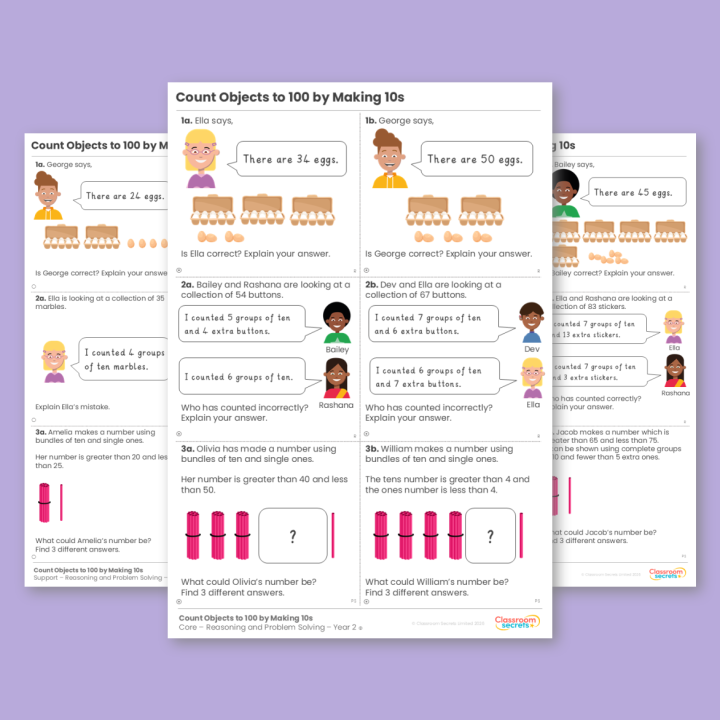
• Q1: Reasoning – Decide whether a character has correctly counted a group of eggs shown in boxes of ten and extra ones arranged linearly.
• Q2: Reasoning – Explain the mistake a character has made when counting a collection in groups of ten and ones.
• Q3: Problem Solving – Find possible numbers made from bundles of ten and single ones within a given range.
Core
• Q1: Reasoning – Decide whether a character has correctly counted a group of eggs shown in boxes of ten and extra ones which have been grouped together in twos.
• Q2: Reasoning – Decide which of two characters has counted a collection incorrectly, using groups of ten and ones.
• Q3: Problem Solving – Find possible missing numbers made from bundles of ten and single ones within a given range.
Stretch
• Q1: Reasoning – Decide whether a character has correctly counted a larger group of eggs shown in boxes of ten and extra ones which have been grouped together.
• Q2: Reasoning – Decide which character has counted a collection correctly when the extra ones must be regrouped into tens.
• Q3: Problem Solving – Find all possible numbers that fit given conditions about groups of ten and extra ones.
Deeper Reasoning
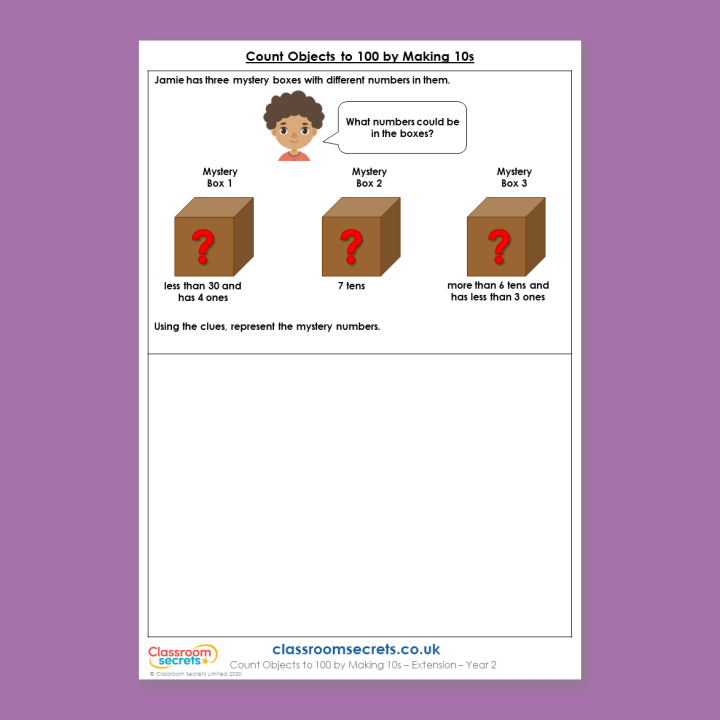
The question in this set focuses on representing a number using objects to deepen understanding in reading and writing numbers to at least 100 in numerals and in words.
.