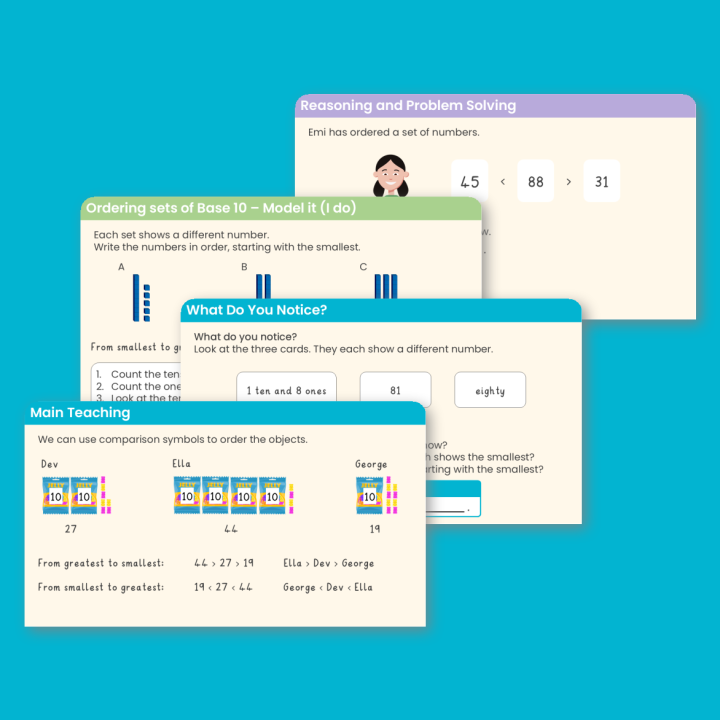
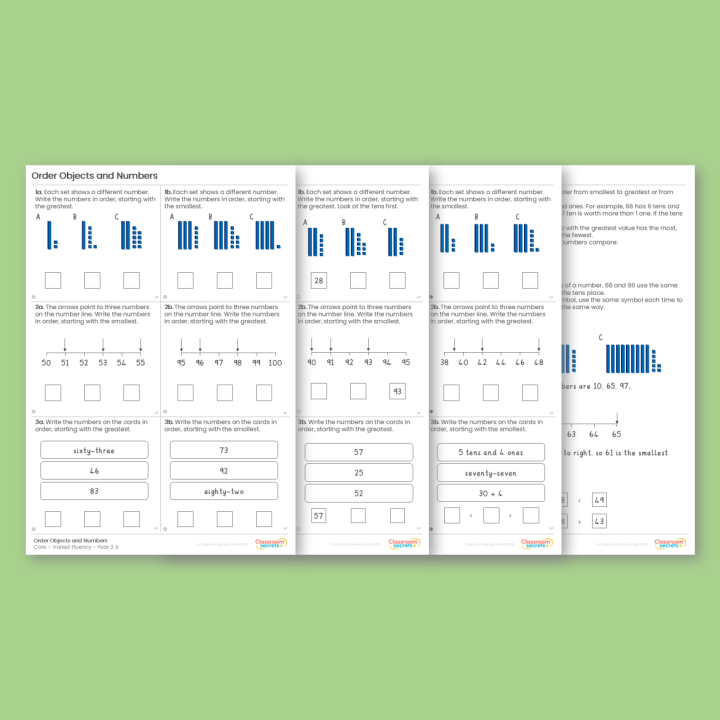
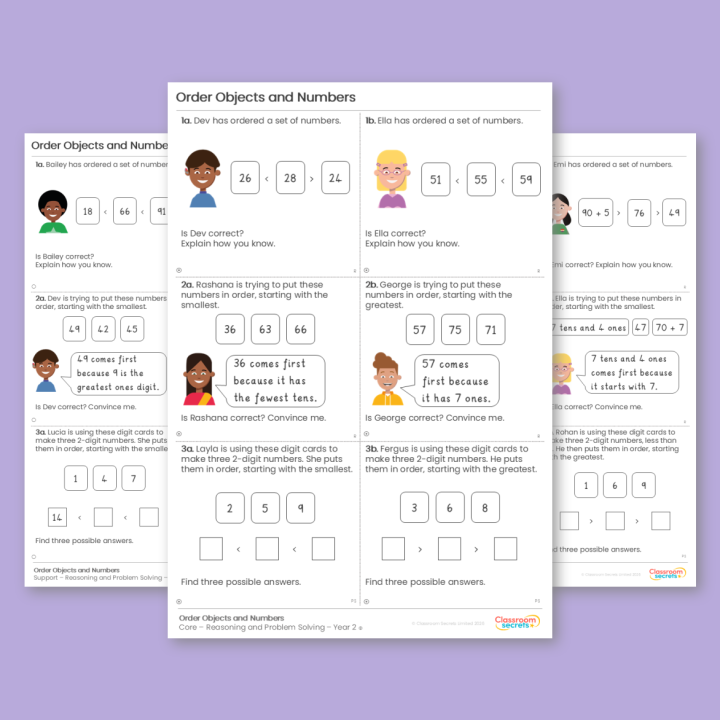
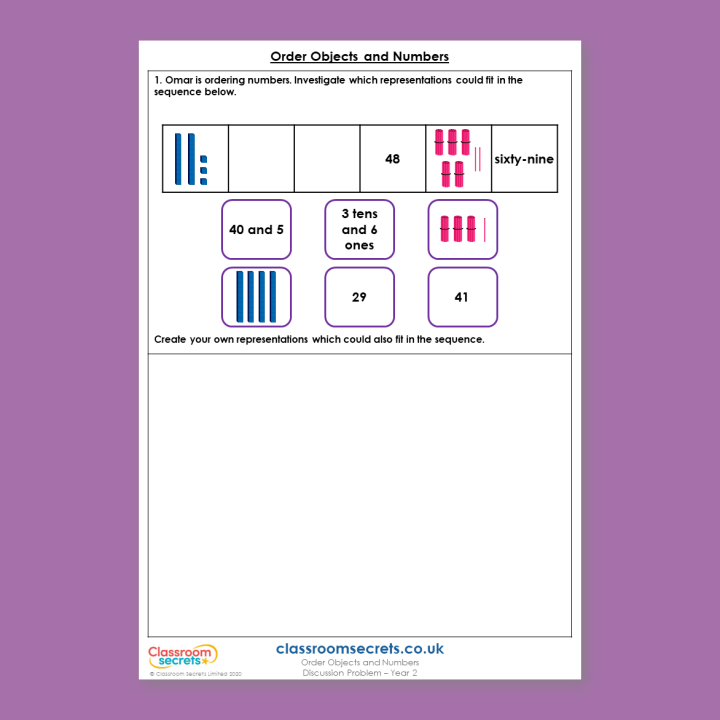
The Year 2 Order Objects and Numbers PowerPoint guides both teachers and children through the lesson, including use of the varied fluency, reasoning and problem solving, deeper reasoning and scaffolded resources. Key learning information about this step:
Key Vocabulary
tens: A group of 10 ones together is the same as 1 ten.
ones: Individual units that make up a whole number.
compare numbers: When we compare numbers, we look at the differences between the numbers to decide if one number is greater than, less than or equal to the other number. Symbols can be used to compare numbers. The > symbol means greater than or more than. The < symbol means less than. The = symbol means equal to.
comparison symbols: Comparison symbols are used to represent more than/greater than (>), less than (<) and equal to (=).
Varied Fluency
Knowledge Organiser
• Designed to support all children via key information and examples.
For the purple sections of the four levels, copy and paste these from the first sheet of the varied fluency resource.
Scaffolded Examples
Reading Base 10, then putting two and then three numbers in order.
Support
• Q1: order three sets of Base 10 with the same tens, with one number given.
• Q2: order three numbers on a number line labelled in 1s, with one given.
• Q3: order three numbers shown on cards, with one number given.
Core
• Q1: order three sets of Base 10, where two sets have the same tens.
• Q2: order three numbers marked on a number line labelled in 1s.
• Q3: order three numbers shown on cards as numerals or words.
Stretch
• Q1: order three sets of Base 10.
• Q2: order three numbers on a number line labelled in 2s.
• Q3: order three numbers on cards using comparison symbols, none written as a numeral.
Reasoning and Problem Solving
Support
• Q1: Reasoning - decide whether a character has used the comparison symbols correctly, using numbers with different tens.
• Q2: Reasoning - decide whether a character is right about which number comes first, where two or more numbers have the same tens.
• Q3: Problem Solving - make 2-digit numbers from digit cards and order them, with one number given.
Core
• Q1: Reasoning - decide whether a character has used the comparison symbols correctly, where the numbers are close together.
• Q2: Reasoning - decide whether a character is right about which number comes first, where two numbers have the same tens.
• Q3: Problem Solving - make 2-digit numbers from digit cards and order them.
Stretch
Q1: Reasoning - decide whether a character has used the comparison symbols correctly, where one number is written as an addition.
Q2: Reasoning - decide whether a character is right about ordering numbers written in different ways, including numbers that are equal.
Q3: Problem Solving - make 2-digit numbers from digit cards and order them, following an extra rule.
Deeper Reasoning
The question in this set focuses on investigating representations that fit a number sequence to deepen understanding in comparing and ordering numbers from 0 up to 100.