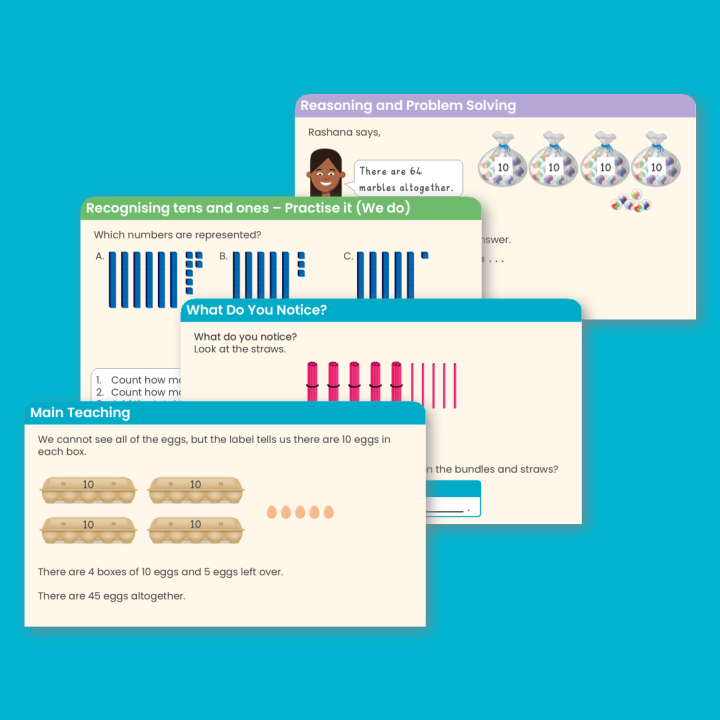
The Year 2 Recognise Tens and Ones PowerPoint guides both teachers and children through the lesson, including use of the varied fluency, reasoning and problem solving, deeper reasoning and scaffolded resources. Key learning information about this step:
Key Vocabulary
ones: Individual units that make up a whole number.
tens: A group of 10 ones together is the same as 1 ten.
total/altogether: Describe the new whole number that is created by adding parts together.
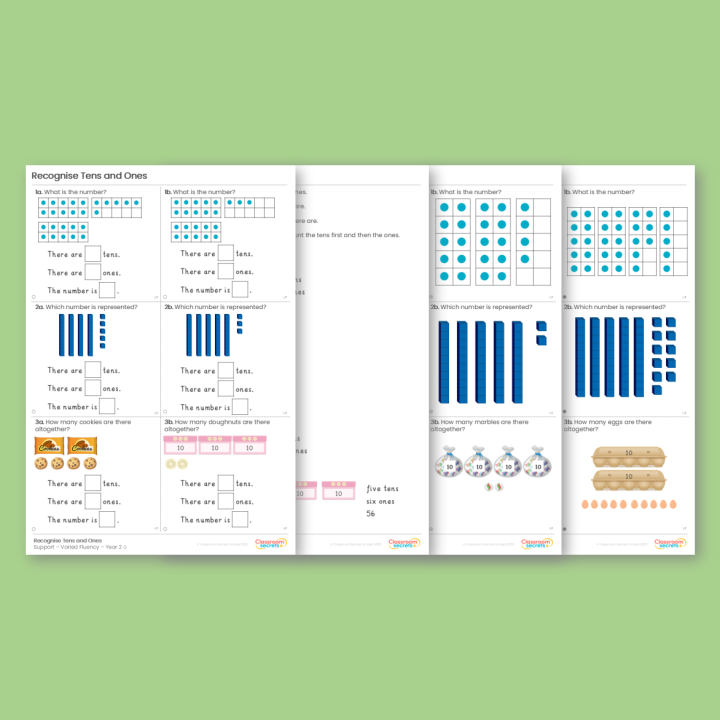
Varied Fluency
Knowledge Organiser
• Designed to support all children via key information and examples.
Scaffolded Examples
• Counting the tens and ones in a representation; completing sentences to record
• the tens, ones and the number shown, with guided support.
Support
• Q1: counting groups of ten counters and ones, with sentence stems.
• Q2: counting tens and ones shown with Base 10, with sentence stems.
• Q3: counting packets of ten and single items, with sentence stems.
Core
• Q1: counting groups of ten counters and ones.
• Q2: counting tens and ones shown with Base 10.
• Q3: counting packets of ten and single items.
Stretch
• Q1: counting groups of ten counters and ones with combining ones from two groups and exchanging ten ones for a ten.
• Q2: counting tens and ones shown with Base 10, exchanging more than ten ones for a ten.
• Q3: counting packets of ten and more than nine single items.
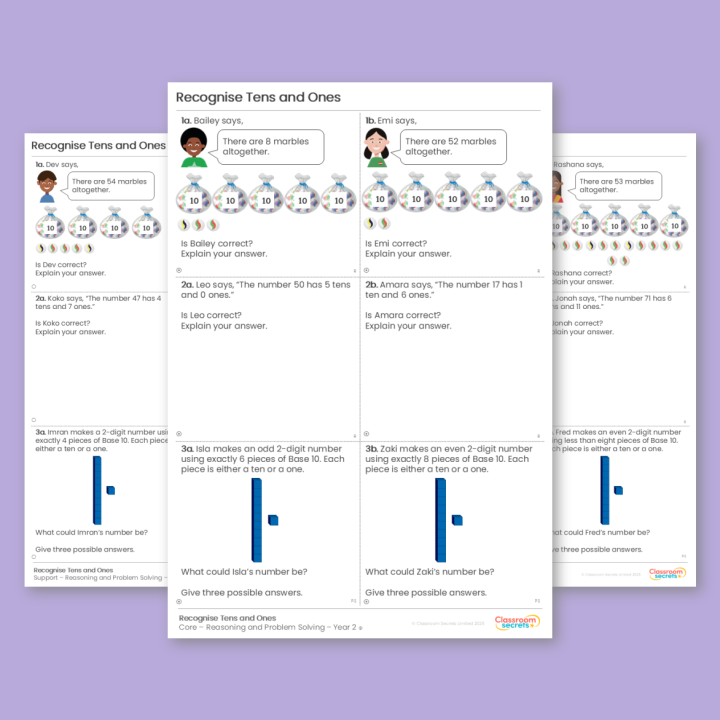
Reasoning and Problem Solving
Support
• Q1: Reasoning - deciding whether a child has counted bags of ten and single marbles correctly, spotting mixed-up tens and ones.
• Q2: Reasoning - deciding whether a statement about the tens digit and the ones digit of a 2-digit number is correct.
• Q3 Problem Solving - making 2-digit numbers from a given number of Base 10 pieces, where each piece is either a ten or a one.
Core
• Q1: Reasoning - deciding whether a child has counted bags of ten and single marbles correctly, with understanding of representation.
• Q2: Reasoning - deciding whether a statement about the tens digit and the ones digit of a 2-digit number is correct, with use of placeholder zero or a counting error.
• Q3: Problem Solving - making 2-digit numbers from a given number of Base 10 pieces, where each piece is either a ten or a one, with the extra condition that the number is odd or even.
Stretch
• Q1: Reasoning - deciding whether a child has counted bags of ten and single marbles correctly, with more than nine ones.
• Q2: Reasoning - deciding whether a number made from tens and more than nine ones has been written correctly.
• Q3: Problem Solving - making 2-digit numbers from an unspecified number of Base 10 pieces, where each piece is either a ten or a one, with the extra condition that the number is odd or even.
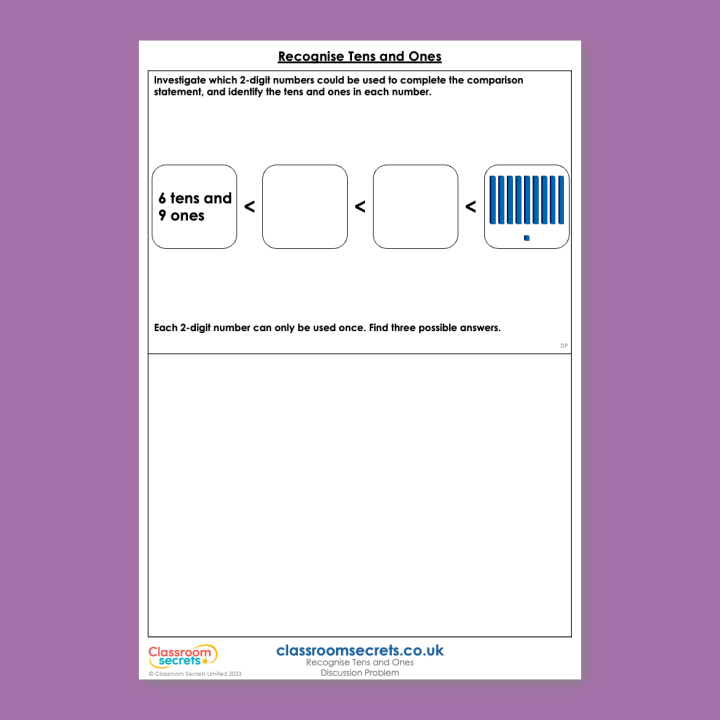
Deeper Reasoning
The question in this set focuses on problem solving and comparing numbers to deepen understanding in partitioning, identifying and representing numbers using different representations.
.