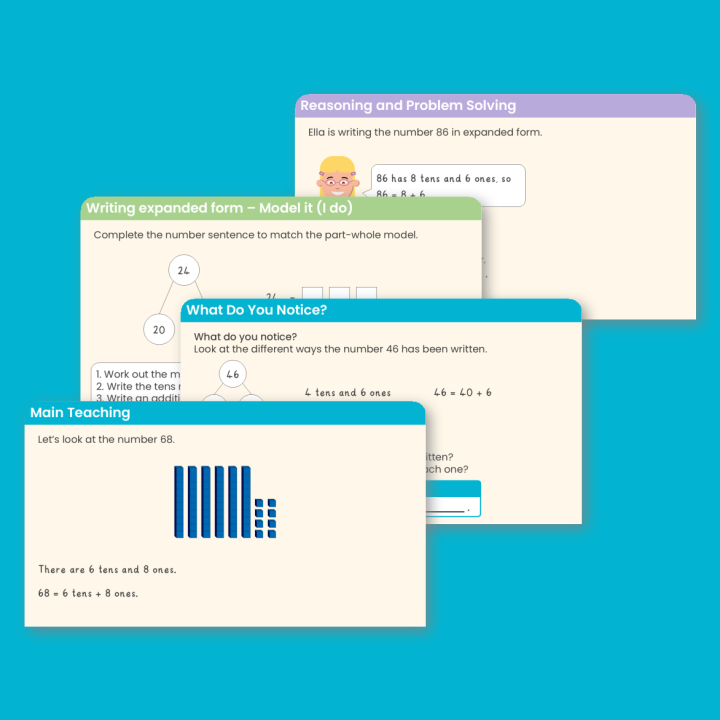
The Year 2 Write Numbers to 100 in Expanded Form PowerPoint guides both teachers and children through the lesson, including use of the varied fluency, reasoning and problem solving, deeper reasoning and scaffolded resources. Key learning information about this step:
Key Vocabulary
tens: A group of 10 ones together is the same as 1 ten.
ones: Individual units that make up a whole number.
partitioning: The splitting of a number into different parts, usually into tens and ones. For example: the number 23 can be partitioned into 20 and 3.
flexible partitioning: The splitting of a number into different parts in different ways. For example: the number 34 could be broken down into 2 tens and 14 ones.
part-whole model: A representation that shows the whole number and the parts it has been split into.
number sentence: A sentence written using numbers and symbols, such as +, –, x, ÷ and =. For example: 2 + 2 = 4.
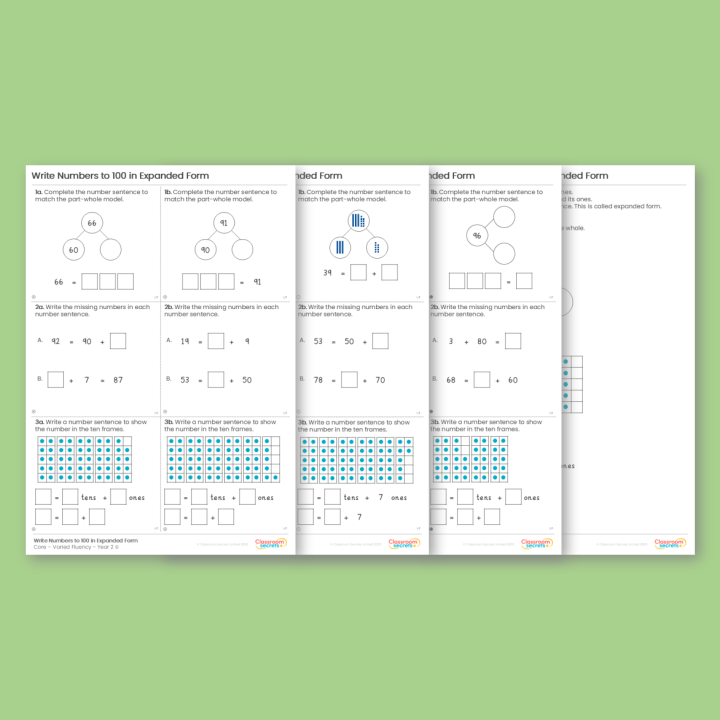
Varied Fluency
Knowledge Organiser
• Designed to support all children via key information and examples.
Scaffolded Examples
• Finding the tens and ones in a part-whole model, writing the number sentence, then finding a missing number.
Support
• Q1: Complete the number sentence, using Base 10 in a part-whole model to support.
• Q2: Find the missing ones part in two number sentences.
• Q3: Write two number sentences for ten frames, with one part given.
Core
• Q1: Complete a number sentence, with one part of the part-whole model given.
• Q2: Find a missing part in two number sentences, in varied layouts.
• Q3: Write two number sentences for a ten frame representation.
Stretch
• Q1: Write a number sentence, with no parts of the part-whole model given.
• Q2: Find the missing whole or a missing part in two number sentences.
• Q3: Write two number sentences for ten frames not in value order.
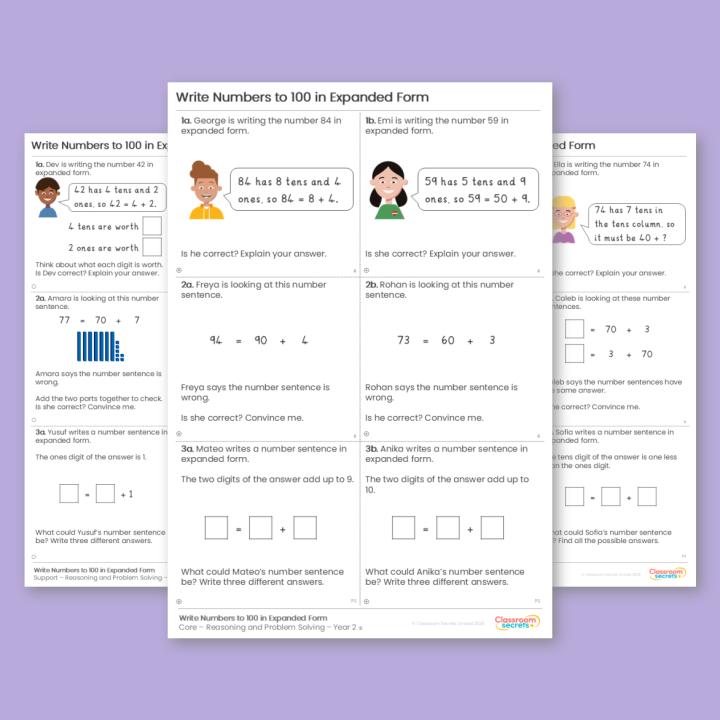
Reasoning and Problem Solving
Support
• Q1: Reasoning - deciding whether a number has been written correctly in expanded form, supported by stems for the value of the tens and the ones.
• Q2: Reasoning - deciding whether a number sentence in expanded form is wrong, using a standard partition, with a prompt to add the parts.
• Q3: Problem Solving - writing number sentences in expanded form for numbers with a given ones digit, with the ones digit given in the sentence stem.
Core
• Q1: Reasoning - deciding whether a number has been written correctly in expanded form.
• Q2: Reasoning - deciding whether a number sentence in expanded form is wrong, using a standard partition, with no prompt given.
• Q3: Problem Solving - writing number sentences in expanded form for numbers whose digits have a given total, using a sentence stem.
Stretch
• Q1: Reasoning - deciding whether the value of the tens digit has been used correctly to start a number sentence.
• Q2: Reasoning - deciding whether two number sentences in expanded form have the same answer.
• Q3: Problem Solving - finding every number sentence in expanded form where the tens digit has a given relationship to the ones digit, using a sentence stem.
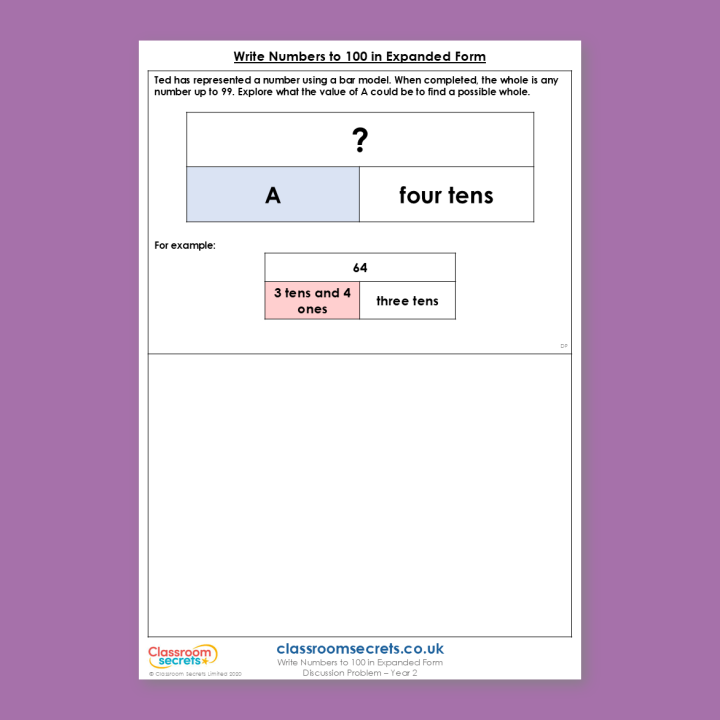
Deeper Reasoning
The question in this set focuses on partitioning with tens and ones to deepen understanding in reading and writing numbers up to 100.