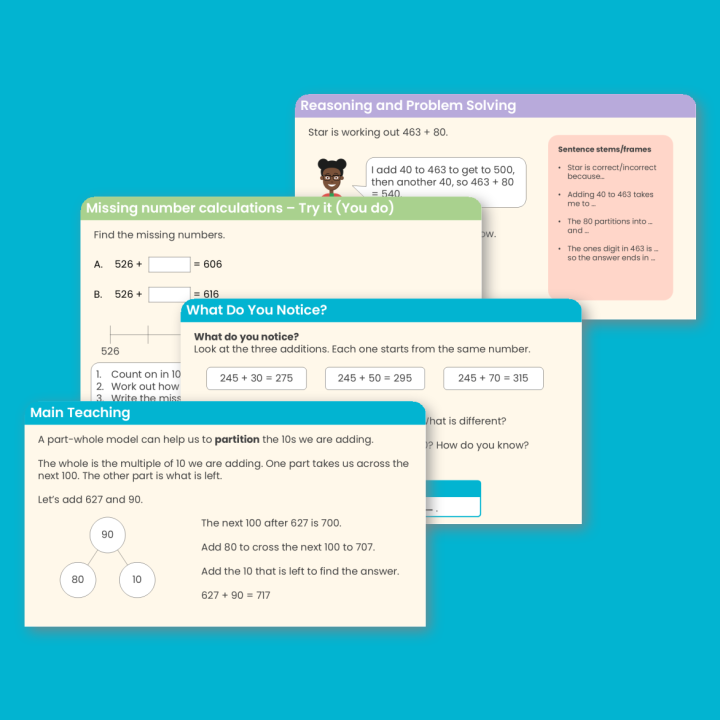
The Year 3 Add 10s Across a 100 PowerPoint guides both teachers and children through the lesson, including use of the varied fluency, reasoning and problem solving, deeper reasoning and scaffolded resources. Key learning information about this step:
Key Vocabulary
multiple: A product of one number multiplied by another number. For example: multiples of 10 are the products of numbers multiplied by 10.
number lines: A horizontal or vertical line which has numbers placed at equal points. Number lines can be used to show either positive or negative numbers. Most number lines begin at 0.
partitioning: The splitting of a number into different parts. For example: the number 547 can be partitioned into 500, 40 and 7.
exchange: When a digit is taken from one place value column and placed in another.
Varied Fluency
Knowledge Organiser
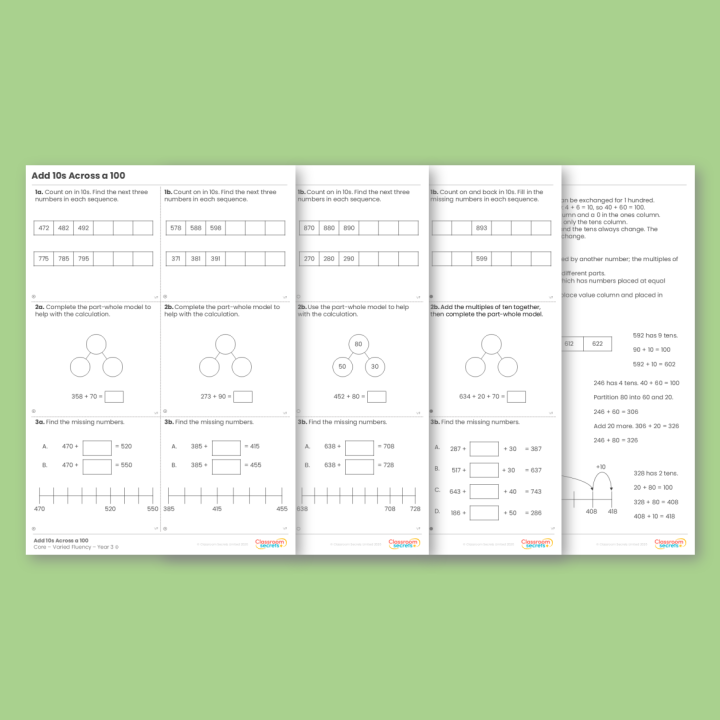
• Designed to support all children via key information and examples.
Scaffolded Examples
• Using number tracks, a part-whole model and sentence stems to cross the next 100 and then find the missing number.
Support
• Q1: Complete two number tracks with multiples of 10, across a 100.
• Q2: Use a part-whole model, already partitioned, to add 10s across a 100.
• Q3: Find the missing number when adding 10s across a 100, with labelled number lines to help.
Core
• Q1: Complete two number tracks, across a 100.
• Q2: Use a part-whole model to add 10s across a 100.
• Q3: Find two missing numbers when adding 10s across a 100, with labelled number lines to help.
Stretch
• Q1: Complete two number tracks, across a 100, with missing numbers before and after a given number.
• Q2: Use a part-whole model to add 10s across a 100, where two multiples of ten must be combined first.
• Q3: Find four missing numbers when adding 10s across a 100, each adding two multiples of ten, with no number lines.
Reasoning and Problem Solving
Support
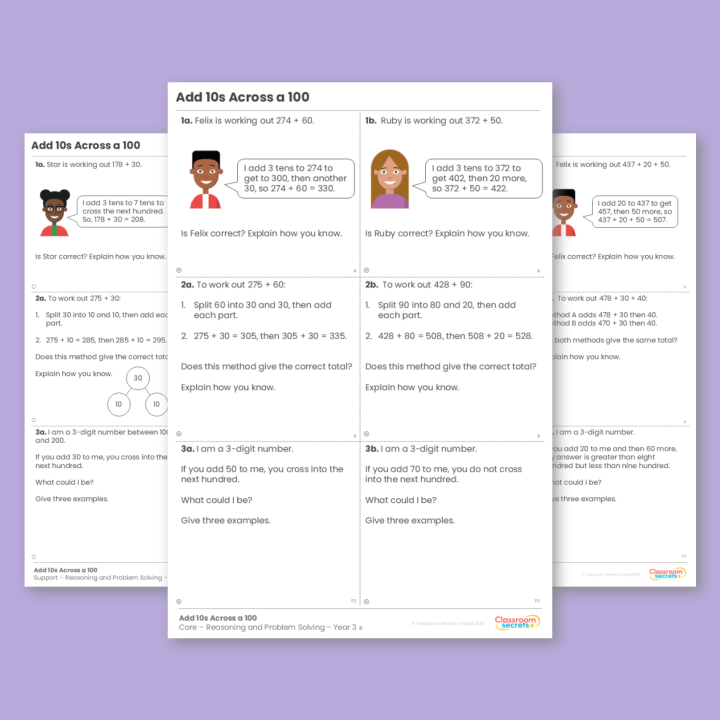
• Q1: Reasoning - Judge whether a character has correctly added a multiple of 10 to cross the next hundred.
• Q2: Reasoning - Judge whether a described method of splitting and adding a multiple of 10 gives the correct total. Part-whole model given.
• Q3: Problem Solving - Identify 3-digit numbers that do or do not cross a hundred when a given multiple of 10 is added.
Core
• Q1: Reasoning - Judge whether a character has correctly added a multiple of 10 to a 3-digit number by splitting it into two parts.
• Q2: Reasoning - Judge whether a described method of splitting and adding a multiple of 10 gives the correct total.
• Q3: Problem Solving - Identify 3-digit numbers that do or do not cross a hundred when a given multiple of 10 is added.
Stretch
• Q1: Reasoning - Judge whether a character has correctly added two multiples of 10 to a 3-digit number, crossing a hundred.
• Q2: Reasoning - Judge whether two methods give the correct total when adding two multiples of 10.
• Q3: Problem Solving - Identify 3-digit numbers that meet a range condition after two multiples of 10 are added.
Deeper Reasoning
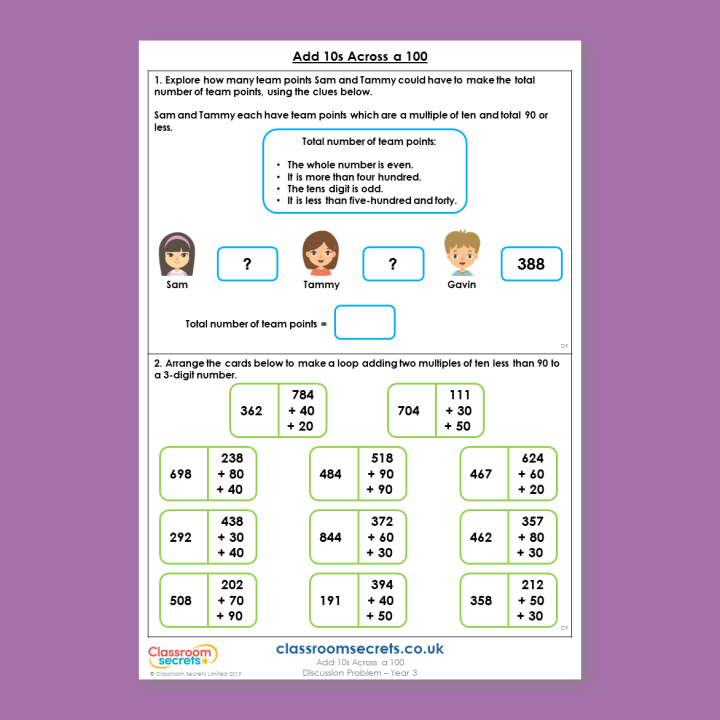
The questions in this set focus on problem solving with addition to deepen understanding in adding numbers mentally, including 3-digit numbers and hundreds.