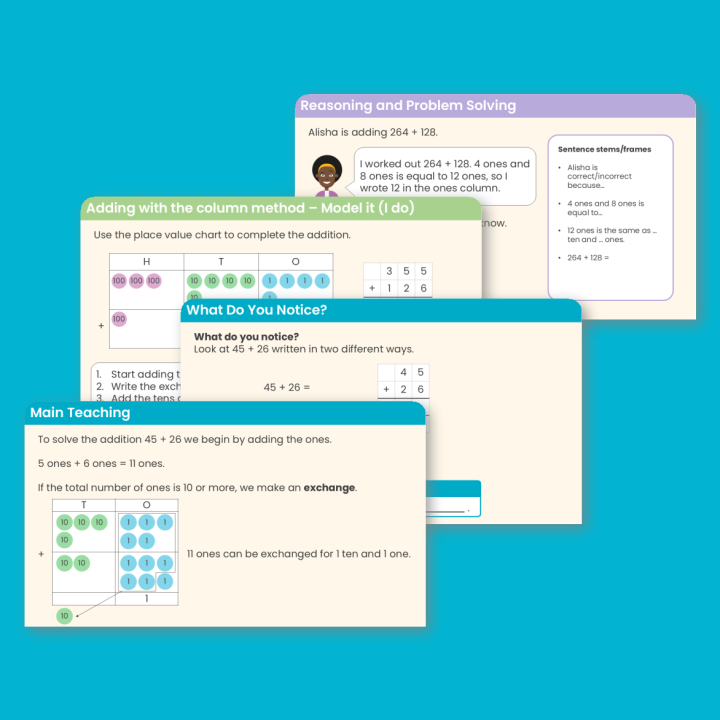
The Year 3 Add Two Numbers (across a 10) PowerPoint guides both teachers and children through the lesson, including use of the varied fluency, reasoning and problem solving, deeper reasoning and scaffolded resources. Key learning information about this step:
Key Vocabulary
place value chart: Used to identify the value of the digits that make up a number.
place value counters: A physical resource which represents numbers. They are usually in different colours and have different numbers written on them, to represent ’ones’, ’tens’, ’hundreds’ etc.
exchange: When a digit is taken from one place value column and placed in another.
formal written method: This is also known as the column method for addition, subtraction and multiplication. For division, this may also be known as the bus stop method.
Varied Fluency
Knowledge Organiser
• Designed to support all children via key information and examples.
Scaffolded Examples
• Using place value counters and sentence stems to add two 2-digit numbers with an exchange.
Support
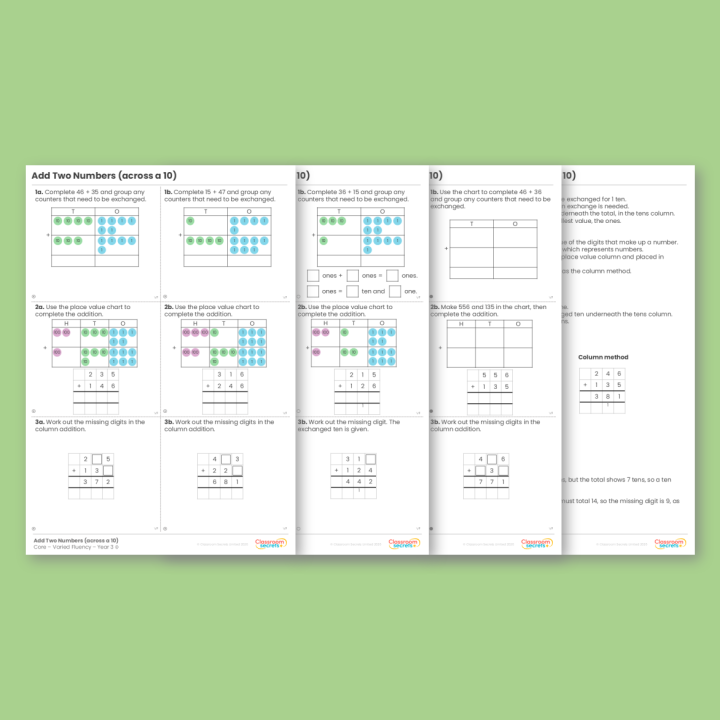
• Q1: Add two 2-digit numbers with counters, with sentence stems to complete.
• Q2: Complete a 3-digit column addition with a place value chart; the exchanged ten is given.
• Q3: Find one missing digit in a column addition; the exchanged ten is given.
Core
• Q1: Add two 2-digit numbers with counters, with no sentence stems.
• Q2: Complete a 3-digit column addition with a place value chart.
• Q3: Find two missing digits in a column addition.
Stretch
• Q1: Make both 2-digit numbers in an empty chart, then show the total.
• Q2: Make both 3-digit numbers in an empty chart, then complete the column addition.
• Q3: Find three missing digits in a column addition.
Reasoning and Problem Solving
Support
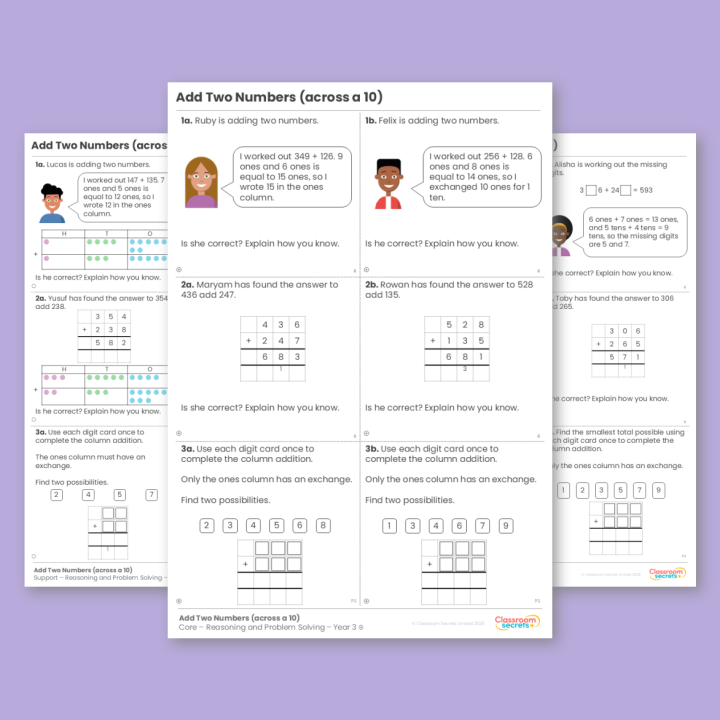
• Q1: Reasoning – judge whether a character has exchanged correctly when adding two 3-digit numbers; place value chart provided.
• Q2: Reasoning – judge a worked 3-digit column addition where the exchanged ten may not have been added; place value chart provided.
• Q3: Problem Solving – use four digit cards to make two possible calculations with one exchange; exchanged ten given.
Core
• Q1: Reasoning – judge whether a character has exchanged correctly when adding two 3-digit numbers.
• Q2: Reasoning – judge a worked 3-digit column addition where the exchanged ten may not have been added.
• Q3: Problem Solving – use six digit cards to make two possible calculations with one exchange.
Stretch
• Q1: Reasoning – judge whether a character has exchanged correctly when identifying the missing digits in two 3-digit numbers.
• Q2: Reasoning – judge a worked 3-digit column addition where the exchanged ten is written in the wrong column; zero used as a placeholder.
• Q3: Problem Solving – use six digit cards to make the smallest total with one exchange.
Deeper Reasoning
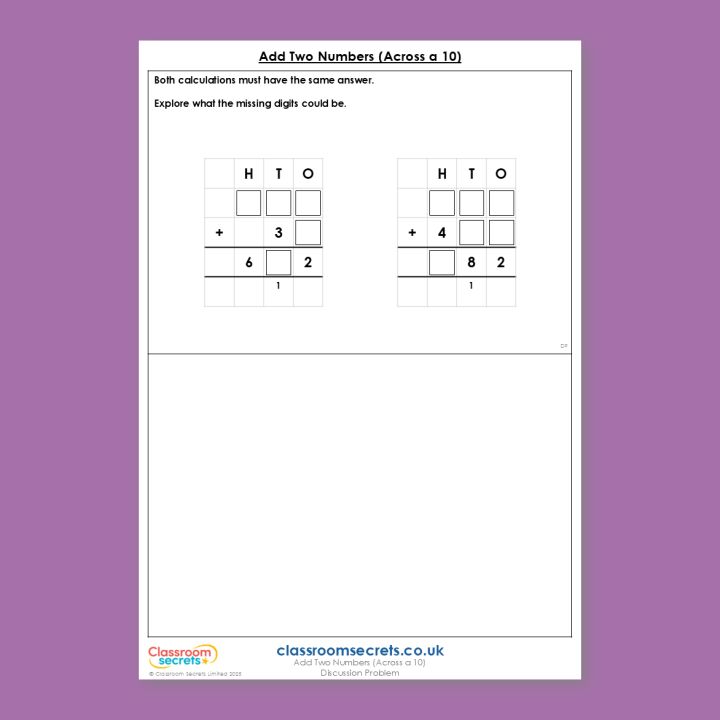
The question in this set focuses on identifying the missing digits in two calculations to deepen understanding in adding numbers with up to three digits, using formal written methods of columnar addition.