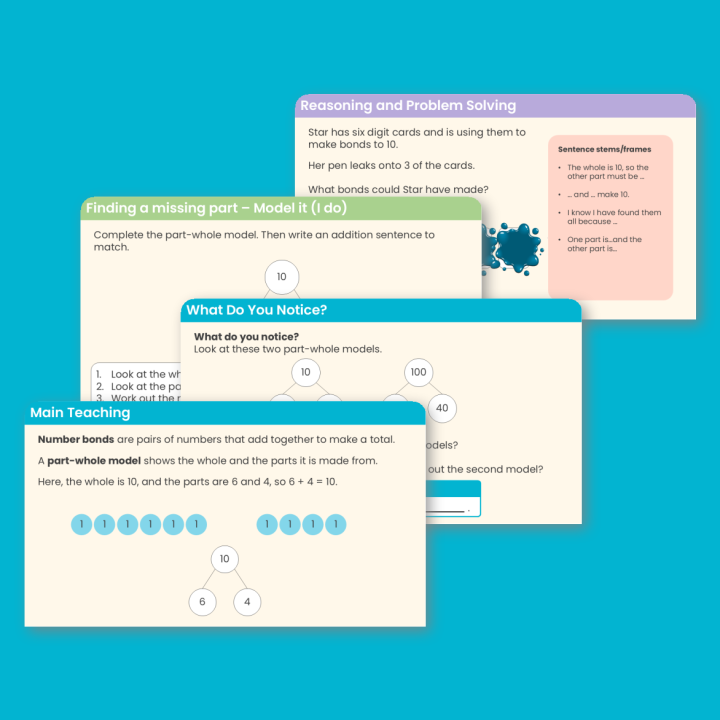
The Year 3 Apply number Bonds within 10 PowerPoint guides both teachers and children through the lesson, including use of the varied fluency, reasoning and problem solving, deeper reasoning and scaffolded resources. Key learning information about this step:
Key Vocabulary
number bonds: Pairs of numbers that add together to make a given total. For example, 6 and 4 are a number bond to 10.
part-whole model: A representation showing the whole number and the parts it has been split into.
bar models: Show how numbers can be split into different parts, by splitting them into bars or boxes. Bar models can be used to solve a wide variety of calculations, showing the relationship between the whole model and the parts.
related facts: Also known as fact families, these are a group of four calculations that are created using the same three numbers.
For example: 2 + 5 = 7; 5 + 2 = 7; 7 – 2 = 5; 7 – 5 = 2.
This can also be used to identify derived facts, for example 20 + 50 = 70.
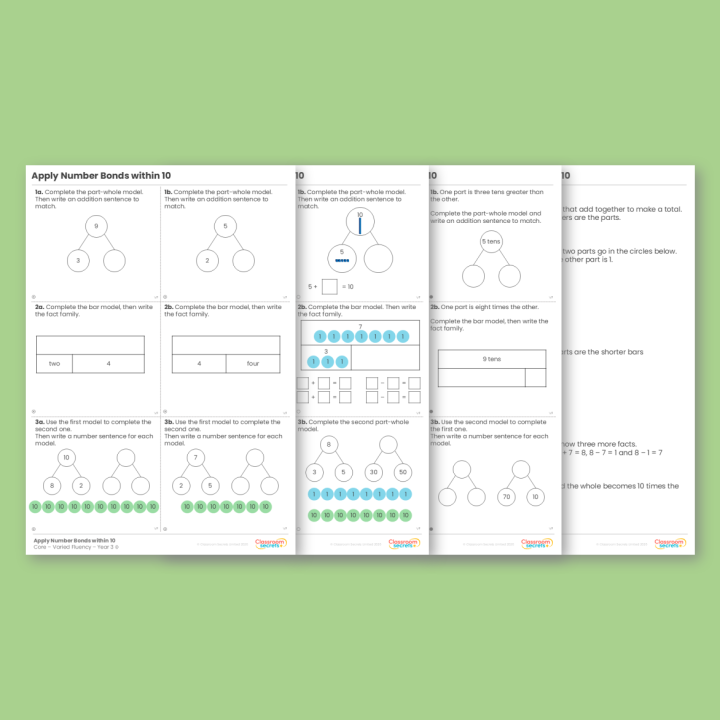
Varied Fluency
Knowledge Organiser
• Designed to support all children via key information and examples.
For the purple sections of the four levels, copy and paste these from the first sheet of the varied fluency resource.
Scaffolded Examples
Finding a missing part of 10; finding a missing part of a bar model; scaling a number bond to 100.
Support
• Q1: Finding a missing part when the whole is 10; Base 10 included in part-whole model; partially completed number sentence provided.
• Q2: Finding a missing part when the whole and one part are given; place value counters included in bar model; fact family frames provided.
• Q3: Completing the whole of a scaled part-whole model; ones and tens place value counters provided.
Core
• Q1: Finding a missing part when the whole is less than 10.
• Q2: Finding the whole from two given parts, then writing the fact family.
• Q3: Scaling a complete number bond to a related fact; tens place value counters provided.
Stretch
• Q1: Finding both parts from a whole given in tens and an additive relationship between the parts.
• Q2: Finding both parts from a whole given in tens and a multiplicative relationship, then writing the fact family.
• Q3: Completing the whole of a bond in tens, then working backwards to find the bond within 10; no counters provided.
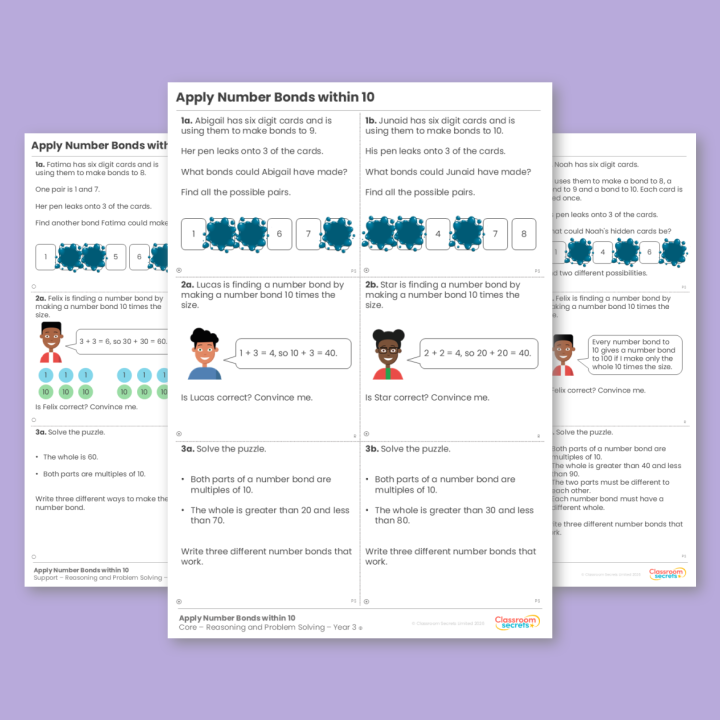
Reasoning and Problem Solving
Support
• Q1: Problem Solving - finding pairs of digit cards that make a given total, with one pair given; 3 cards hidden.
• Q2: Reasoning - judging a statement about making a number bond 10 times the size; place value counters provided.
• Q3: Problem Solving - finding two multiples of 10 that make a given whole.
Core
• Q1: Problem Solving - finding all the pairs of digit cards that make a given total; 3 cards hidden.
• Q2: Reasoning - judging a statement about making a number bond 10 times the size.
• Q3: Problem Solving - finding number bonds of multiples of 10 within a given range of wholes.
Stretch
• Q1: Problem Solving - finding all the pairs of digit cards that make a given total; 4 cards hidden.
• Q2: Reasoning - judging a generalisation about making the parts and the whole 10 times the size.
• Q3: Problem Solving - finding possible hidden cards when three bonds have three different totals; 3 cards hidden; more than one solution.
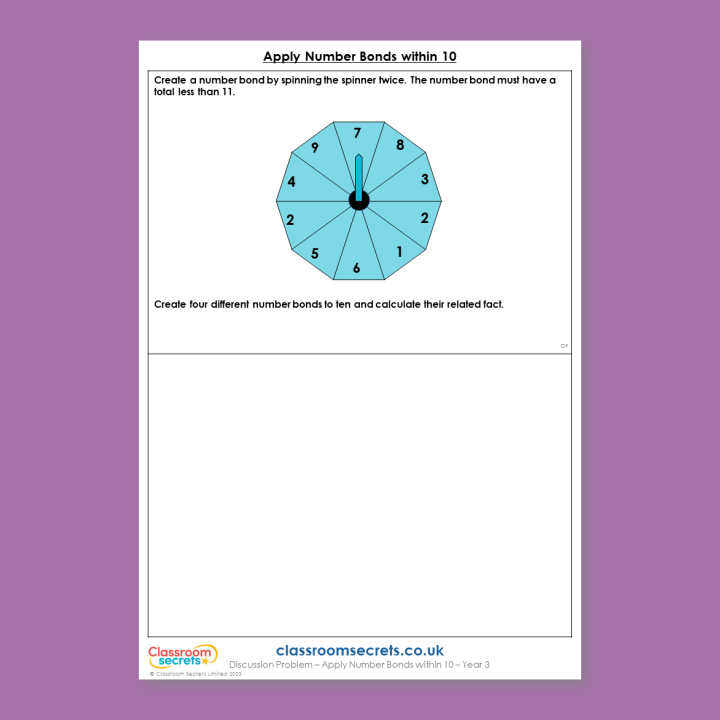
Deeper Reasoning
The question in this set focuses on finding different number bonds by spinning a spinner to deepen understanding in adding and subtracting numbers mentally.