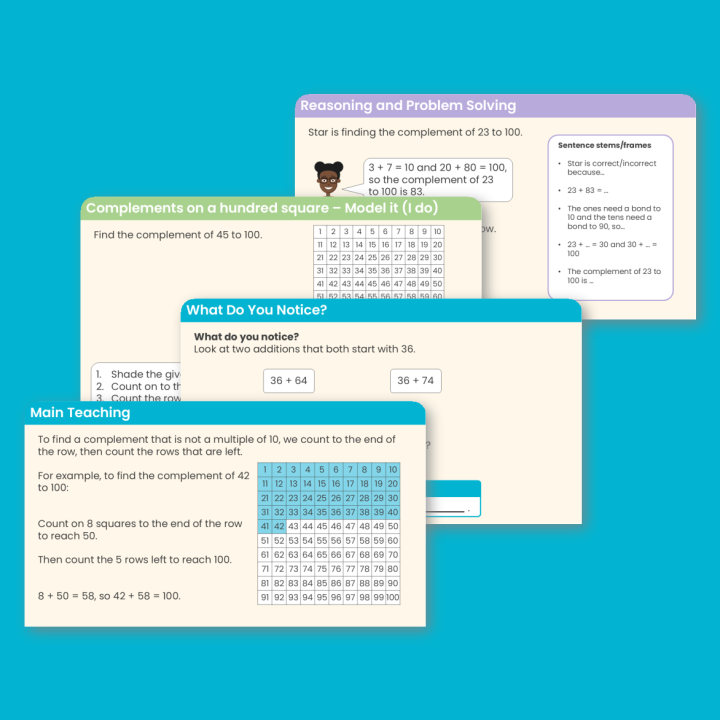
The Year 3 Complements to 100 PowerPoint guides both teachers and children through the lesson, including use of the varied fluency, reasoning and problem solving, deeper reasoning and scaffolded resources. Key learning information about this step:
Key Vocabulary
complement: The number that must be added to a given number to reach a stated total. For example: the complement of 36 to 100 is 64.
partitioning: The splitting of a number into different parts. For example: the number 547 can be partitioned into 500, 40 and 7.
related facts: Also known as fact families, these are a group of four calculations that are created using the same three numbers, for example 2 + 5 = 7, 5 + 2 = 7, 7 – 2 = 5, 7 – 5 = 2.
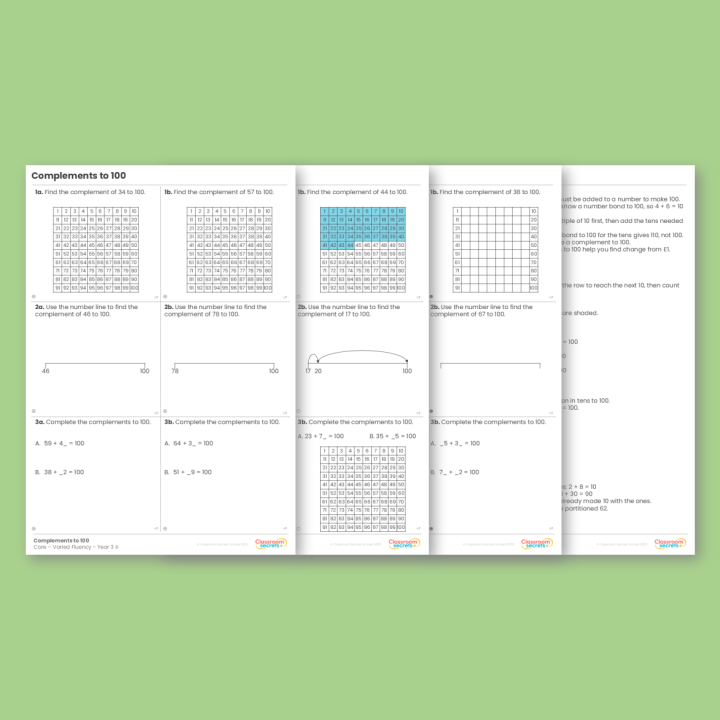
Varied Fluency
Knowledge Organiser
• Designed to support all children via key information and examples.
Scaffolded Examples
• Counting on to the next multiple of 10, then counting on in tens to 100 using a hundred square.
Support
• Q1: Find the complement to 100; hundred square provided with the number shaded.
• Q2: Find the complement to 100 on a number line; the jumps are drawn and the next multiple of 10 is labelled.
• Q3: Find the missing digits in a complement to 100; hundred square provided.
Core
• Q1: Find the complement to 100; hundred square provided.
• Q2: Find the complement to 100 on a number line; start and end number given.
• Q3: Find the missing digits in a complement to 100.
Stretch
• Q1: Find the complement to 100; partially completed hundred square provided.
• Q2: Find the complement to 100 on a blank number line.
• Q3: Find the missing digits in a complement to 100; two missing digits per complement.
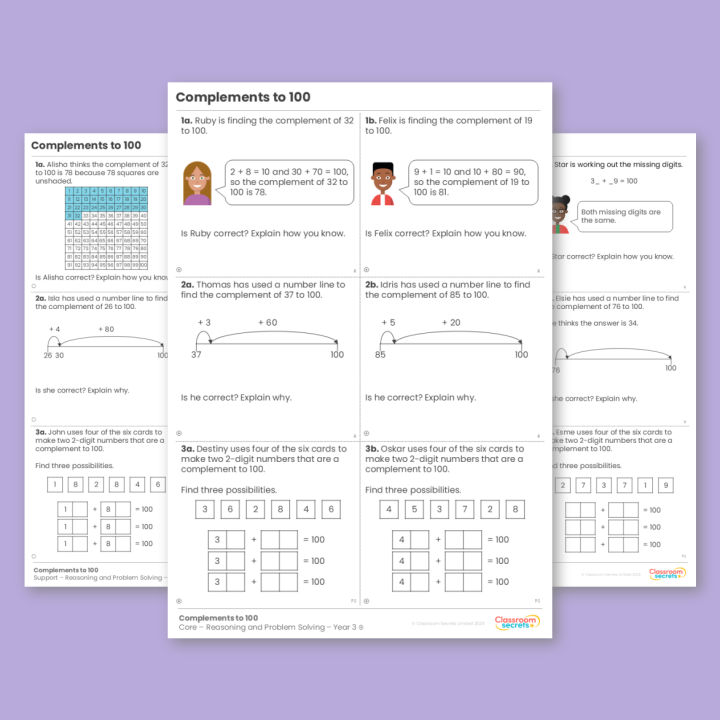
Reasoning and Problem Solving
Support
• Q1: Reasoning – judge whether a character has found a complement to 100 correctly; hundred square provided.
• Q2: Reasoning – judge whether a character has used a number line to find a complement to 100 correctly; all numbers labelled.
• Q3: Problem Solving – use digit cards to make two 2-digit numbers that are a complement to 100 from six cards; both tens digits are placed.
Core
• Q1: Reasoning – judge whether a character has found a complement to 100 correctly.
• Q2: Reasoning – judge whether a character has used a number line to find a complement to 100 correctly; some numbers labelled.
• Q3: Problem Solving – use digit cards to make two 2-digit numbers that are a complement to 100 from six cards; one tens digit is placed.
Stretch
• Q1: Reasoning – judge whether a character has found the missing digits in a complement to 100 correctly.
• Q2: Reasoning – judge whether a character has used a number line to find a complement to 100 correctly; start and end numbers labelled.
• Q3: Problem Solving – use digit cards to make two 2-digit numbers that are a complement to 100 from six cards; no digits are placed.
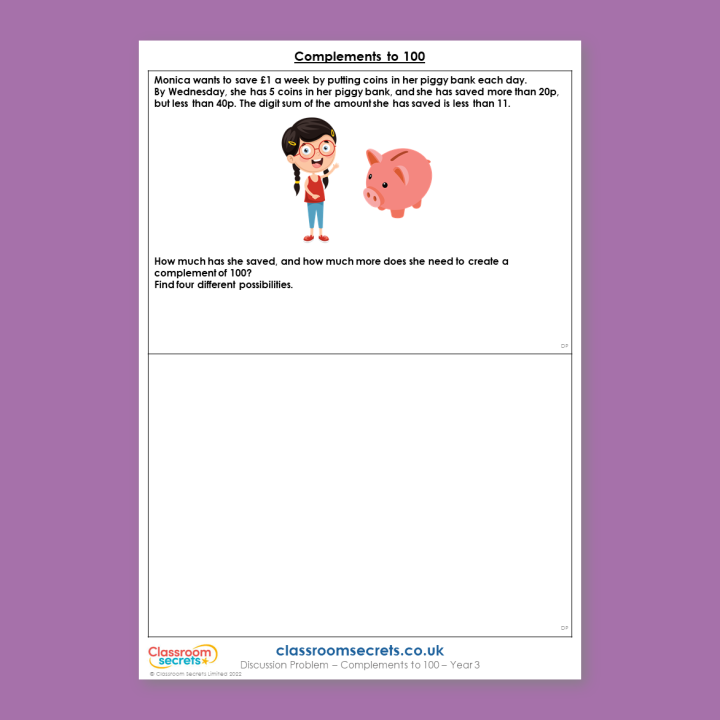
Deeper Reasoning
The question in this set focuses on using the clues to work out how much money has been saved and how much more is needed to create a complement to 100 to deepen understanding in adding numbers mentally.