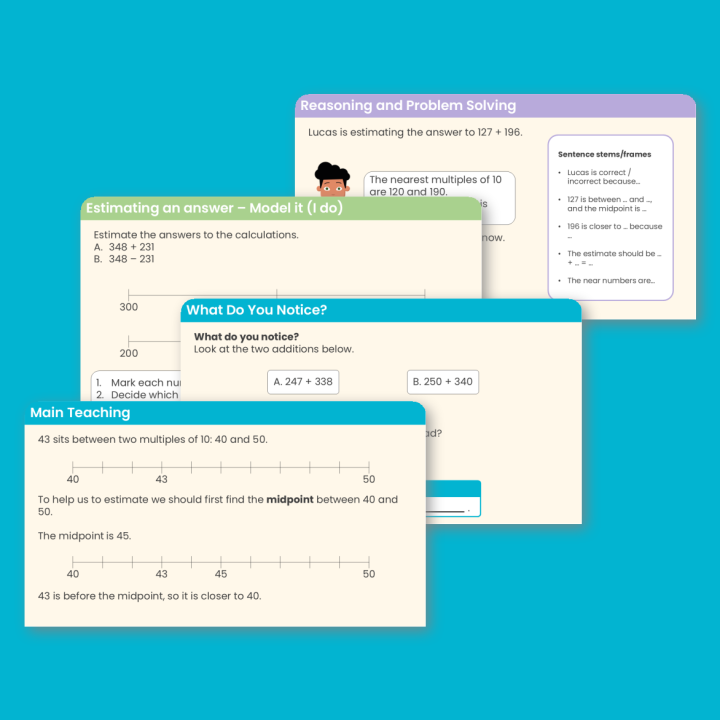
The Year 3 Estimate Answers PowerPoint guides both teachers and children through the lesson, including use of the varied fluency, reasoning and problem solving, deeper reasoning and scaffolded resources. Key learning information about this step:
Key Vocabulary
estimate: To make a sensible guess at what the answer could be. You usually estimate the answer by rounding the numbers to make the calculation easier. Another word for estimate is approximate.
calculation: Determines an amount. It may involve addition, subtraction, multiplication or division, or a combination of these.
multiple: A product of one number multiplied by another number. For example: multiples of 10 are the products of numbers multiplied by 10.
midpoint: The point on a number line that is exactly halfway between the start and end values.
Varied Fluency
Knowledge Organiser
• Designed to support all children via key information and examples.
Scaffolded Examples
• Using sentence stems and number lines to estimate an answer.
Support
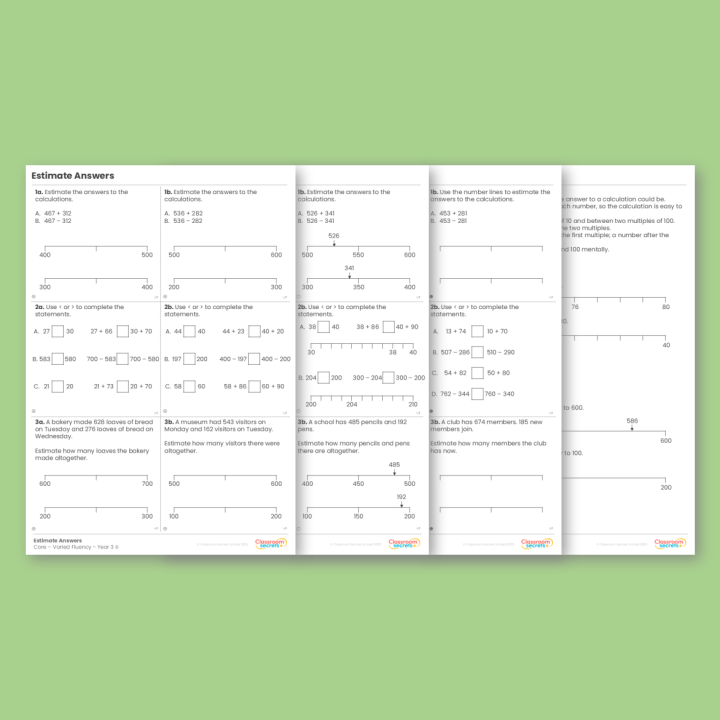
• Q1: Estimate the answers to the calculations; two number lines given with all three markers labelled.
• Q2: Use < or > to compare two numbers, then use this to compare two calculations; number lines given.
• Q3: Estimate the answer to an addition word problem; two number lines given with all three markers labelled.
Core
• Q1: Estimate the answers to the calculations; two number lines given with start and end markers only.
• Q2: Use < or > to compare two numbers, then use this to compare two calculations.
• Q3: Estimate the answer to an addition word problem; two number lines given with start and end markers only.
Stretch
• Q1: Estimate the answers to the calculations; two blank number lines given.
• Q2: Use < or > to compare two calculations.
• Q3: Estimate the answer to an addition or subtraction word problem; blank number lines given.
Reasoning and Problem Solving
Support
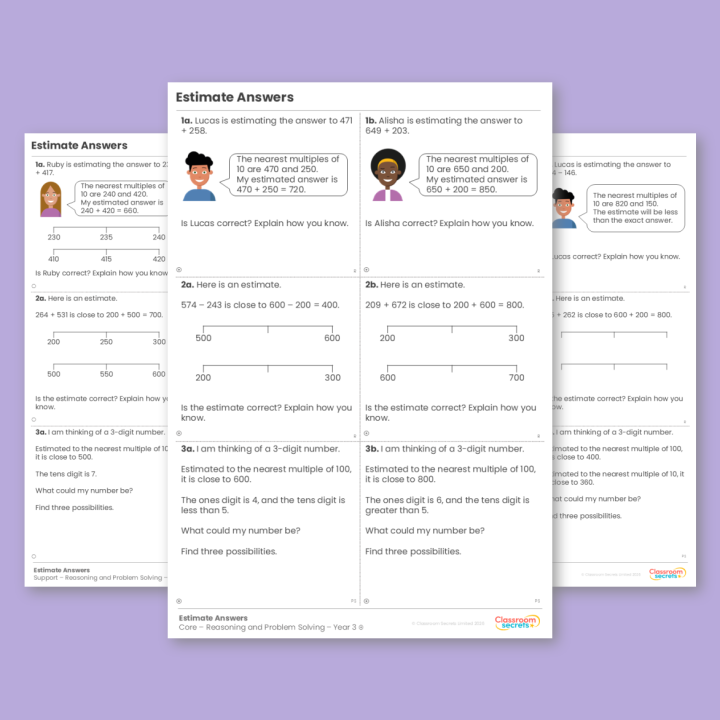
• Q1: Reasoning – explain whether a character has estimated an addition correctly; number lines provided.
• Q2: Reasoning – spot the error in an estimated calculation; number lines provided with start, end and midpoint labelled.
• Q3: Problem Solving – find a 3-digit number from its estimate to the nearest 100 and one given digit.
Core
• Q1: Reasoning – explain whether a character has estimated an addition correctly.
• Q2: Reasoning – spot the error in an estimated calculation; number lines provided with start and end points labelled.
• Q3: Problem Solving – find a 3-digit number from its estimate to the nearest 100 and two conditions on its digits.
Stretch
• Q1: Reasoning – explain whether a character has correctly identified if a subtraction estimate will be bigger or smaller than the exact answer.
• Q2: Reasoning – spot the error in an estimated calculation; blank number lines provided.
• Q3: Problem Solving – find a 3-digit number from two estimates, one to the nearest 100 and one to the nearest 10.
Deeper Reasoning
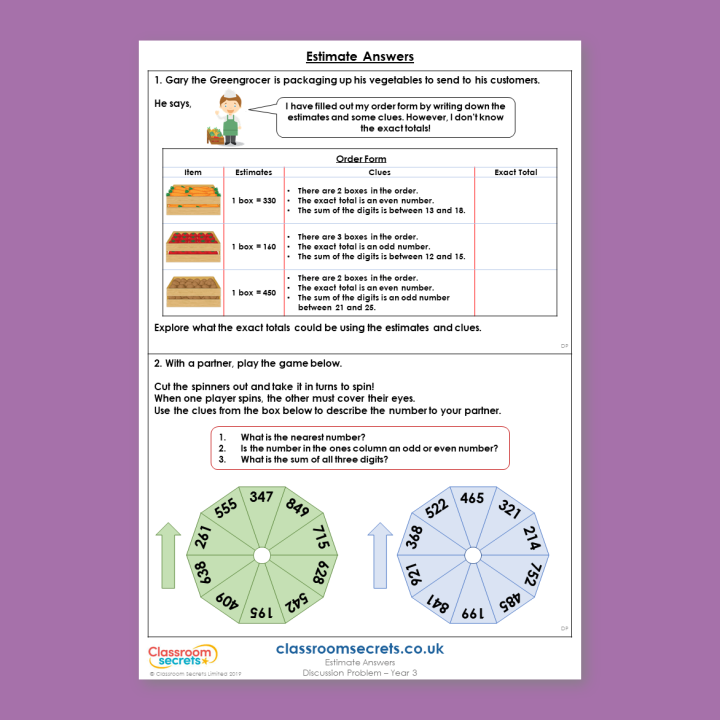
The questions in this set focus on using the clues to complete the order form and a spinner game to play in pairs to deepen understanding in estimating the answer to a calculation.