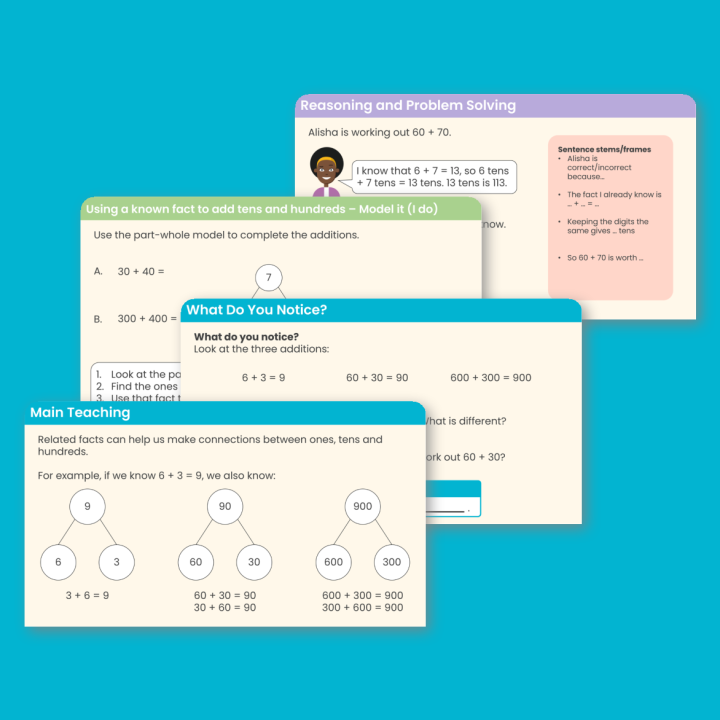
The Year 3 Make Connections PowerPoint guides both teachers and children through the lesson, including use of the varied fluency, reasoning and problem solving, deeper reasoning and scaffolded resources. Key learning information about this step:
Key Vocabulary
related facts: Also known as fact families, these are a group of four calculations that are created using the same three numbers, for example 2 + 5 = 7, 5 + 2 = 7, 7 – 2 = 5, 7 – 5 = 2. This can also be used to identify derived facts, for example 20 + 50 = 70.
partitioning: The splitting of a number into different parts. For example: the number 547 can be partitioned into 500, 40 and 7.
part-whole model: A representation showing the whole number and the parts it has been split into.
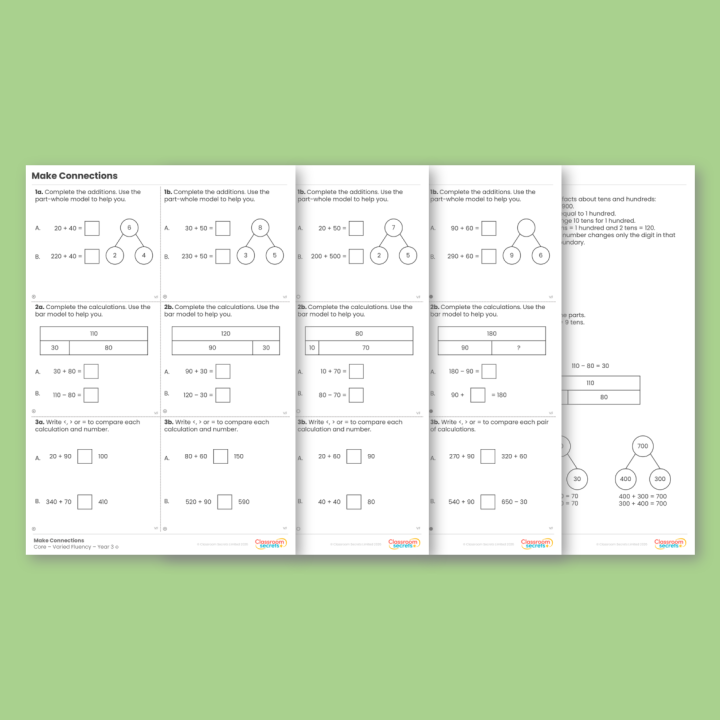
Varied Fluency
Knowledge Organiser
• Designed to support all children via key information and examples.
For the purple sections of the four levels, copy and paste these from the first sheet of the varied fluency resource.
Scaffolded Examples
• Using a known fact about ones to add tens, then comparing two calculations.
Support
• Q1: complete two additions from a part-whole model; no crossing.
• Q2: complete an addition and a subtraction from a bar model; no crossing.
• Q3: compare each calculation with a number; totals within 100.
Core
• Q1: complete two additions from a part-whole model; one a 3-digit number.
• Q2: complete an addition and a subtraction from a bar model; crossing.
• Q3: compare a calculation with a number, and with another calculation.
Stretch
• Q1: find the whole, then complete two additions crossing a hundred.
• Q2: find the missing part, then complete a subtraction and an addition with a missing addend.
• Q3: compare calculations that add 90, using compensation.
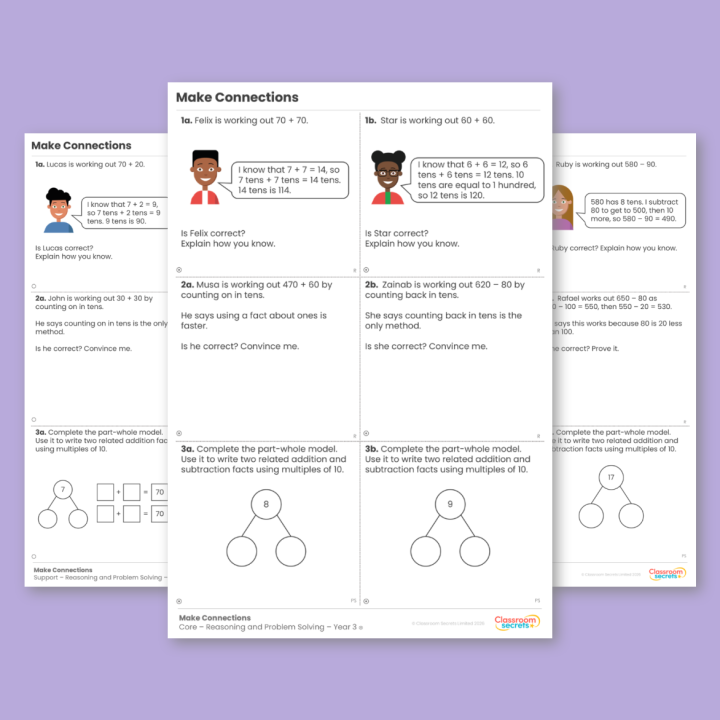
Reasoning and Problem Solving
Support
• Q1: Reasoning – explain whether a character has read a number of tens correctly, using tens that do not cross a hundred.
• Q2: Reasoning – decide whether a character is right that counting in tens is the only method for adding two multiples of 10.
• Q3: Problem Solving – complete a part-whole model to find two multiples of 10 that add to a given total, then use it to write two addition facts.
Core
• Q1: Reasoning – explain whether a character has read a number of tens correctly, using calculations that cross a hundred.
• Q2: Reasoning – decide whether a character is right about the faster method for a calculation with a 3-digit number.
• Q3: Problem Solving – complete a part-whole model for a given ones fact, then use it to write two related addition and subtraction facts with tens.
Stretch
• Q1: Reasoning – explain whether a character has kept the hundreds when using a fact about ones on a 3-digit number.
• Q2: Reasoning – decide whether a character has adjusted correctly after adding or subtracting 100.
• Q3: Problem Solving – complete a part-whole model for a ones fact greater than 10, then use it to write two related addition and subtraction facts that cross a hundred.
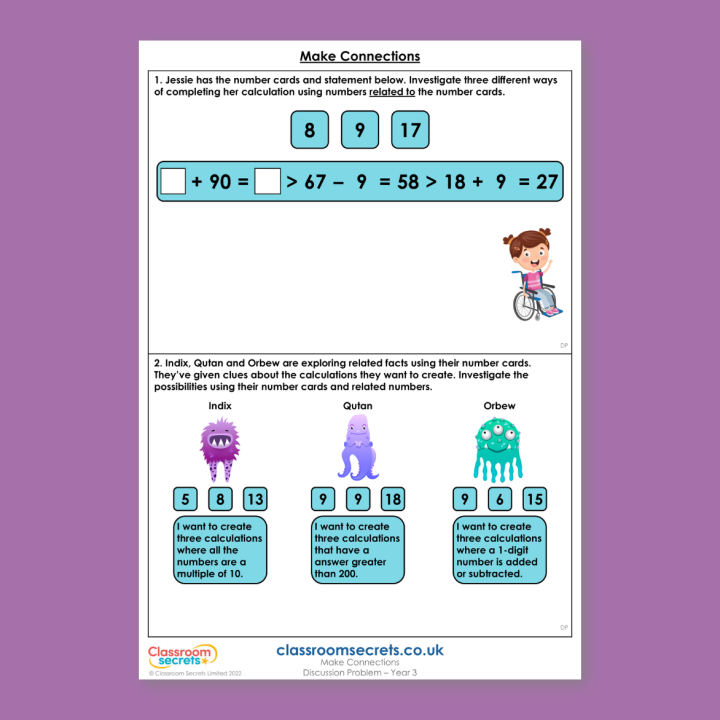
Deeper Reasoning
The questions in this set focus on investigating different ways to complete calculations using number cards, related numbers and number facts to deepen understanding in adding and subtracting numbers mentally, including: three-digit numbers and ones, three-digit numbers and tens and three-digit numbers and hundreds.