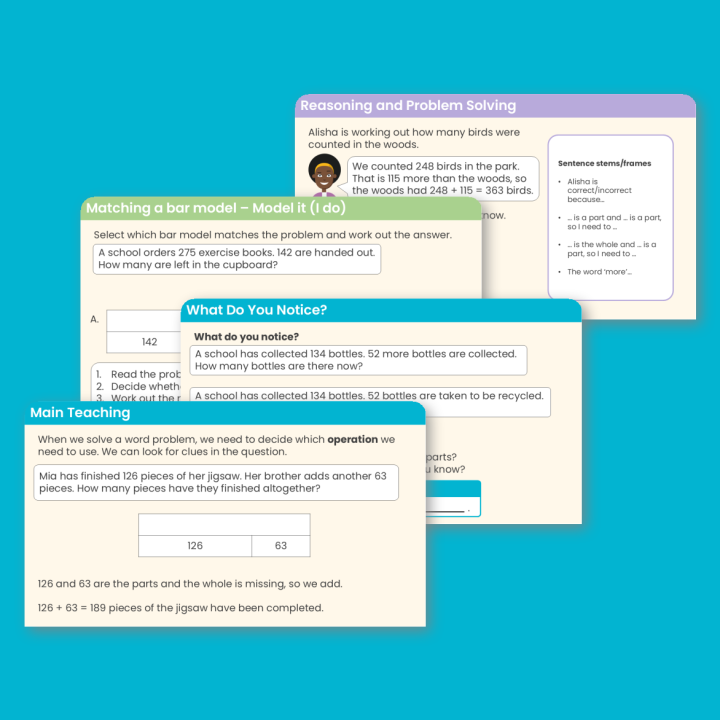
The Year 3 Make Decisions PowerPoint guides both teachers and children through the lesson, including use of the varied fluency, reasoning and problem solving, deeper reasoning and scaffolded resources. Key learning information about this step:
Key Vocabulary
operation: The function required to complete the calculation or problem. The four operations are: addition, subtraction, multiplication and division.
multi-step problems: Maths problems that have more than one operation. An example may include both an addition and a subtraction.
efficient: To choose the best method to solve a calculation. Sometimes a mental method can be quicker than a written one if there are no exchanges.
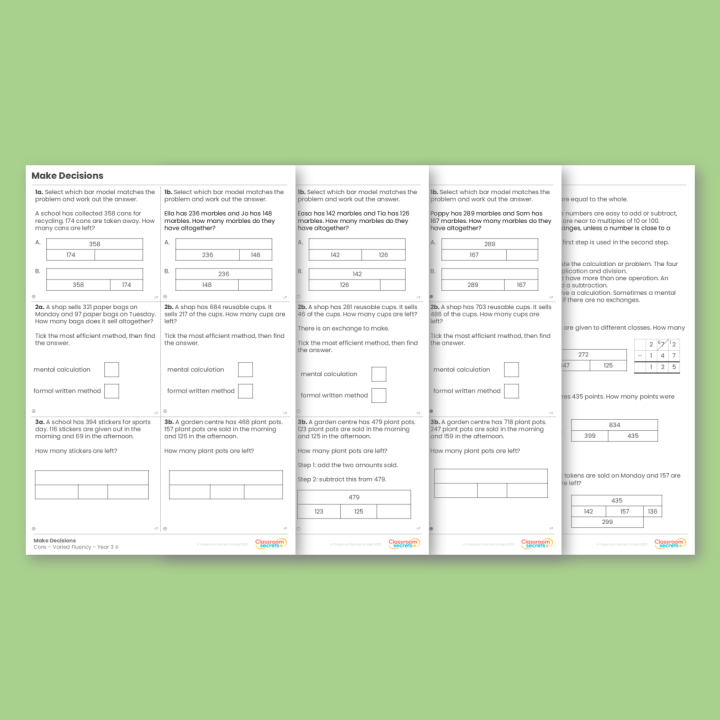
Varied Fluency
Knowledge Organiser
• Designed to support all children via key information and examples.
Scaffolded Examples
• Finding the whole and the parts, then choosing the operation and method.
Support
• Q1: Match a problem to one of two bar models and solve; no exchange.
• Q2: Select the most efficient method; a cue is given; one exchange.
• Q3: Solve a two-step problem; both steps given; partially completed bar model; no exchange.
Core
• Q1: Match a problem to one of two bar models and solve; one exchange.
• Q2: Select the most efficient method; no cue is given; one exchange
• Q3: Solve a two-step problem; empty bar model; one exchange.
Stretch
• Q1: Match a problem to one of two bar models and solve; two exchanges.
• Q2: Select the most efficient method; no cue given; two exchanges.
• Q3: Solve a two-step problem; empty bar model; two exchanges.
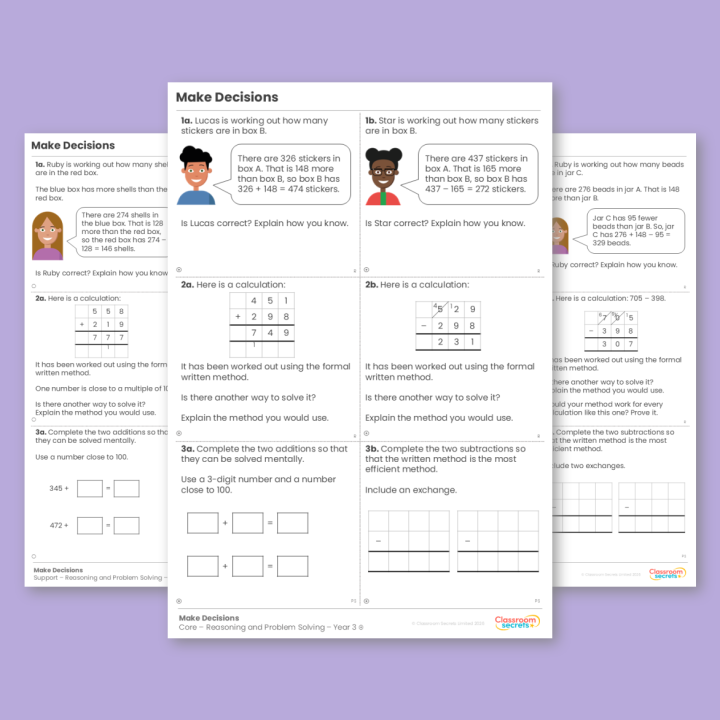
Reasoning and Problem Solving
Support
• Q1: Reasoning – explain whether a character has found a smaller amount correctly; two parts; the first step is given.
• Q2: Reasoning – explain another way to solve a calculation; a cue to the method is given.
• Q3: Problem Solving – write calculations suited to a given method; starting number given.
Core
• Q1: Reasoning – explain whether a character has found a smaller amount correctly; two parts.
• Q2: Reasoning – explain another way to solve a calculation; one exchange.
• Q3: Problem Solving – write calculations suited to a given method.
Stretch
• Q1: Reasoning – explain whether a character has found a smaller amount correctly; three parts.
• Q2: Reasoning – explain another way to solve a calculation; two exchanges.
• Q3: Problem Solving – write calculations suited to a given method; each must meet a stated condition.
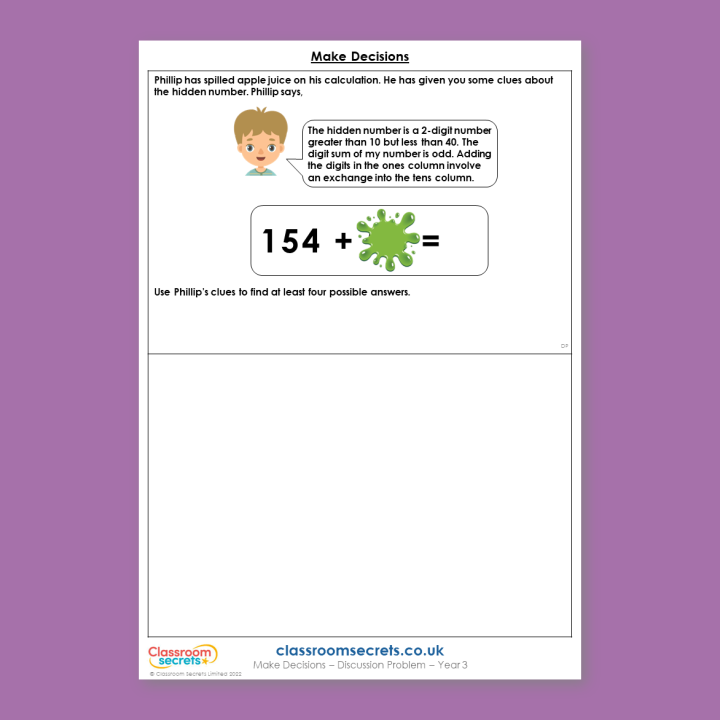
Deeper Reasoning
The question in this set focuses on using the clues to identify the missing number to deepen understanding in solving problems, including missing number problems, using number facts, place value, and more complex addition and subtraction.