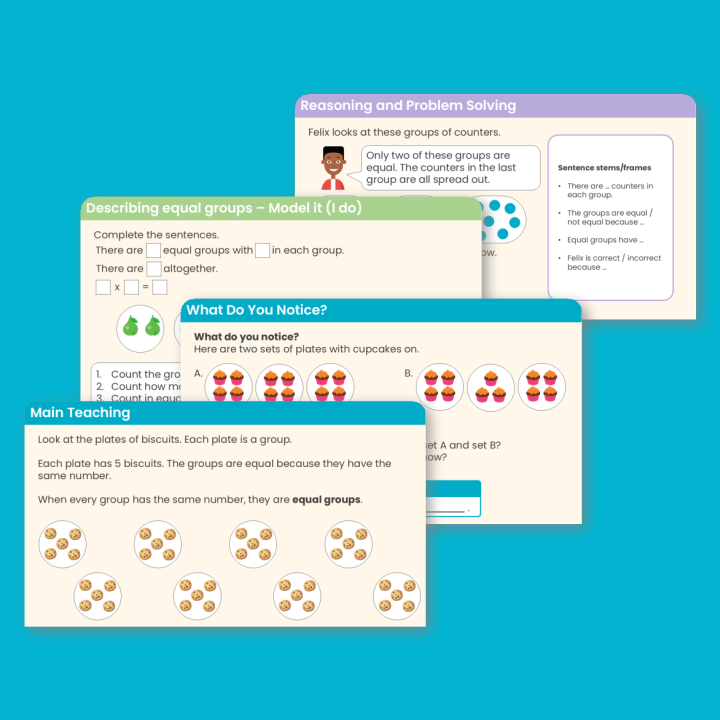
The Year 3 Multiplication - Equal Groups PowerPoint guides both teachers and children through the lesson, including use of the varied fluency, reasoning and problem solving, deeper reasoning and scaffolded resources. Key learning information about this step:
Key Vocabulary
equal groups: Groups that have the same number of objects in each group.
altogether: Describes how many objects there are in total.
repeated addition: Adding equal groups to find the total.
multiplication: A more efficient way of completing repeated addition. We can show multiplication using groups. For example: 3 groups of 2 children would be 3 x 2.
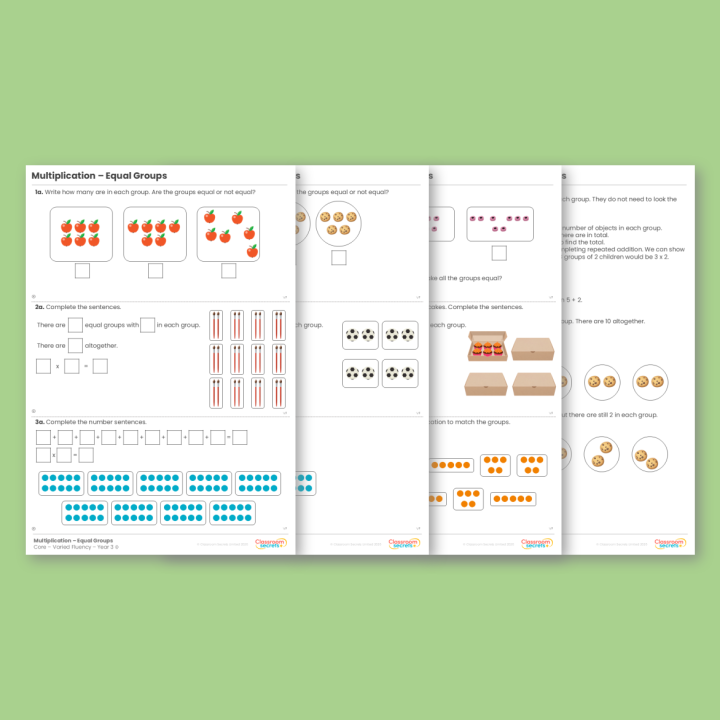
Varied Fluency
Knowledge Organiser
• Designed to support all children via key information and examples.
Scaffolded Examples
• Counting groups to decide if they are equal; describing equal groups.
Support
• Q1: Decide if groups are equal; same layout in each group; sentence stem provided.
• Q2: Describe groups; number of groups given.
• Q3: Use number sentences to describe groups; number sentences partially completed.
Core
• Q1: Count each group, then identify if equal or not equal; groups set out differently.
• Q2: Describe groups; no values given.
• Q3: Use number sentences to describe groups; blank number sentences provided.
Stretch
• Q1: Count each group, then identify how many more are needed to make the groups equal.
• Q2: Describe groups when only one group is shown.
• Q3: Use number sentences to describe groups; no number sentences given; groups set out differently.
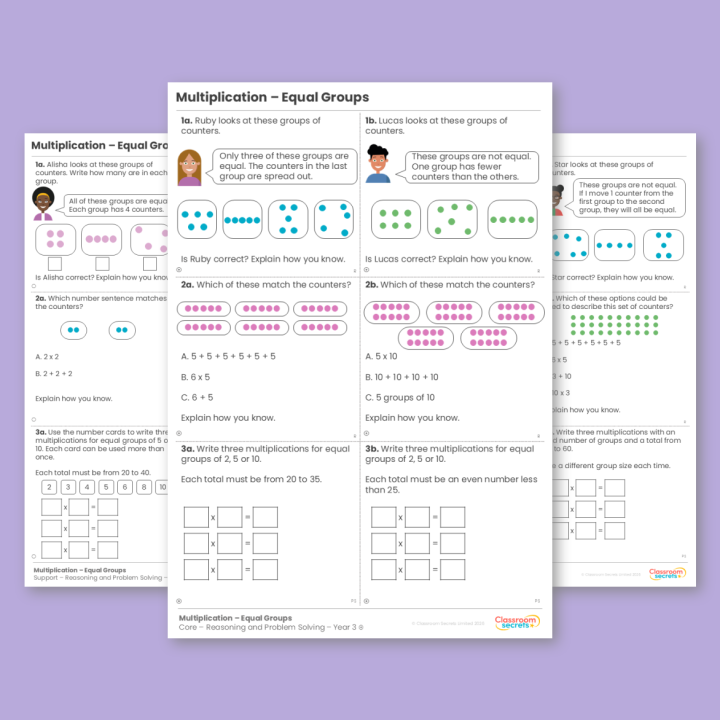
Reasoning and Problem Solving
Support
• Q1: Reasoning – explain whether a character has judged equal groups correctly; write the number in each group first.
• Q2: Reasoning – identify the number sentence that matches the counters.
• Q3: Problem Solving – use number cards to write multiplications for groups of 5 or 10 that fit a rule.
Core
• Q1: Reasoning – explain whether a character has judged equal groups correctly; groups set out in different ways.
• Q2: Reasoning – identify which options match the counters; three options.
• Q3: Problem Solving – write multiplications for groups of 2, 5 or 10 that fit a rule.
Stretch
• Q1: Reasoning – explain whether a character can make groups equal by adding or moving counters.
• Q2: Reasoning – identify which options match the counters; four options; counters not grouped into boxes.
• Q3: Problem Solving – write multiplications that fit two rules at once.
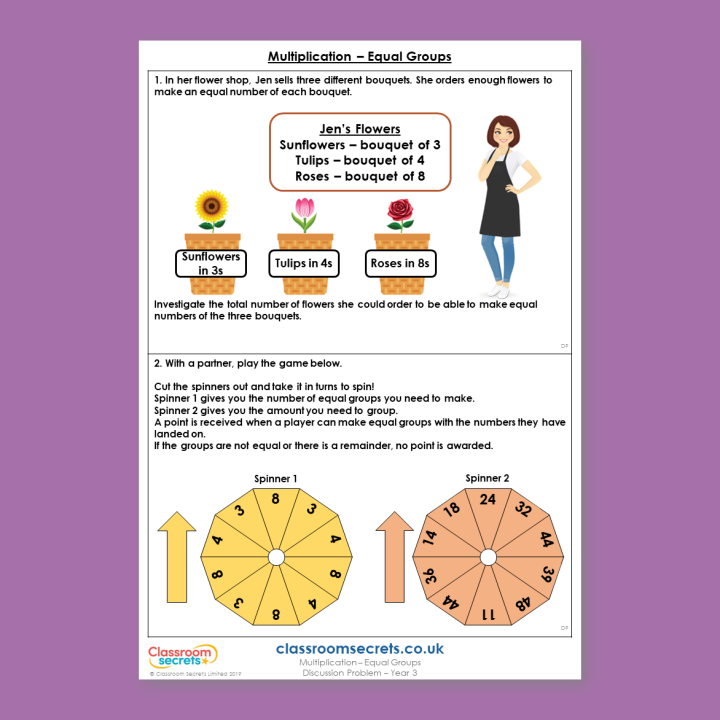
Deeper Reasoning
The questions in this set focus on the real-life context of a florists to investigate the total number of flowers that could be used in three bouquets and a spinner activity to play with a partner to deepen understanding in writing and calculating mathematical statements for multiplication and division using the multiplication tables that they know, including for two-digit numbers times one-digit numbers, using mental and progressing to formal written methods.