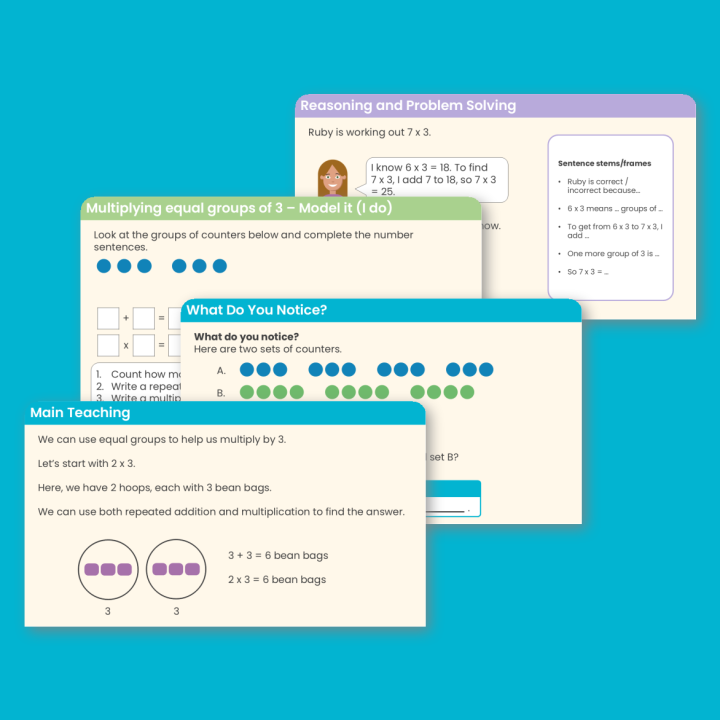
The Year 3 Multiply by 3 PowerPoint guides both teachers and children through the lesson, including use of the varied fluency, reasoning and problem solving, deeper reasoning and scaffolded resources. Key learning information about this step:
Key Vocabulary
multiple: A product of one number multiplied by another number. For example: multiples of 10 are the products of numbers multiplied by 10.
product: The answer of multiplying two or more numbers together. For example: 30 is the product of 6 x 5.
commutative: Calculations which have the same answer no matter what order the numbers are in. Only addition and multiplication are commutative. For example: 2 x 6 = 12 and 6 x 2 = 12 and 5 + 4 = 9 and 4 + 5 = 9.
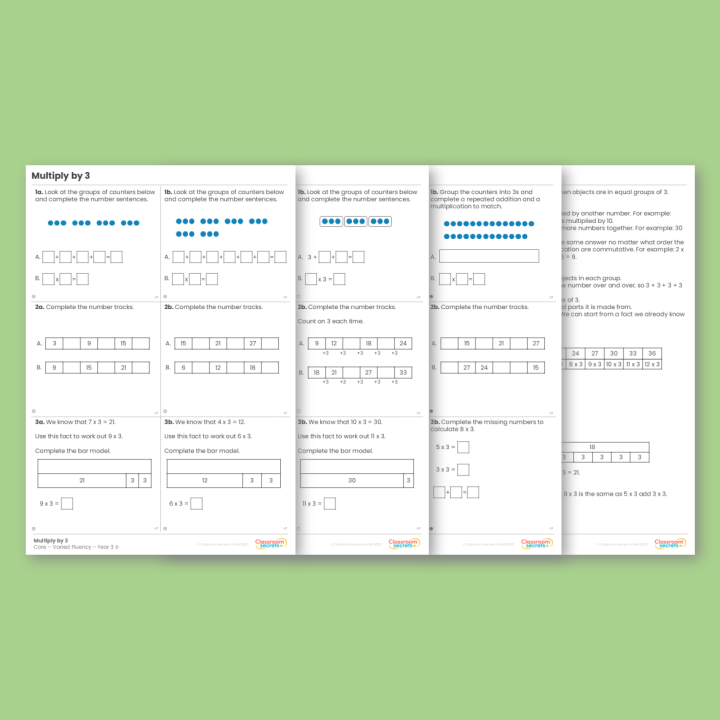
Varied Fluency
Knowledge Organiser
• Designed to support all children via key information and examples.
Scaffolded Examples
• Guided practice completing equal groups of 3 with sentence stems.
Support
• Q1: Count equal groups of 3 that are circled; number sentences partially completed.
• Q2: Complete two number tracks in 3s; two gaps each and +3 jumps given.
• Q3: Add one more group of 3 to a known fact; bar model given.
Core
• Q1: Count equal groups of 3 and complete blank number sentences.
• Q2: Complete two number tracks in 3s; three gaps each and no +3 jumps.
• Q3: Add two more groups of 3 to a known fact; bar model given.
Stretch
• Q1: Ring loose counters into groups of 3; no grouping is shown.
• Q2: Complete two number tracks; the start is missing and track B counts back.
• Q3: Use flexible partitioning to find the answer to a multiplication; no bar model given.
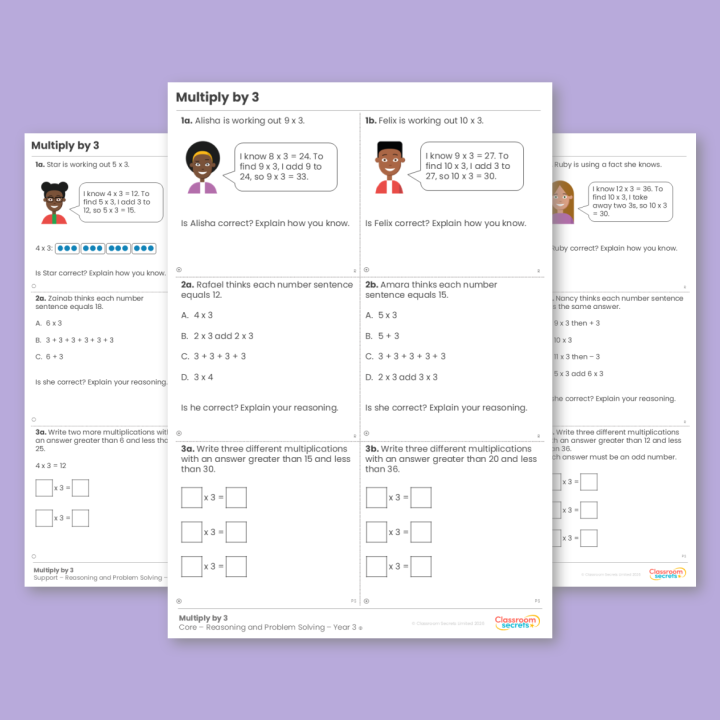
Reasoning and Problem Solving
Support
• Q1: Reasoning – explain whether a character has added one more group of 3 correctly; counters provided.
• Q2: Reasoning – explain whether three calculations give the same answer; answer given.
• Q3: Problem Solving – write multiplications by 3 to fit a given range; one example given.
Core
• Q1: Reasoning – explain whether a character has added one more group of 3 correctly.
• Q2: Reasoning – explain whether four calculations give the same answer; answer given.
• Q3: Problem Solving – write multiplications by 3 to fit a given range.
Stretch
• Q1: Reasoning – explain whether a character has counted on or back by the correct number of 3s; more than one step is needed.
• Q2: Reasoning – explain whether four calculations give the same answer; answer not given.
• Q3: Problem Solving – write multiplications by 3 to fit a range and a second rule about the answer.
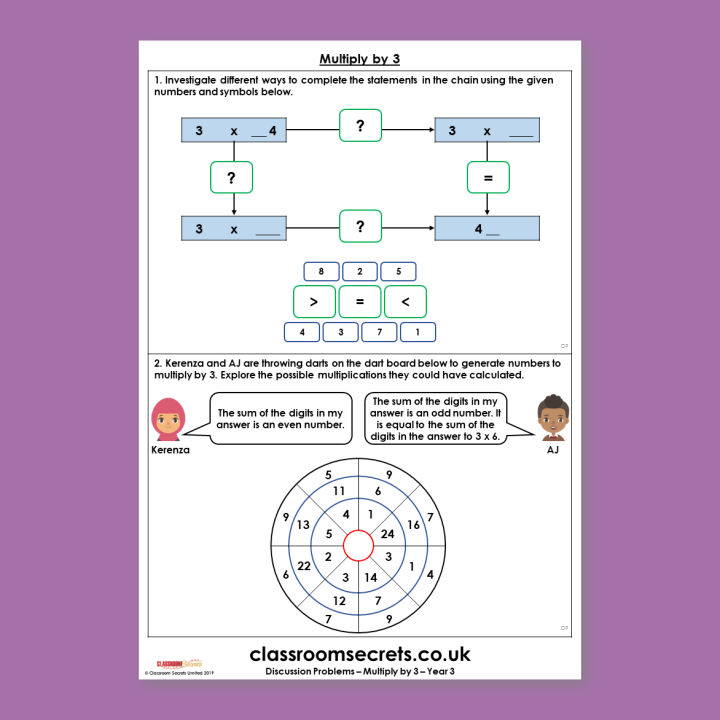
Deeper Reasoning
The questions in this set focus on investigating different ways to complete the statements and exploring the possible numbers scored on a dartboard to deepen understanding in recalling and using multiplication and division facts for the 3, 4 and 8 multiplication tables.