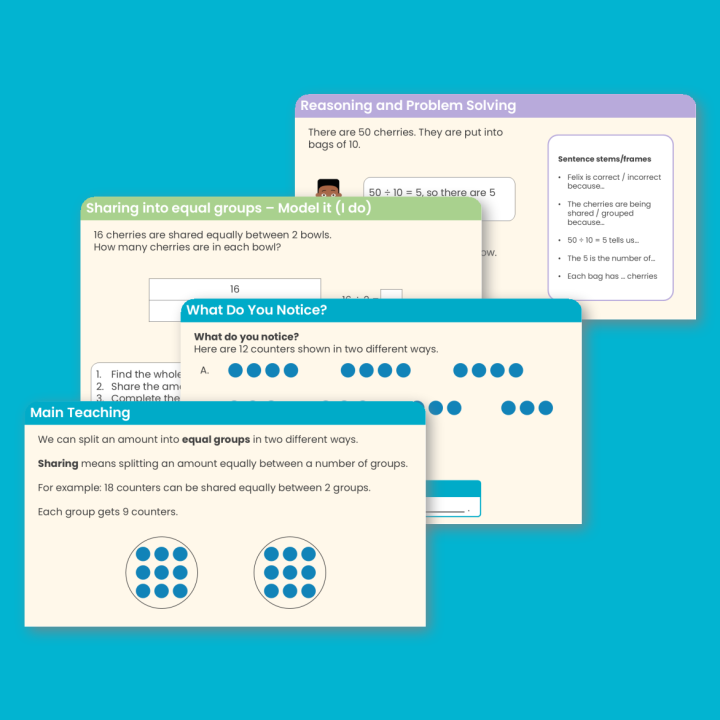
The Year 3 Sharing and Grouping PowerPoint guides both teachers and children through the lesson, including use of the varied fluency, reasoning and problem solving, deeper reasoning and scaffolded resources. Key learning information about this step:
Key Vocabulary
sharing: When a number of objects are shared into equal groups so that each part has the same number of objects in it.
grouping: Taking a known number of objects from the total to find out how many equal groups can be made.
equal groups: Groups that have the same number of objects in each group.
bar models: Show how numbers can be split into different parts, by splitting them into bars or boxes. Bar models can be used to solve a wide variety of calculations, showing the relationship between the whole model and the parts.
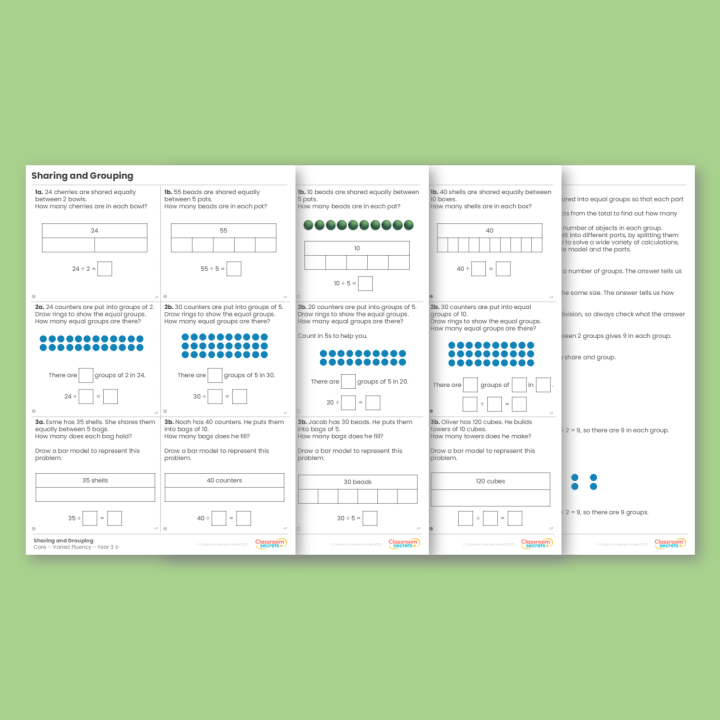
Varied Fluency
Knowledge Organiser
• Designed to support all children via key information and examples.
Scaffolded Examples
• Guided practice sharing equally between groups and finding how many equal groups can be made.
Support
• Q1: Share an amount equally using a bar model and complete the number sentence; pictorial representation provided.
• Q2: Group counters then complete the number sentences; counting prompt given.
• Q3: Complete the bar model and number sentence to solve the word problem; bar model divisions given.
Core
• Q1: Share an amount equally using a bar model and complete the number sentence.
• Q2: Group counters then complete the number sentences.
• Q3: Complete the bar model and number sentence to solve the word problem.
Stretch
• Q1: Share an amount equally using a bar model and complete the number sentence; only the whole is given in the number sentence.
• Q2: Group counters then complete the number sentences; number sentences blank.
• Q3: Complete the bar model and blank number sentence to solve the word problem.
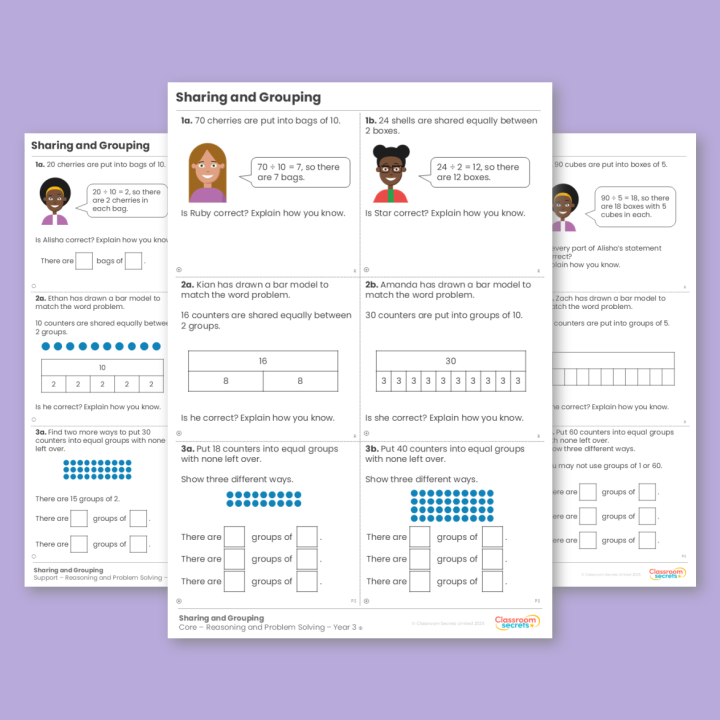
Reasoning and Problem Solving
Support
• Q1: Reasoning – explain whether a character has read a division answer correctly; the statement makes one claim, so it is either right or wrong; sentence stem provided.
• Q2: Reasoning – identify if the bar model matches the word problem; counters provided.
• Q3: Problem Solving – complete sentences to show two equal groupings of an amount; one example given; pictorial support provided.
Core
• Q1: Reasoning – explain whether a character has read a division answer correctly; the statement makes one claim, so it is either right or wrong.
• Q2: Reasoning – identify if the bar model matches the word problem.
• Q3: Problem Solving – complete sentences to show three equal groupings of an amount; pictorial support provided.
Stretch
• Q1: Reasoning – explain whether a character has read a division answer correctly; the statement makes several claims, so each part must be judged separately and may be partly right.
• Q2: Reasoning – identify if the bar model matches the word problem; bar model blank.
• Q3: Problem Solving – complete sentences to show three equal groupings of an amount; no pictorial support.
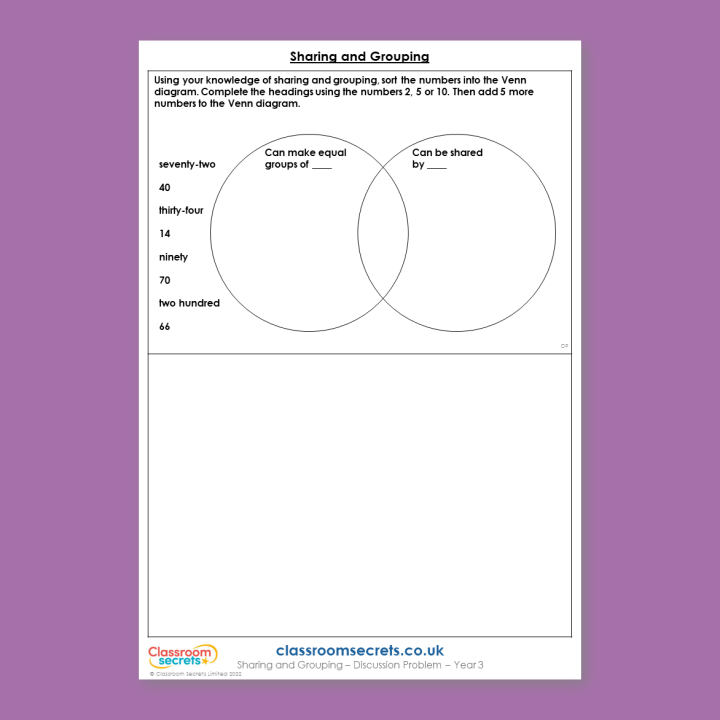
Deeper Reasoning
The question in this set focuses on using sorting numbers into a Venn diagram to deepen understanding in writing and calculating mathematical statements for multiplication and division using the multiplication tables that they know, including for two-digit numbers times one-digit numbers, using mental and progressing to formal written methods.