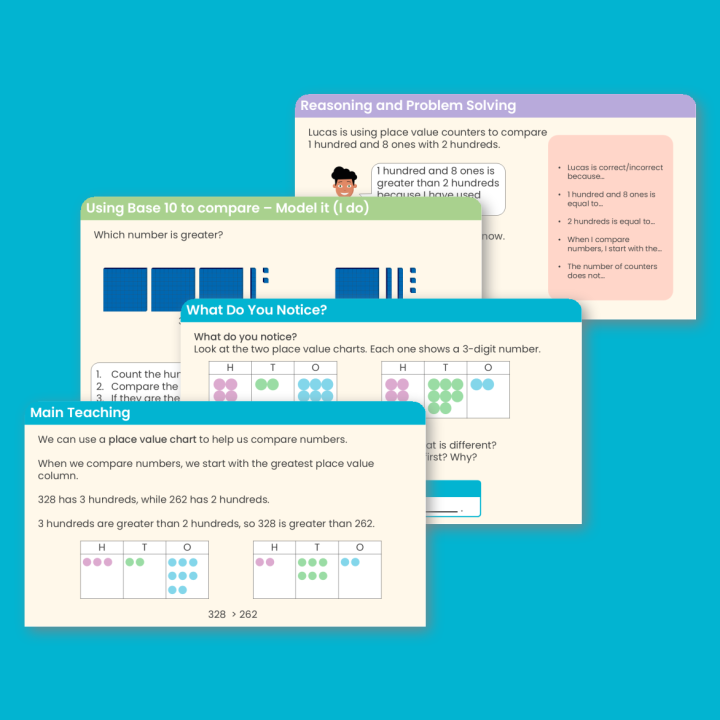
The Year 3 Compare Numbers to 1,000 PowerPoint guides both teachers and children through the lesson, including use of the varied fluency, reasoning and problem solving, deeper reasoning and scaffolded resources. Key learning information about this step:
Key Vocabulary
compare: To look at two or more numbers or amounts to decide which is greater, which is less, or whether they are equal.
> < = : Comparison symbols used to represent greater than (>),
less than (<) and equal to (=).
place value chart: Used to identify the value of the digits that make up a number.
place value counters: A physical resource which represents numbers. They are usually in different colours and have different numbers written on them, to represent 'ones', 'tens', 'hundreds' etc.
Varied Fluency
Knowledge Organiser
• Designed to support all children via key information and examples.
Scaffolded Examples
Guided practice comparing 122 and 311 in Base 10.
Support
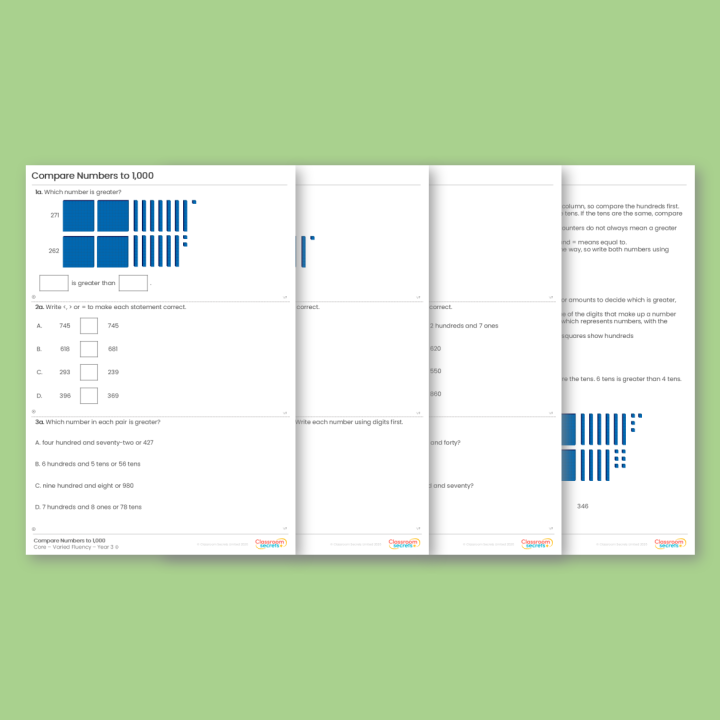
• Q1: Compare two numbers shown in Base 10; hundreds counted first.
• Q2: Complete statements using <, > or =; compare numbers written in digits.
• Q3: Compare pairs written in words or digits.
Core
• Q1: Compare two numbers shown in Base 10, same hundreds, different tens.
• Q2: Complete statements using <, > or =; some digits match.
• Q3: Compare pairs written in words or place value parts.
Stretch
• Q1: Compare two numbers in Base 10; same hundreds and tens.
• Q2: Complete statements; numbers written in different forms.
• Q3: Compare pairs using flexible partitioning.
Reasoning and Problem Solving
Support
• Q1: Reasoning - explain whether a comparison is correct; both numbers given in digits.
• Q2: Reasoning - explain whether a comparison is correct by comparing digits in place value order.
• Q3: Problem Solving - find three numbers between two given numbers.
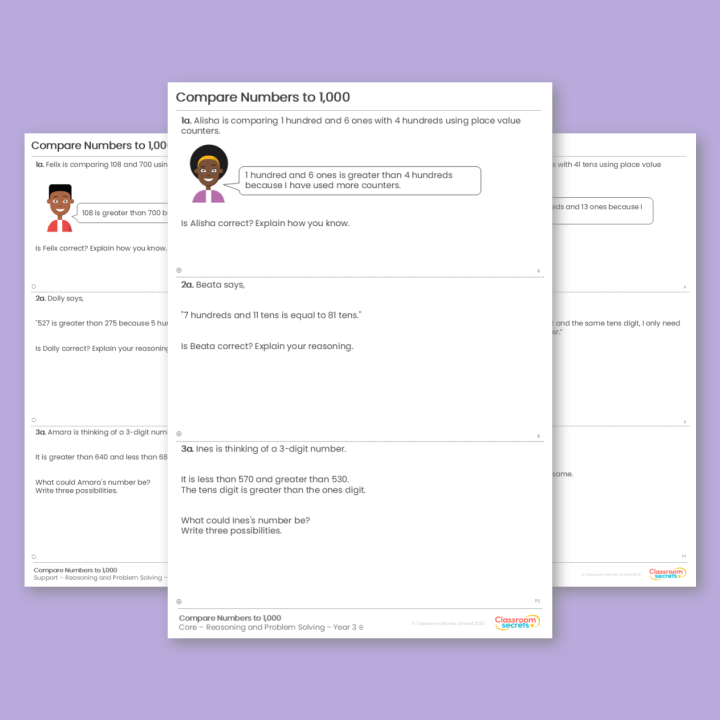
Core
• Q1: Reasoning - explain whether a comparison is correct; numbers given as hundreds, tens and ones.
• Q2: Reasoning - explain whether a comparison between numbers written using place value units is correct.
• Q3: Problem Solving - find three numbers between two given numbers; one digit condition.
Stretch
Q1: Reasoning - explain whether a comparison is correct; numbers use flexible partitioning.
Q2: Reasoning - explain whether a statement about comparing flexibly partitioned numbers is correct.
Q3: Problem Solving - find three numbers in a given range using non-standard place-value forms, with one digit condition.
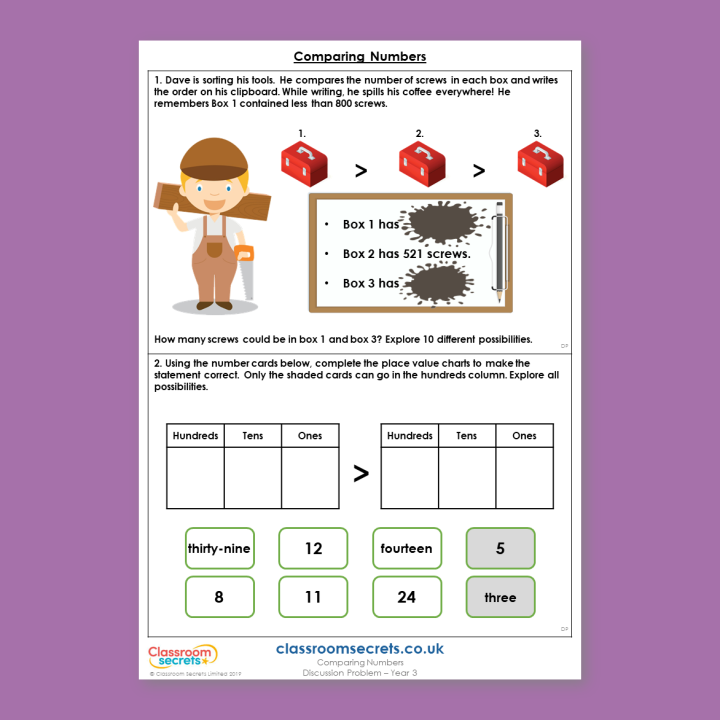
Deeper Reasoning
The questions in this set focus on problem solving with the inequality symbols and digit cards to deepen understanding in comparing and ordering numbers up to 1,000.