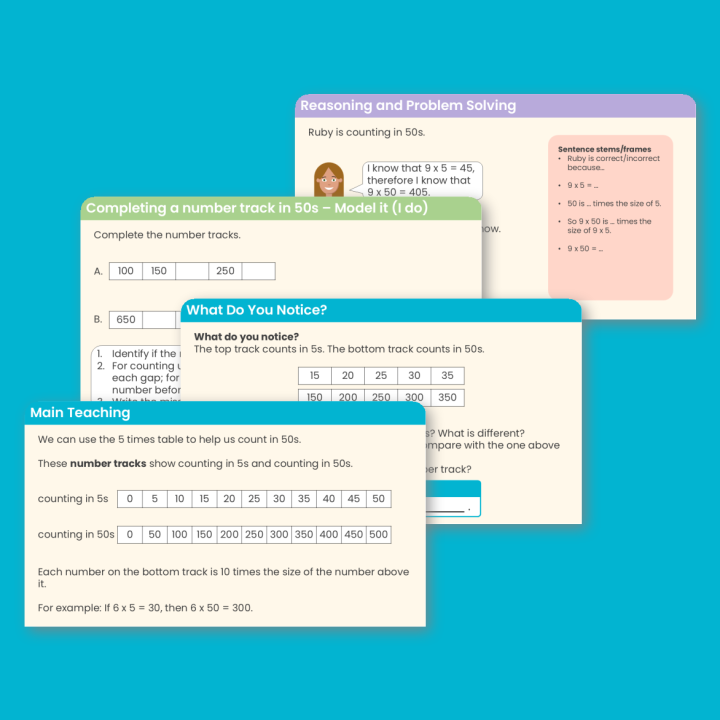
The Year 3 Count in 50s PowerPoint guides both teachers and children through the lesson, including use of the varied fluency, reasoning and problem solving, deeper reasoning and scaffolded resources. Key learning information about this step:
Key Vocabulary
multiple: A product of one number multiplied by another number. For example: multiples of 10 are the products of numbers multiplied by 10.
sequence: A series of numbers or images that follow a set pattern. For example: numbers may increase by 2 each time.
number tracks: A representation of the order of numbers when counting. It can go forwards or backwards. It is similar to a number line, but numbers can go up or down in jumps of 1s, 2s, 3s, etc.
number lines: A horizontal or vertical line which has numbers placed at equal points. Number lines can be used to show either positive or negative numbers. Most number lines begin at 0.
Varied Fluency
Knowledge Organiser
• Designed to support all children via key information and examples.
Scaffolded Examples
• Guided practice completing a number track that counts forwards and backwards in 50s; completing a number line; finding the total amount from groups of 50s.
Support
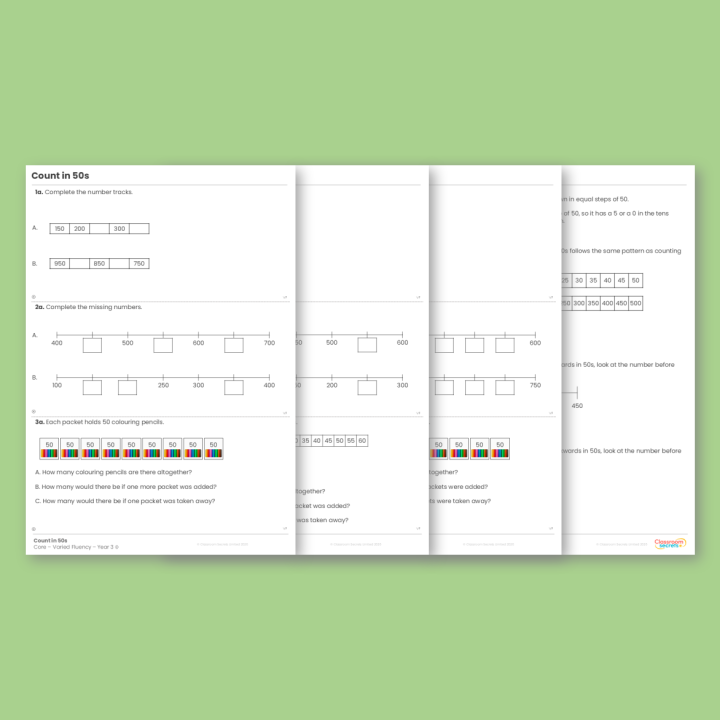
• Q1: Two number tracks counting forwards and backwards in 50s; one number missing on each.
• Q2: Two number lines in 50s; two numbers missing on each.
• Q3: Finding the total amount and then one more and one less; 5 times table provided.
Core
• Q1: Two number tracks counting forwards and backwards in 50s; two numbers missing on each.
• Q2: Two number lines in 50s; three numbers missing on each.
• Q3: Finding the total amount and then one more and one less.
Stretch
• Q1: Two number tracks counting forwards and backwards in 50s; three numbers missing on each.
• Q2: Two number lines in 50s; only the end numbers labelled.
• Q3: Finding the total amount and then two more and three less.
Reasoning and Problem Solving
Support
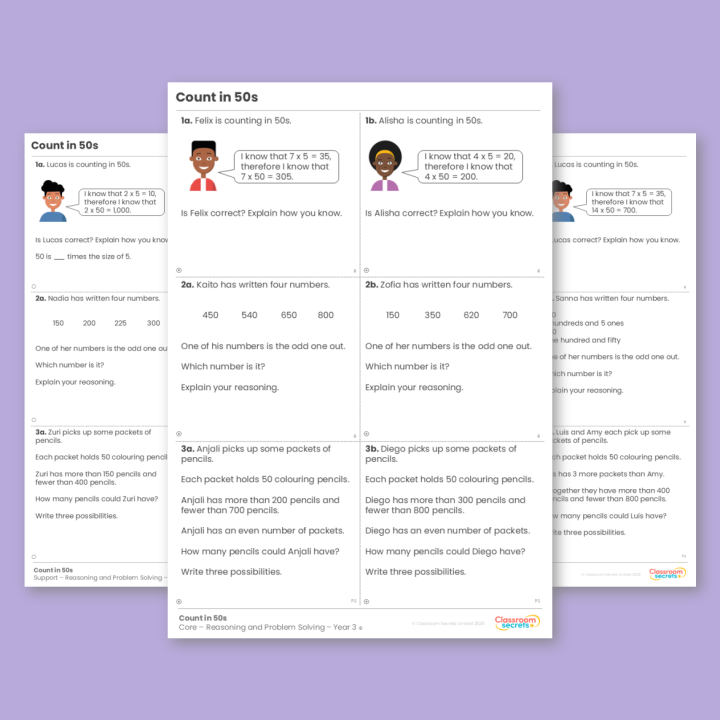
• Q1: Reasoning - explain whether scaling a 5 times table fact to 50 is correct; a sentence stem is given.
• Q2: Reasoning - find the odd one out and explain; numbers form a counting sequence.
• Q3: Problem Solving - find possible pencil totals from packets of 50 within a range.
Core
• Q1: Reasoning - explain whether scaling a 5 times table fact to 50 is correct.
• Q2: Reasoning - find the odd one out and explain.
• Q3: Problem Solving - find pencil totals from an even number of packets of 50.
Stretch
• Q1: Reasoning - explain a scaling fact that also requires doubling.
• Q2: Reasoning - find the odd one out and explain; numbers written as numerals and in words.
• Q3: Problem Solving - find one child's pencil total from packets of 50; one child has more packets than the other and their combined total is within a range.
Deeper Reasoning
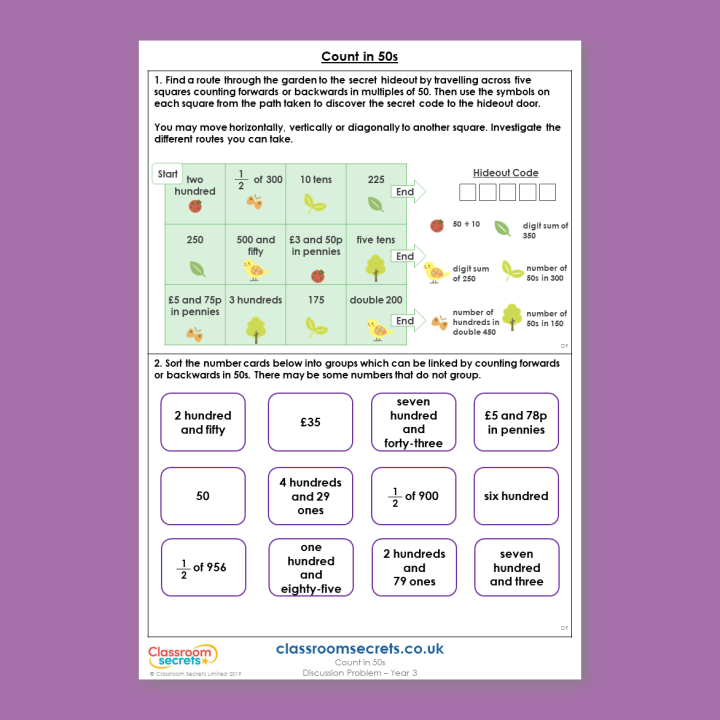
The questions in this set focus on finding a route through a garden to a secret hideout and sorting the number cards that can be linked by counting forwards and backwards in 50s to deepen understanding in counting from 0 in multiples of 50.