The Year 3 Hundreds, Tens and Ones PowerPoint guides both teachers and children through the lesson, including use of the varied fluency, reasoning and problem solving, deeper reasoning and scaffolded resources. Key learning information about this step:
Key Vocabulary
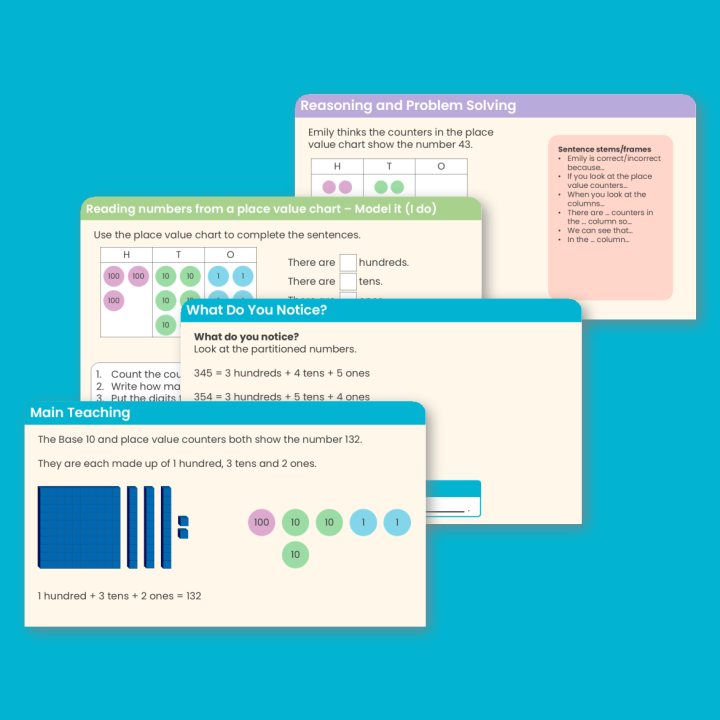
place value chart: Used to identify the value of the digits that make up a number.
place value counters: A physical resource which represent numbers. They are usually in different colours and have different numbers written on them, to represent ‘ones’, ‘tens’, ‘hundreds’ etc.
Base 10: A physical resource which represents numbers. The small cubes represent ‘ones’; the rods represent ‘tens’ and are made up of 10 small cubes; the squares represent ‘hundreds’ and are made up of 10 rods.
placeholder: 0 is used to hold a place in a number and maintain its place value.
Varied Fluency
Knowledge Organiser
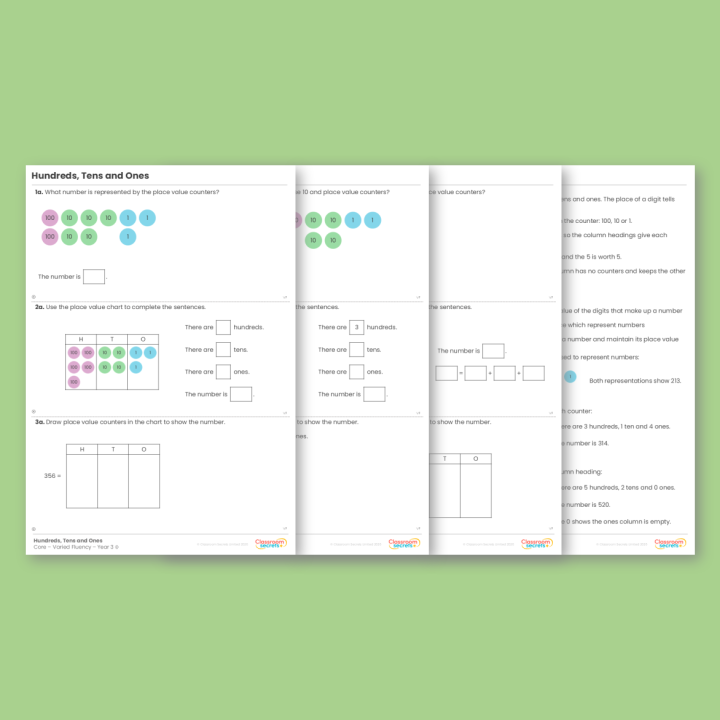
• Designed to support all children via key information and examples.
Scaffolded Examples
• Guided practice in three steps: counting the counters in each column, writing the hundreds, tens and ones, then making the number.
Support
• Q1: Write the number represented by both Base 10 and place value counters; Base 10 and counters grouped by type.
• Q2: Read a chart with place value counters; hundreds given.
• Q3: Draw place value counters for a number; sentence stem given.
Core
• Q1: Write the number represented by place value counters; counters grouped by type.
• Q2: Read a chart with place value counters; all digits and some use of a placeholder.
• Q3: Draw place value counters for a number; all digits and some use of a placeholder.
Stretch
• Q1: Write the number represented by place value counters; counters not grouped by type.
• Q2: Read a chart with place value counters; some use of a placeholder; identify number and partition.
• Q3: Draw place value counters for a number given in words; some use of a placeholder.
Reasoning and Problem Solving
Support
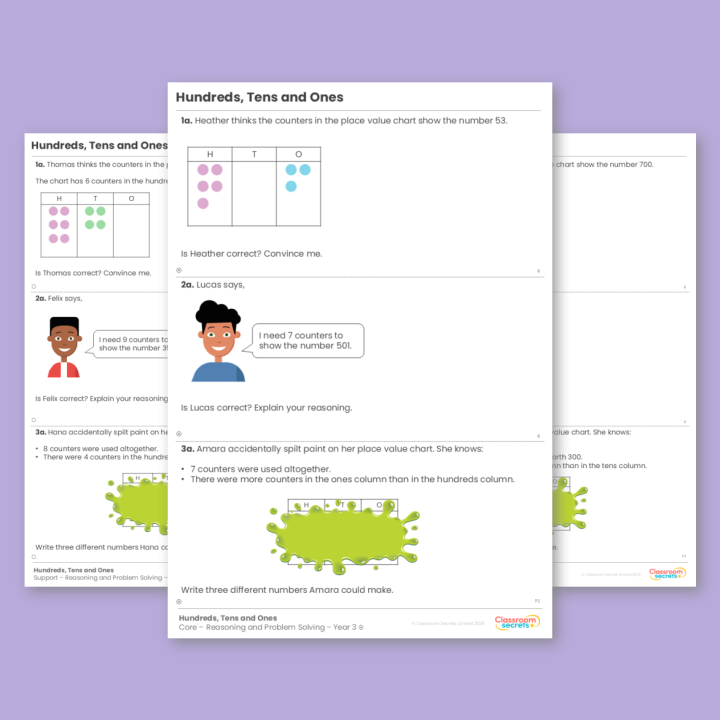
• Q1: Reasoning - explain whether a number read from a place value chart of plain counters is correct; placeholder in the ones; scaffold identifies the number of counters in the hundred and tens columns.
• Q2: Reasoning - explain whether the number of counters needed to show a 3-digit number is correct; one placeholder in the ones; place value chart provided.
• Q3: Problem Solving - work out three numbers that could be hidden; total number of counters and the hundreds digit given.
Core
• Q1: Reasoning - explain whether a number read from a place value chart of plain counters is correct; placeholder in the tens/ones.
• Q2: Reasoning - explain whether the number of counters needed to show a 3-digit number is correct; placeholder in tens/ones.
• Q3: Problem Solving - work out three numbers that could be hidden; total number of counters and a comparison between two columns.
Stretch
• Q1: Reasoning - explain whether a number read from a place value chart of plain counters is correct; placeholder in ones; exchange 10 tens for 1 hundred.
• Q2: Reasoning - explain whether two numbers made of the same digits need the same number of counters; placeholder in tens and ones
• Q3: Problem Solving - work out three numbers that could be hidden; total number of counters, the value of one column and a comparison between two columns.
Deeper Reasoning
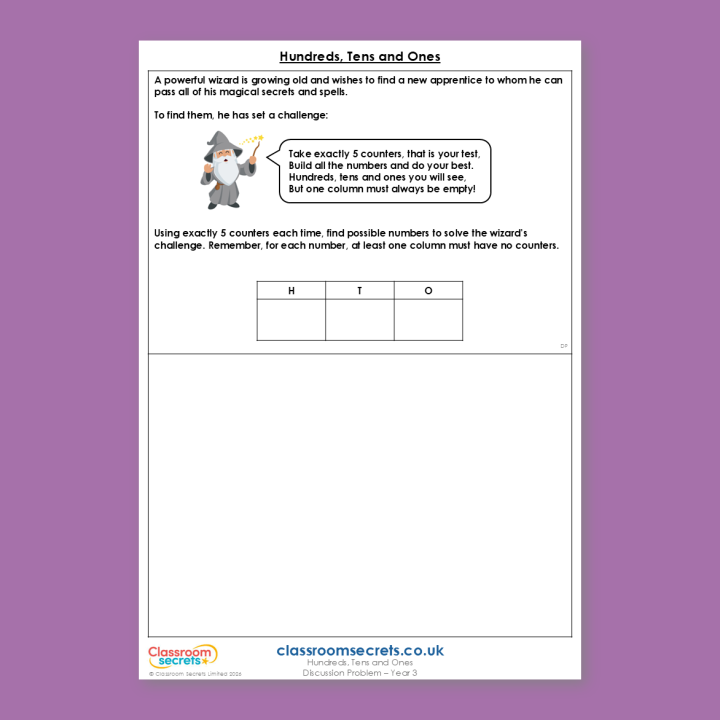
The question in this set focuses on using the given clues to identify the possible numbers in the place value chart to deepen understanding in reading and writing numbers up to 1000.