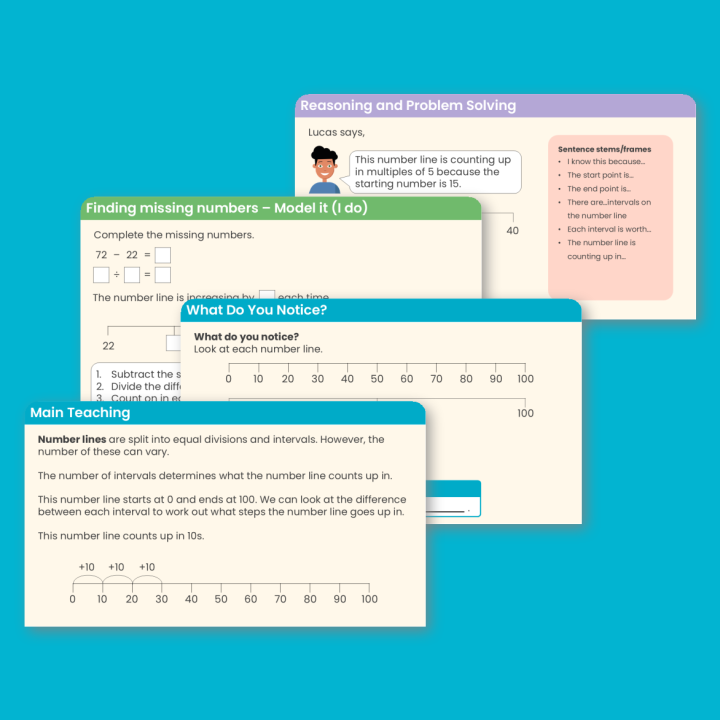
The Year 3 Number Line to 100 PowerPoint guides both teachers and children through the lesson, including use of the varied fluency, reasoning and problem solving, deeper reasoning and scaffolded resources. Key learning information about this step:
Key Vocabulary
number line: A horizontal or vertical line which has numbers placed at equal points. Number lines can be used to show either positive or negative numbers. Most number lines begin at 0, however this is not always the case.
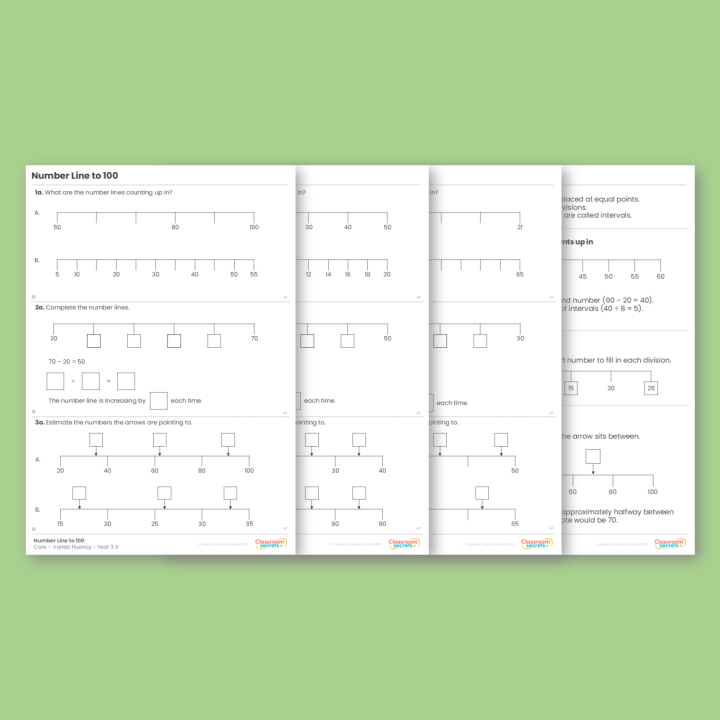
Varied Fluency
Knowledge Organiser
• Designed to support all children via key information and examples.
Scaffolded Examples
• Guided practice in finding the step on a number line, then using it to complete missing numbers. Sentence stems and part-completed steps break each question into single steps.
Support
• Q1: Identify the intervals; every division labelled; number lines start from 0.
• Q2: Complete the number lines; start from 0; counting in 10s and 5s; subtraction and division calculation given.
• Q3: Estimate three numbers; all five divisions labelled; identify halfway numbers.
Core
• Q1: Identify the intervals; some divisions unlabelled; do not start from 0.
• Q2: Complete the number lines; do not start from 0; counting in 10s and 5s; subtraction calculation given.
• Q3: Estimate three numbers; all five divisions labelled.
Stretch
• Q1: Identify the intervals; only the start and end numbers given.
• Q2: Complete the number lines; do not start from 0; counting in 5s and 2s; no calculations given.
• Q3: Estimate three numbers; only three of the five divisions labelled.
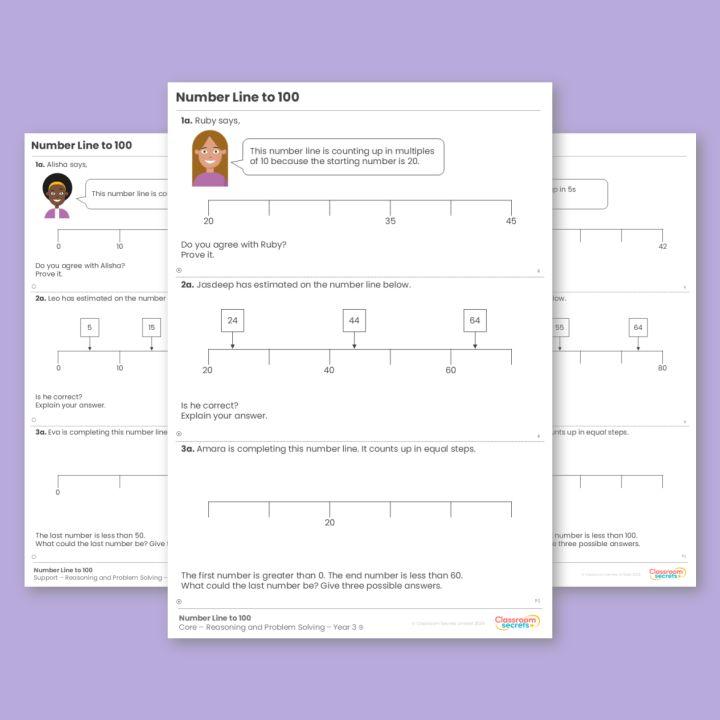
Reasoning and Problem Solving
Support
• Q1: Agree or disagree with a statement about the step size; lines start from 0.
• Q2: Check three estimates; every division is labelled.
• Q3: Find possible end numbers; the start number is given.
Core
• Q1: Agree or disagree with a statement about the step size; lines do not start from 0.
• Q2: Check three estimates; alternate divisions are labelled.
• Q3: Find possible end or start numbers; one division given.
Stretch
• Q1: Agree or disagree with a statement about the step size; six intervals; only the start and end numbers given.
• Q2: Check three estimates; three of the seven divisions are labelled.
• Q3: Find possible start and end numbers; one division given.
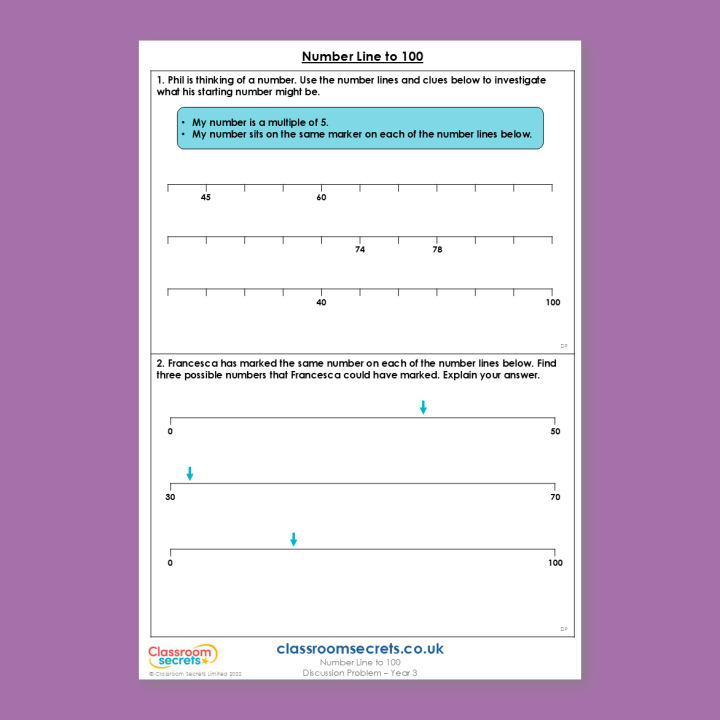
Deeper Reasoning
The questions in this set focus on investigating the possible missing numbers on different number lines to deepen understanding in identifying, representing and estimating numbers using different representations.