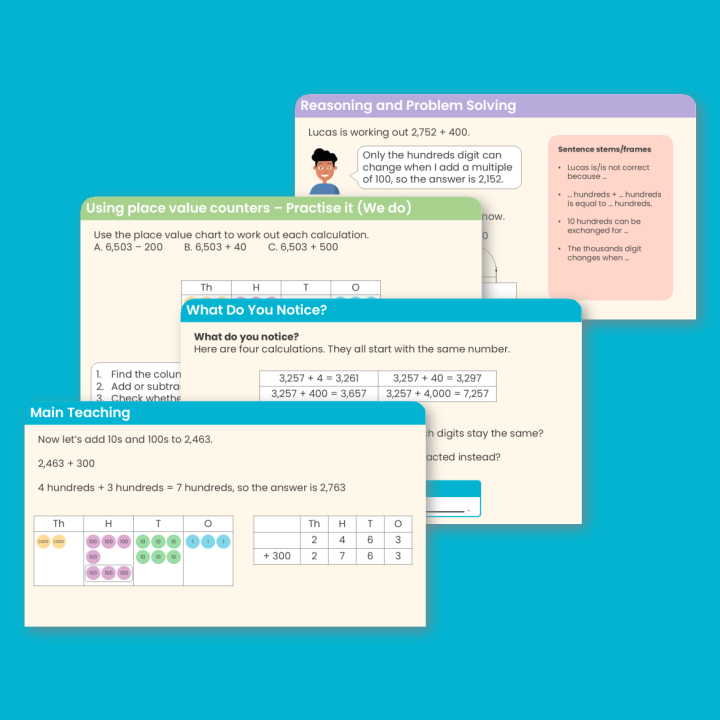
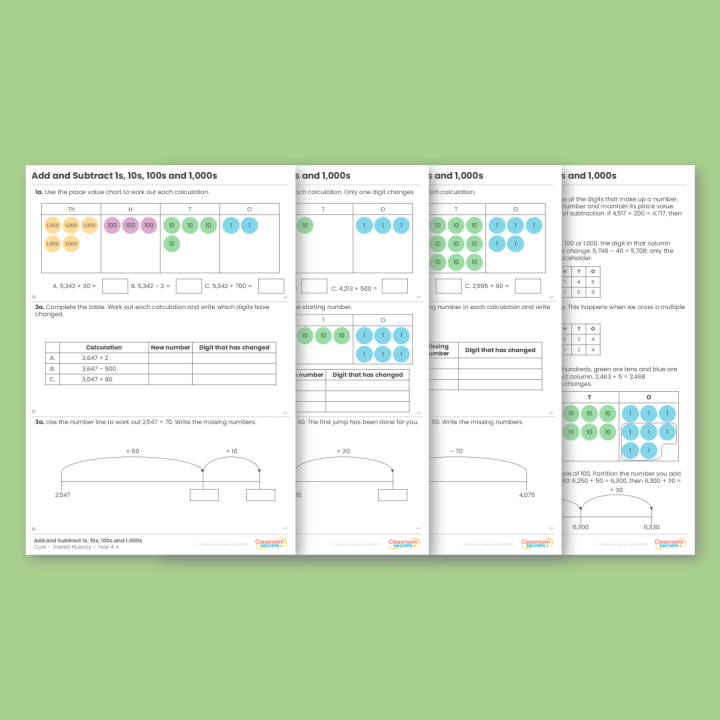
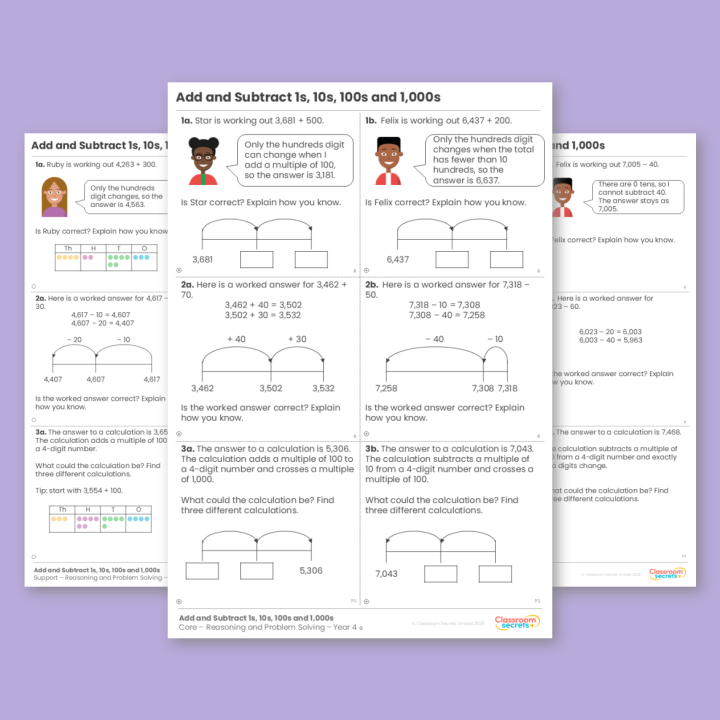
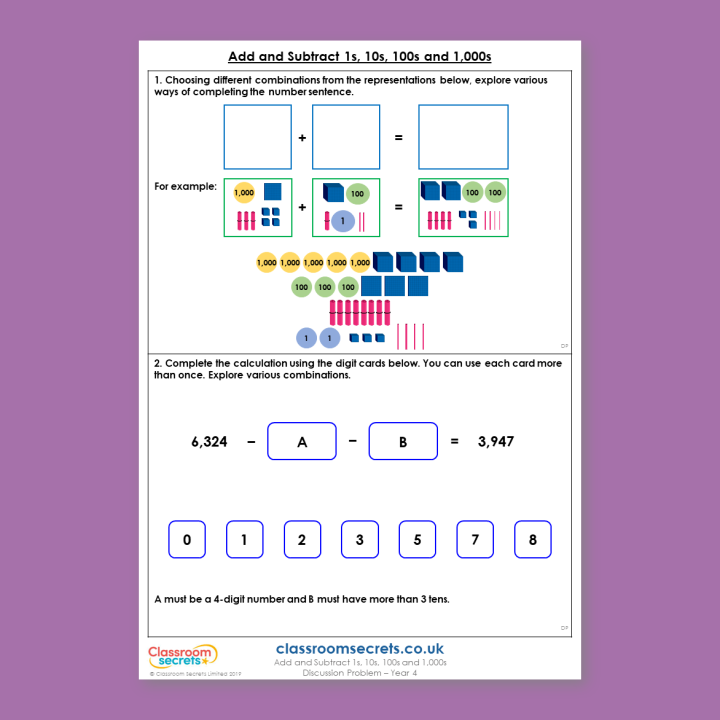
The Year 4 Add and Subtract 1s, 10s, 100s and 1,000s PowerPoint guides both teachers and children through the lesson, including use of the varied fluency, reasoning and problem solving, deeper reasoning and scaffolded resources. Key learning information about this step:
Key Vocabulary
place value chart: Used to identify the value of the digits that make up a number.
placeholder: 0 is used to hold a place in a number and maintain its place value.
exchange: When a digit is taken from one place value column and placed in another.
inverse operations: Used to check working out or to find a starting number by using the opposite operation. Addition is the inverse of subtraction and vice versa. Multiplication is the inverse of division and vice versa.
Varied Fluency
Knowledge Organiser
• Designed to support all children via key information and examples.
Scaffolded Examples
• Using place value counters and sentence stems to add and subtract 1s, 10s, 100s and 1,000s; completing a table, with an example, for spotting which digit changes.
Support
• Q1: Complete 3 calculations from a place value chart; only one digit changes.
• Q2: Complete a table to work out each calculation, with place value counters showing the starting number.
• Q3: Use a number line with the first jump completed.
Core
• Q1: Complete 3 calculations from a place value chart; one crosses a multiple.
• Q2: Complete a table with a calculation and name the digits that change.
• Q3: Use a number line with two jumps and two missing numbers.
Stretch
• Q1: Complete 3 calculations from a place value chart, each crossing a multiple.
• Q2: Complete a table by finding missing numbers and naming the digits that change.
• Q3: Use a number line that crosses a multiple of 1,000.
Reasoning and Problem Solving
Support
• Q1: Reasoning - judging whether a character has added a multiple of 100 correctly; place value counters show the starting number.
• Q2: Reasoning - spotting the error in a two-step worked answer, shown on a number line.
• Q3: Problem Solving - finding calculations that give a set answer, with a tip and place value counters.
Core
• Q1: Reasoning - judging whether a character has added a multiple of 100 correctly, with a number line provided for support.
• Q2: Reasoning - spotting the error in a two-step worked answer that crosses a multiple of 100 with a number line provided for support.
• Q3: Problem Solving - finding calculations that give a set answer and cross a multiple of 100 or 1,000, with a number line provided for support.
Stretch
• Q1: Reasoning - judging a claim where more than one digit changes.
• Q2: Reasoning - spotting the error in a two-step worked answer that crosses a multiple of 1,000.
• Q3: Problem Solving - finding calculations that give a set answer where exactly two digits change.
Deeper Reasoning
The questions in this set focus on problem solving with addition and subtraction to deepen understanding in adding and subtracting numbers with up to four digits using the formal written methods of columnar addition and subtraction where appropriate, and solving addition and subtraction two-step problems in contexts, deciding which operations and methods to use and why.