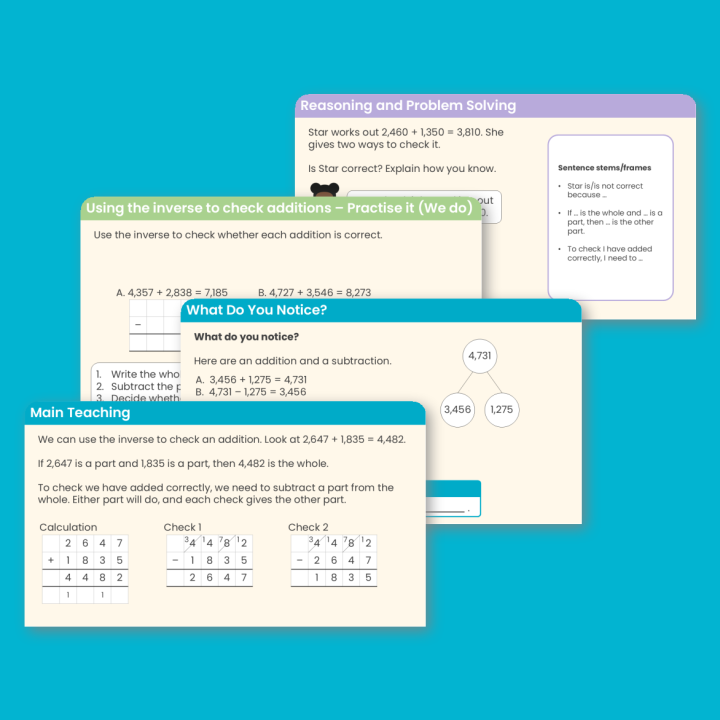
The Year 4 Checking Strategies PowerPoint guides both teachers and children through the lesson, including use of the varied fluency, reasoning and problem solving, deeper reasoning and scaffolded resources. Key learning information about this step:
Key Vocabulary
inverse operations: Used to check working out or to find a starting number by using the opposite operation. Addition is the inverse of subtraction and vice versa. Multiplication is the inverse of division and vice versa.
related facts: Also known as fact families, these are a group of four calculations that are created using the same three numbers, for example 2 + 5 = 7, 5 + 2 = 7, 7 – 2 = 5, 7 – 5 = 2. This can also be used to identify derived facts, for example 20 + 50 = 70.
part-whole model: A representation showing the whole number and the parts it has been split into.
Varied Fluency
Knowledge Organiser
• Designed to support all children via key information and examples.
Scaffolded Examples
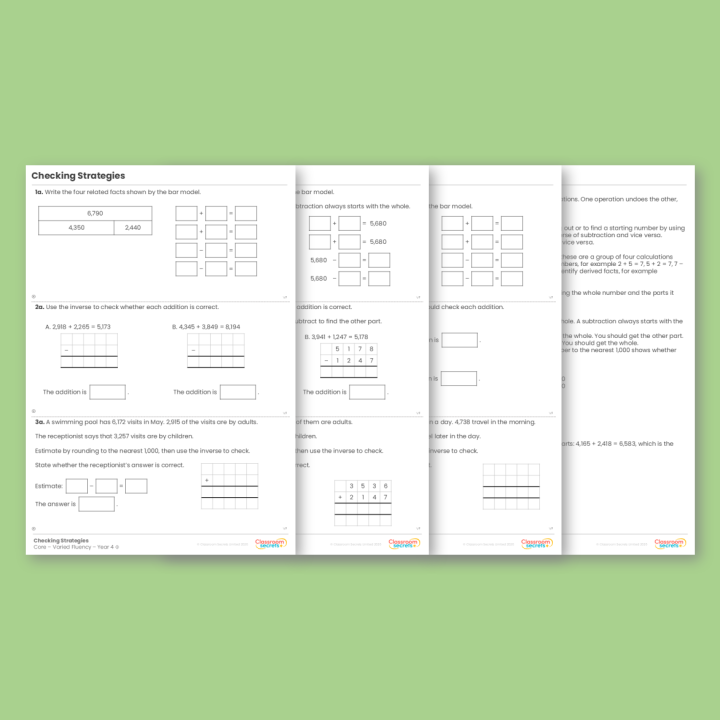
• Finding the whole and parts in a bar model, then writing the related facts.
Support
• Q1: Write the related facts from a bar model; the whole is given in each fact.
• Q2: Check two additions with the inverse; grid numbers given; one exchange.
• Q3: Estimate, then check a subtraction in context; one rounded number given.
Core
• Q1: Write the four related facts shown by a complete bar model.
• Q2: Check two additions with the inverse; set out each grid; two exchanges.
• Q3: Estimate, then use the inverse to check a subtraction in context.
Stretch
• Q1: Find a missing part of a bar model, then write its four related facts.
• Q2: Check two additions with two inverse calculations; exchange across a zero; no grid provided.
• Q3: Estimate, then check a subtraction in context; no operation provided.
Reasoning and Problem Solving
Support
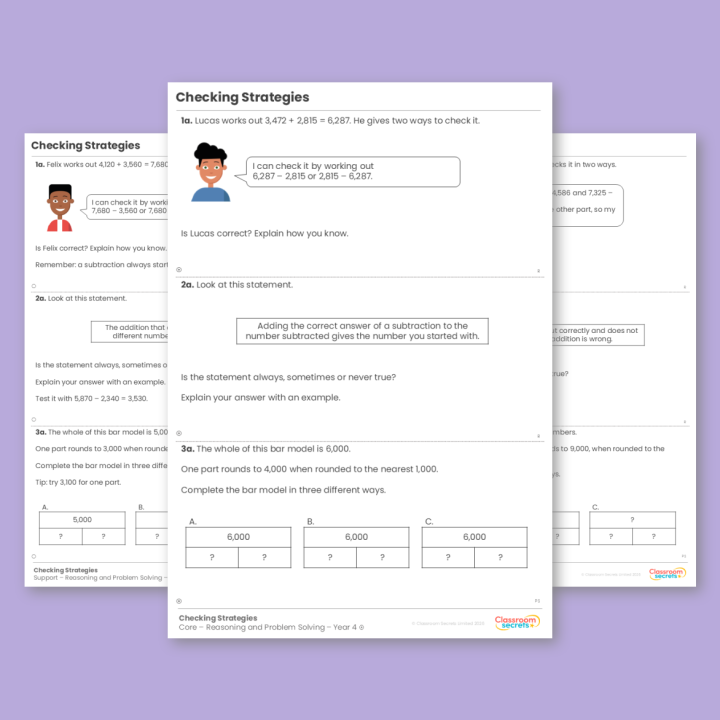
• Q1: Reasoning – explain whether a character’s two checks are correct; no exchanges and a reminder.
• Q2: Reasoning – decide if a statement is always, sometimes or never true; an example to test.
• Q3: Problem Solving – complete a bar model where one part rounds to a given 1,000; a tip is given.
Core
• Q1: Reasoning – explain whether a character’s two inverse checks for an addition are correct.
• Q2: Reasoning – decide if a statement about checking is always, sometimes or never true.
• Q3: Problem Solving – complete a bar model three ways where one part rounds to a given 1,000.
Stretch
• Q1: Reasoning – check a character’s two worked inverse checks; find and correct any mistake.
• Q2: Reasoning – decide if a statement is always, sometimes or never true; prove it with two examples.
• Q3: Problem Solving – complete a bar model with an unknown whole; parts and whole meet rounding rules.
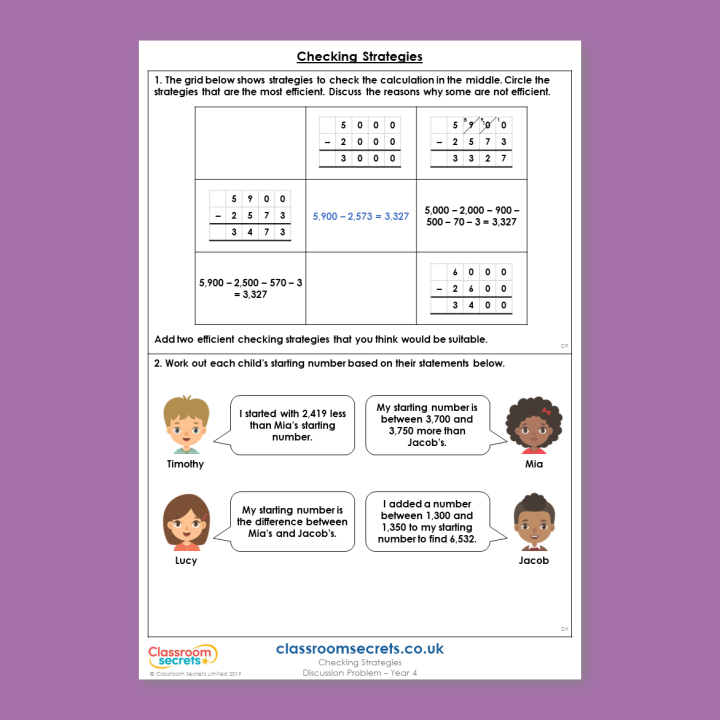
Deeper Reasoning
The questions in this set focus on problem solving with addition and subtraction to deepen understanding in estimating and using inverse operations to check answers to a calculation.