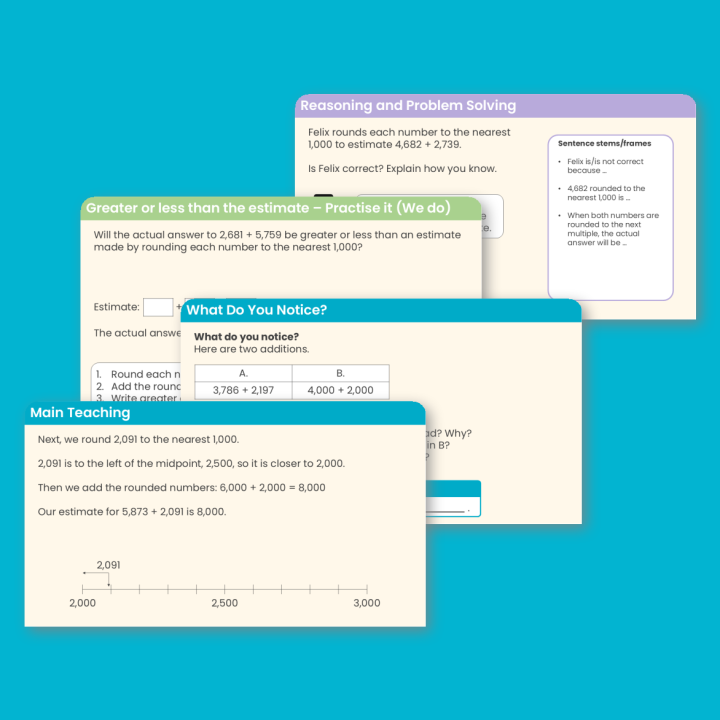
The Year 4 Estimate Answers PowerPoint guides both teachers and children through the lesson, including use of the varied fluency, reasoning and problem solving, deeper reasoning and scaffolded resources. Key learning information about this step:
Key Vocabulary
representation: A number that has been shown in different ways. For example, in numerals, words or using equipment such as Base 10 or a place value chart.
Base 10: A physical resource which represents numbers. The small cubes represent ‘ones’; the rods represent ‘tens’ and are made up of 10 small cubes; the squares represent ‘hundreds’ and are made up of 10 rods; the large cubes represent ‘thousands’ and are made up of 10 squares.
placeholder: 0 is used to hold a place in a number and maintain its place value.
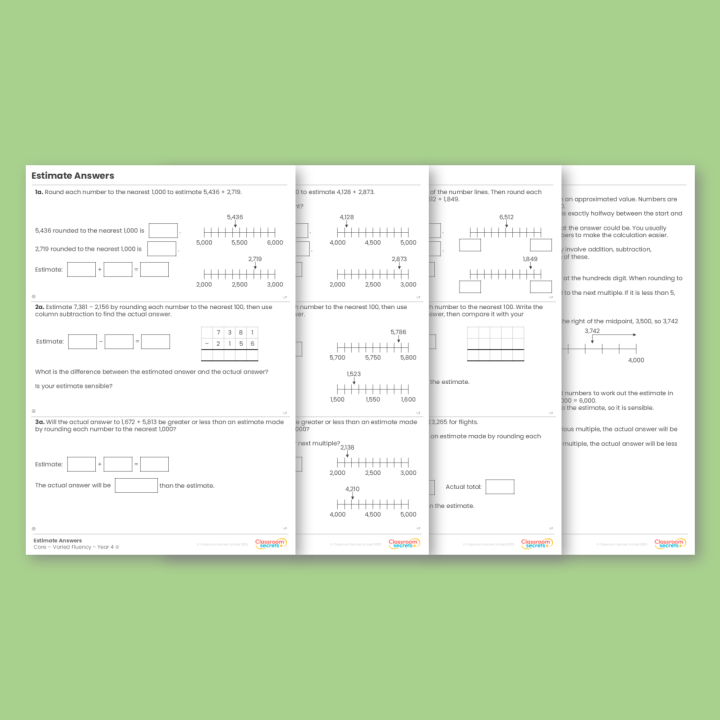
Varied Fluency
Knowledge Organiser
• Designed to support all children via key information and examples.
Scaffolded Examples
• Rounding to the nearest 1,000 and 100 with number lines and sentence stems, then estimating.
Support
• Q1: Round to the nearest 1,000 to estimate; number lines and a midpoint hint.
• Q2: Round to the nearest 100 using number lines, then subtract; no exchanges.
• Q3: Decide if the answer is greater or less than the estimate; number lines given.
Core
• Q1: Round to the nearest 1,000 to estimate an addition; number lines given.
• Q2: Round to the nearest 100 to estimate, subtract, then judge whether the estimate is sensible.
• Q3: Decide if the answer is greater or less than an estimate to the nearest 1,000.
Stretch
• Q1: Label the multiples on each number line, then round to estimate.
• Q2: Estimate to the nearest 100, set out the grid and compare the answers.
• Q3: Decide if a money total is greater or less than an estimate to the nearest £100.
Reasoning and Problem Solving
Support
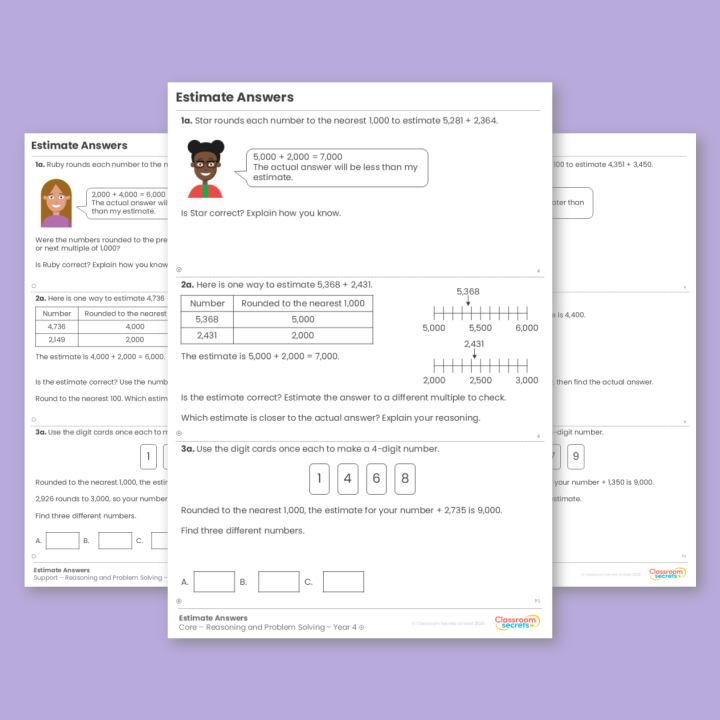
• Q1: Reasoning - explain whether a character is right about an estimate; number lines are given.
• Q2: Reasoning - check an estimate, then round to the nearest 100; number lines and a hint are given.
• Q3: Problem Solving - arrange four digits to make a given estimate; the rounded value is given.
Core
• Q1: Reasoning - explain whether a character is right about an estimate to the nearest 1,000.
• Q2: Reasoning - check an estimate with number lines, then estimate the answer to a different multiple.
• Q3: Problem Solving - arrange four digits so an addition or subtraction has a given estimate.
Stretch
• Q1: Reasoning - explain whether a character is right about an estimate to the nearest 100.
• Q2: Reasoning – check an estimate to the nearest 100, find another way and the actual answer.
• Q3: Problem Solving - arrange four digits to fit an estimate and a greater or less condition.
Deeper Reasoning
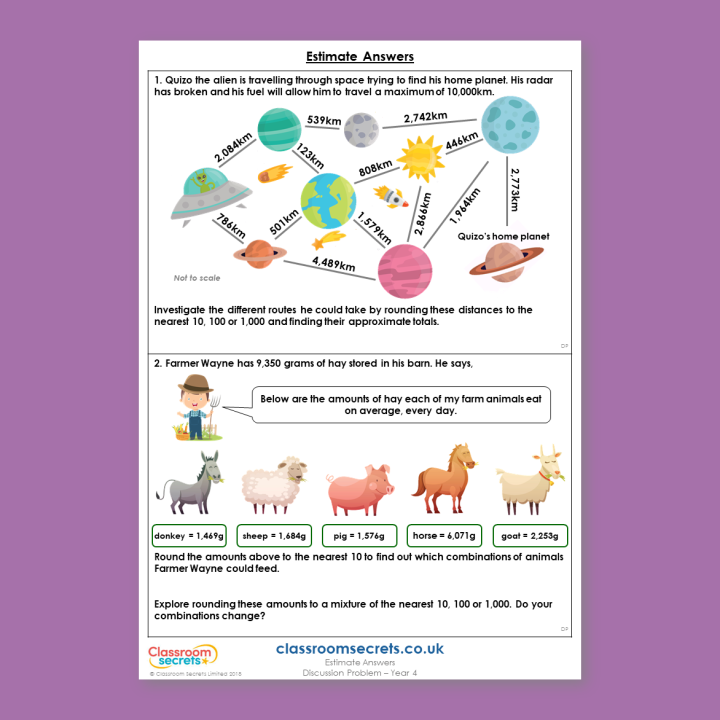
The questions in this set focus on problem solving with estimation to deepen understanding in estimating and using inverse operations to check answers to a calculation.