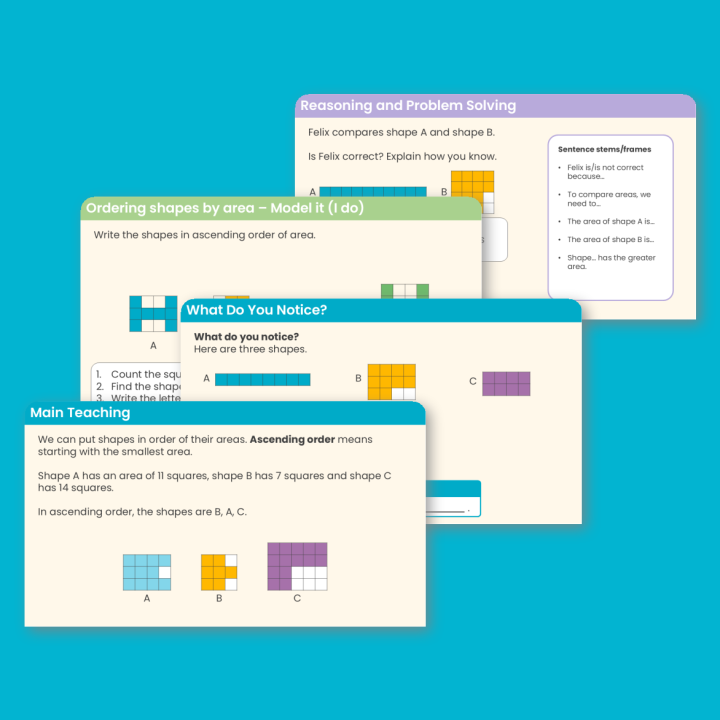
The Year 4 Compare Areas PowerPoint guides both teachers and children through the lesson, including use of the varied fluency, reasoning and problem solving, deeper reasoning and scaffolded resources. Key learning information about this step:
Key Vocabulary
area: The measurement of the surface of a 2D shape. It is measured in unit squares such as centimetre squared (cm²).
rectilinear shapes: A polygon where all lines meet at right angles.
ascending order: When values or quantities have been arranged in size from the smallest to the greatest.
descending order: When values or quantities have been arranged in size from the greatest to the smallest.
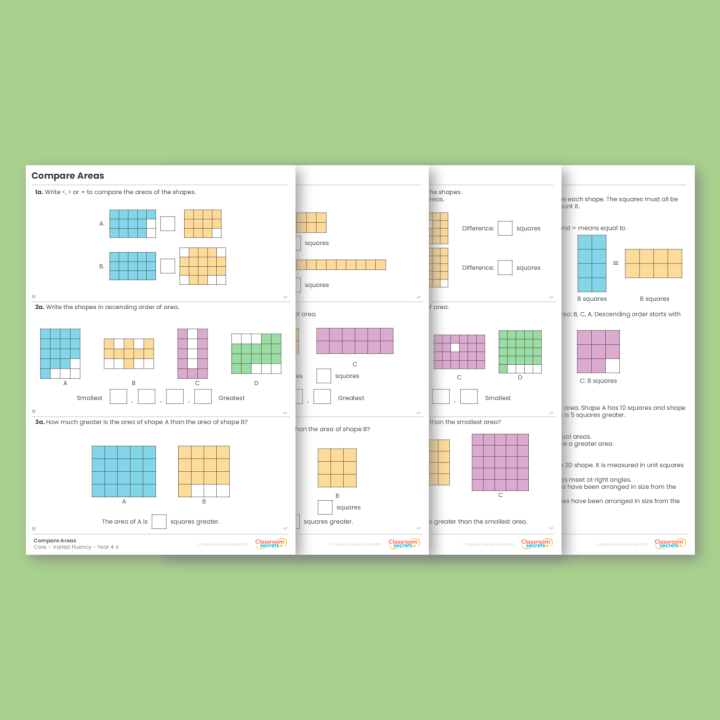
Varied Fluency
Knowledge Organiser
• Designed to support all children via key information and examples.
Scaffolded Examples
• Counting rows of squares to find each area, then comparing with words or <, > or =; putting three areas in order.
Support
• Q1: Write the areas of rectangles, then compare two pairs with <, > or =.
• Q2: Write the areas of three rectangles, then order them from smallest.
• Q3: Write the areas of two rectangles, then find how much greater one is.
Core
• Q1: Compare two pairs of rectilinear shapes using <, > or =.
• Q2: Order four rectilinear shapes in ascending order of area.
• Q3: Find how much greater one rectilinear area is than another.
Stretch
• Q1: Compare two pairs using <, > or =; then find each difference.
• Q2: Order four shapes with close areas in descending order of area.
• Q3: Find the difference between the greatest and smallest of three areas.
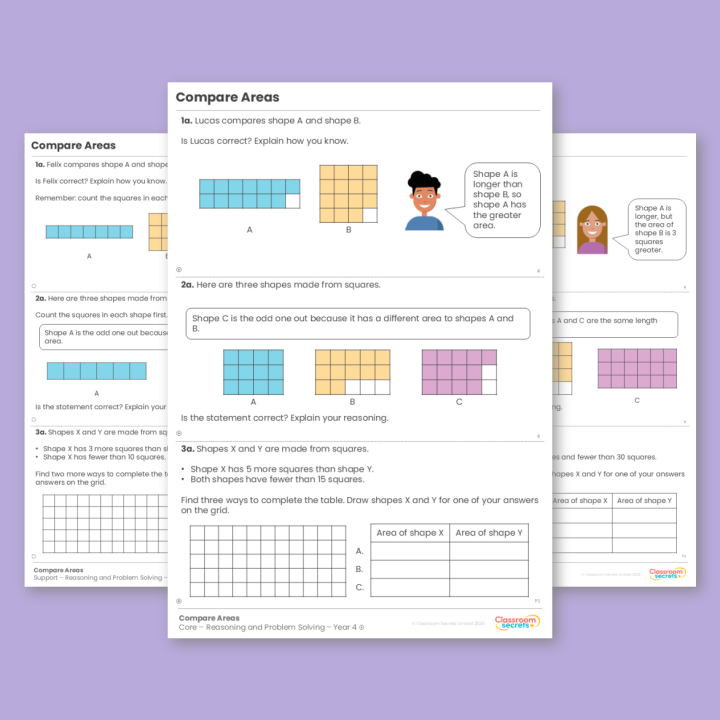
Reasoning and Problem Solving
Support
• Q1: Reasoning – explain whether a character has compared the areas of two rectangles; reminder given.
• Q2: Reasoning – explain whether a statement names the odd one out of three rectangles; hint given.
• Q3: Problem Solving – find areas with a difference of 3 or 4 squares; row A given.
Core
• Q1: Reasoning – explain whether a character has compared the areas of two rectilinear shapes.
• Q2: Reasoning – explain whether a statement names the odd one out of three rectilinear shapes.
• Q3: Problem Solving – find two areas with a given difference that fit a range, in three ways.
Stretch
• Q1: Reasoning – explain a claim about a difference in area or about shapes with missing squares.
• Q2: Reasoning – explain whether a statement names the odd one out when shapes look alike.
• Q3: Problem Solving – find two areas with a given difference and a total that fits a range.
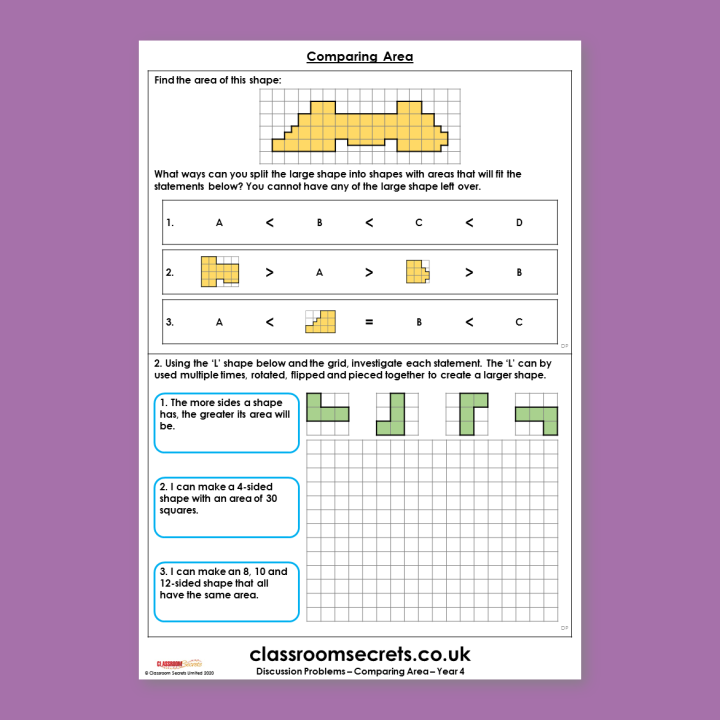
Deeper Reasoning
The questions in this set focus on manipulating parts of a shape in order to meet certain requirements to deepen understanding of how to find and compare the area of rectilinear shapes by counting squares.