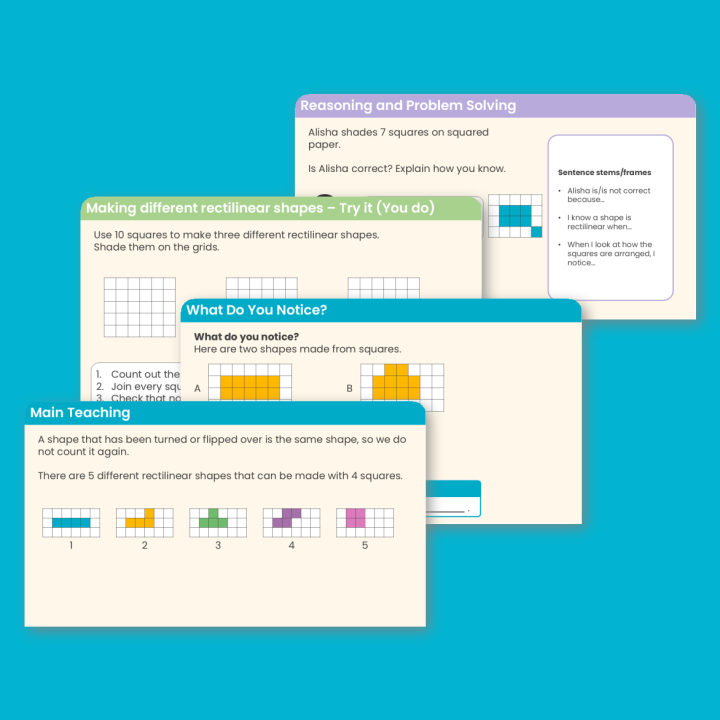
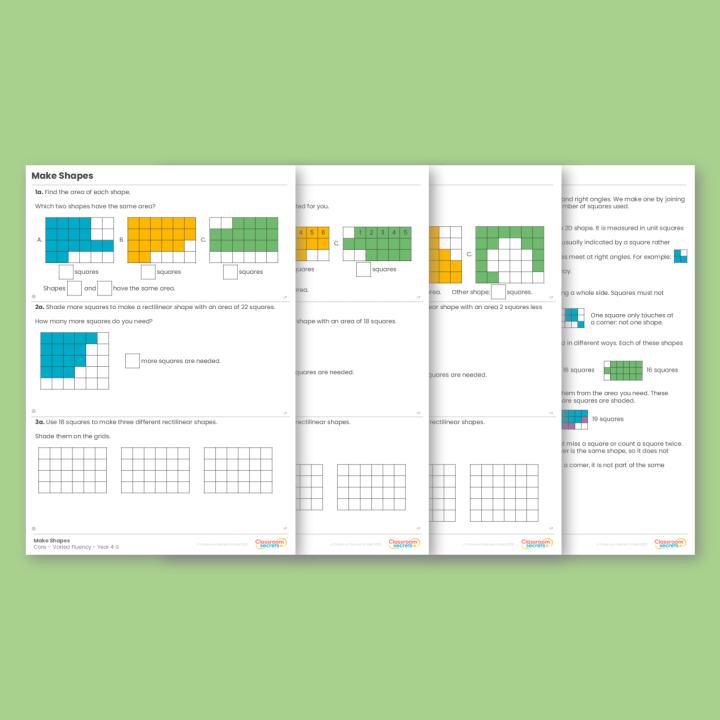
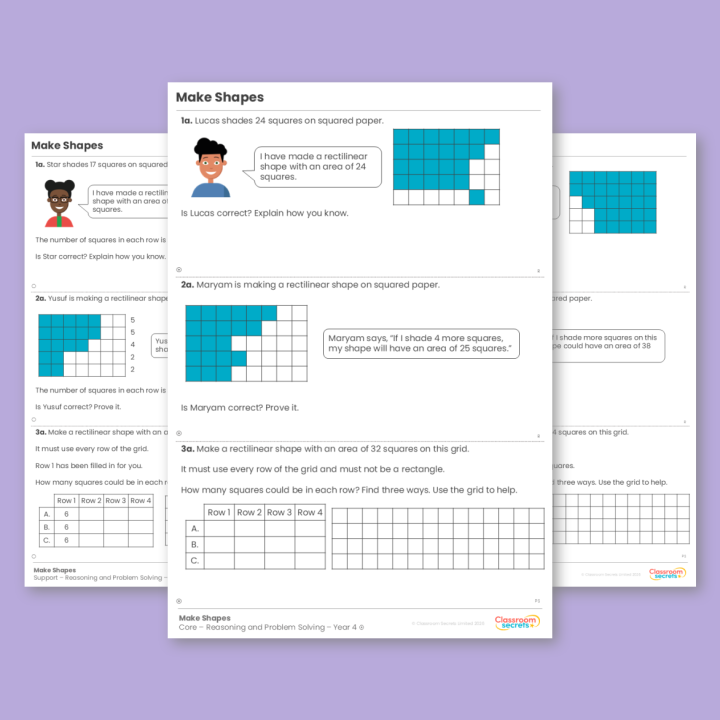
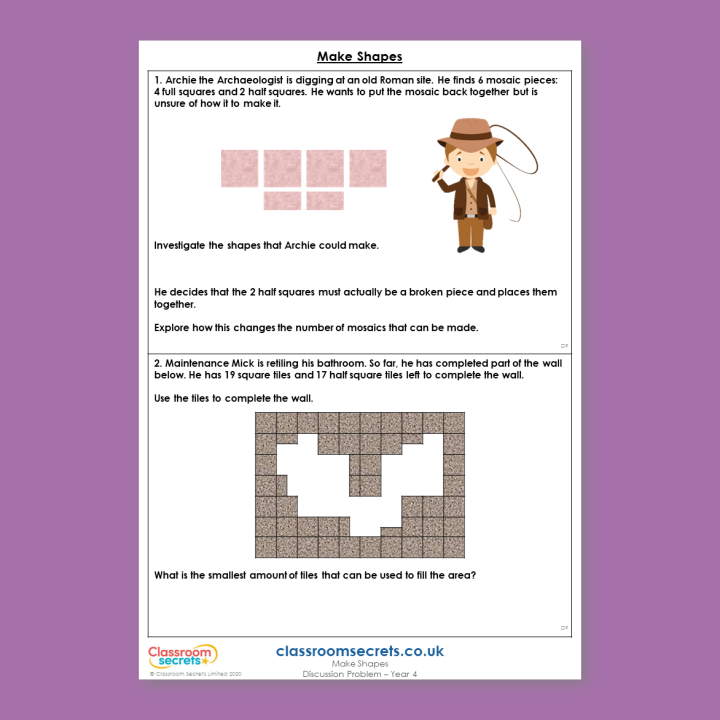
The 4 Make Shapes PowerPoint guides both teachers and children through the lesson, including use of the varied fluency, reasoning and problem solving, deeper reasoning and scaffolded resources. Key learning information about this step:
Key Vocabulary
area: The measurement of the surface of a 2D shape. It is measured in unit squares such as centimetre squared (cm²).
right angles: Measure exactly 90° and are usually indicated by a square rather than a curved line.
rectilinear shapes: A polygon where all lines meet at right angles.
systematically: Working in an organised way.
Varied Fluency
Knowledge Organiser
• Designed to support all children via key information and examples.
Scaffolded Examples
• Counting squares row by row; comparing two areas; finding how many more squares to shade.
Support
• Q1: Find the areas of three shapes; the first row of each is counted.
• Q2: Shade squares to reach an area; the shaded squares are counted.
• Q3: Make two more shapes from 16 or 19 squares; the first is given.
Core
• Q1: Find the areas of three rectilinear shapes and the two that match.
• Q2: Count the shaded squares, then shade more to reach an area.
• Q3: Make three different rectilinear shapes from 18 or 21 squares.
Stretch
• Q1: Find the two matching areas; shapes that look alike do not match.
• Q2: Work out the target area first, then shade more squares.
• Q3: Make three shapes that meet a size rule and are not rectangles.
Reasoning and Problem Solving
Support
• Q1: Reasoning – explain whether a character has made a rectilinear shape; row totals given.
• Q2: Reasoning – explain whether a child has worked out the area of a finished shape; row totals given.
• Q3: Problem Solving – find the squares in each row of a shape on a grid; the first row is given.
Core
• Q1: Reasoning – explain whether a character has made a rectilinear shape with a given area.
• Q2: Reasoning – explain whether a child has worked out the area of a finished shape.
• Q3: Problem Solving – find the squares in each row of a shape that is not a rectangle.
Stretch
• Q1: Reasoning – explain whether a staircase-style shape is one rectilinear shape.
• Q2: Reasoning – explain whether a shape on a grid could reach a stated area.
• Q3: Problem Solving – find the squares in each row of a shape with no two rows the same.
Deeper Reasoning
The questions in this set focus on problem solving with rectilinear shapes to deepen understanding in finding the area of rectilinear shapes by counting squares.