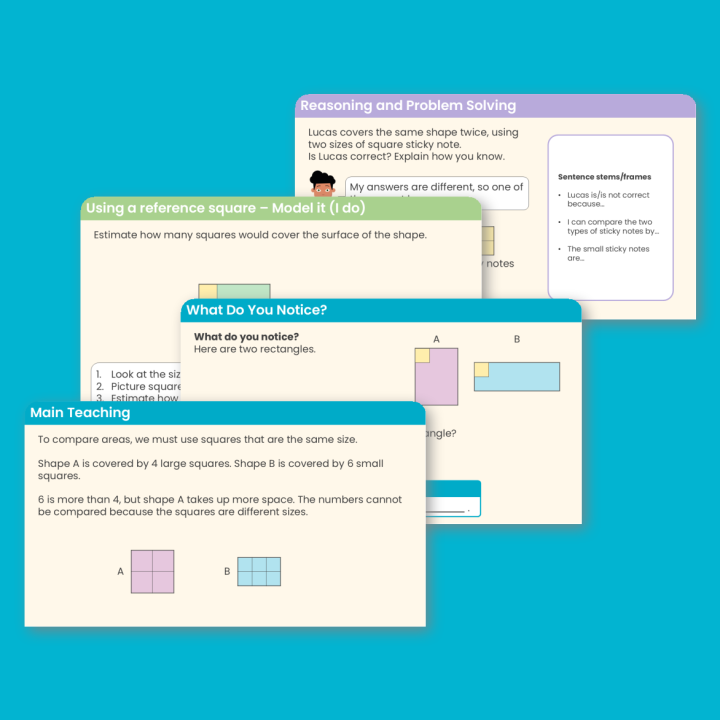
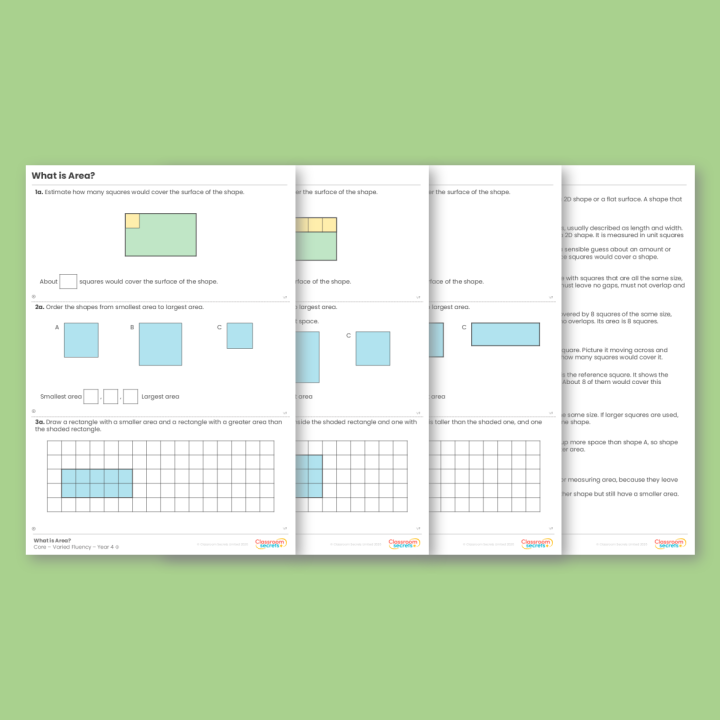
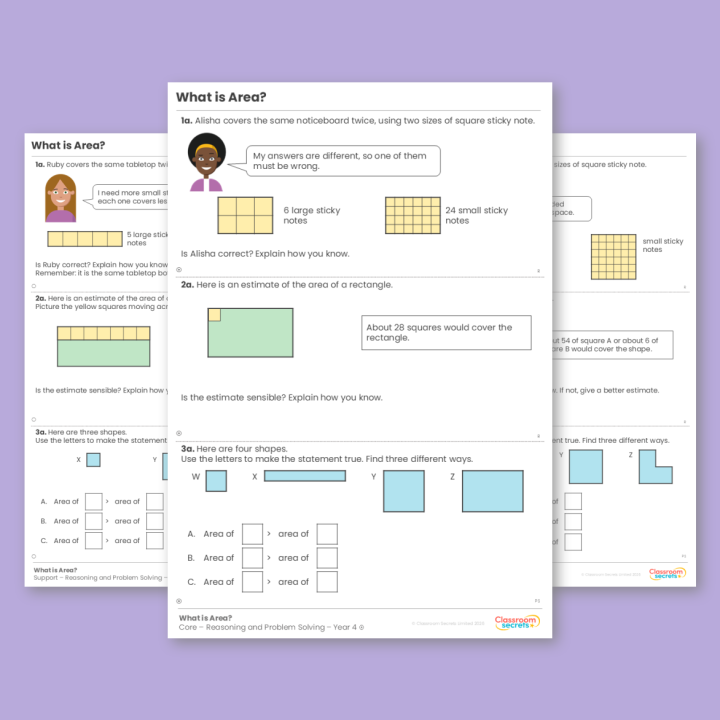
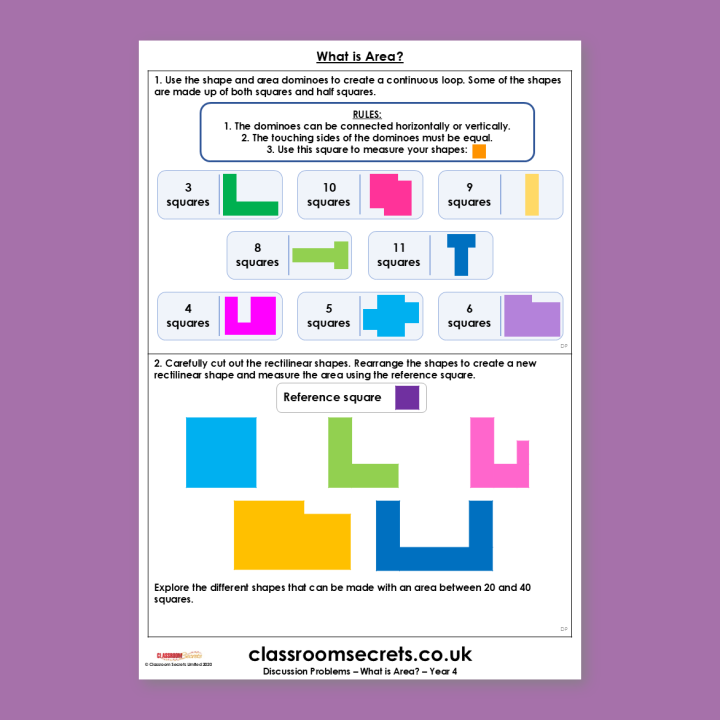
The Year 4 What is Area? PowerPoint guides both teachers and children through the lesson, including use of the varied fluency, reasoning and problem solving, deeper reasoning and scaffolded resources. Key learning information about this step:
Key Vocabulary
2D shape: A flat shape with two dimensions, usually described as length and width.
area: The measurement of the surface of a 2D shape. It is measured in unit squares such as centimetre squared (cm²).
estimate: To use what you know to make a sensible guess about an amount or a measurement. We can estimate an area by picturing how many reference squares would cover a shape.
Varied Fluency
Knowledge Organiser
• Designed to support all children via key information and examples.
Scaffolded Examples
• Comparing shapes by looking, estimating with a reference square, then checking a covering.
Support
• Q1: Estimate how many squares cover a rectangle; the top row is covered.
• Q2: Order three squares by area; the sizes are very different.
• Q3: Draw inside and around a shaded rectangle for smaller and greater areas.
Core
• Q1: Estimate how many squares cover a rectangle using a reference square.
• Q2: Order three squares by area; the sizes are closer together.
• Q3: Draw a smaller and a greater rectangle than a shaded rectangle on a grid.
Stretch
• Q1: Estimate how many squares cover a rectilinear shape using a reference square.
• Q2: Order three shapes of different types by area.
• Q3: Draw a smaller and a greater rectangle on a grid; each meets a size rule.
Reasoning and Problem Solving
Support
• Q1: Reasoning – explain a character’s statement about two sizes of sticky note; counts given.
• Q2: Reasoning – decide if an estimate of area is sensible; the top row is shown.
• Q3: Problem Solving – compare three shapes to complete an area statement in three ways.
Core
• Q1: Reasoning – explain a character’s statement about covering a surface twice.
• Q2: Reasoning – decide if an estimate made with a reference square is sensible.
• Q3: Problem Solving – compare four shapes to complete an area statement in three ways.
Stretch
• Q1: Reasoning – explain a character’s statement about sticky note sizes; no counts given.
• Q2: Reasoning – judge an estimate for two sizes of square.
• Q3: Problem Solving – order three of four shapes by area in three different ways.
Deeper Reasoning
The questions in this set focus on creating a continuous loop of shape cards, linked by their areas, and creating and measuring the areas of new rectilinear shapes, to deepen understanding in finding the area of rectilinear shapes by counting squares.