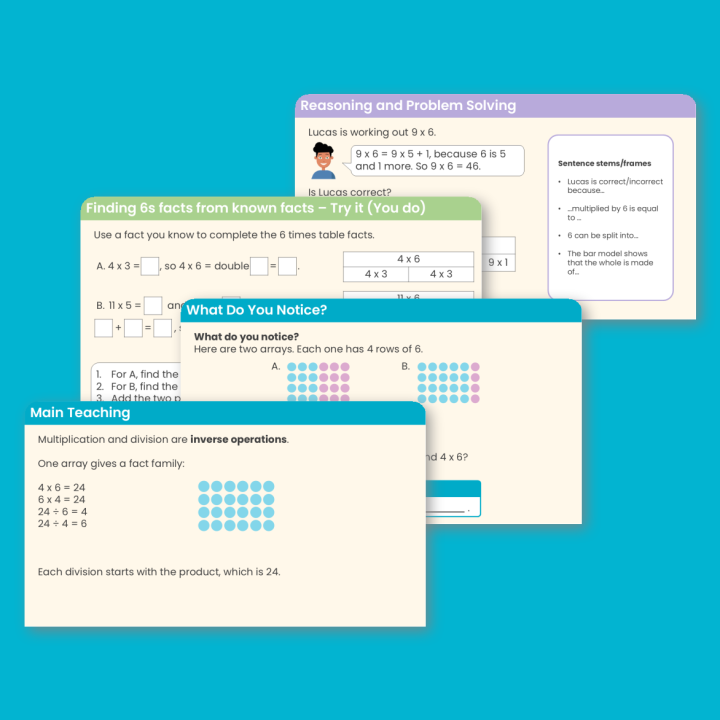
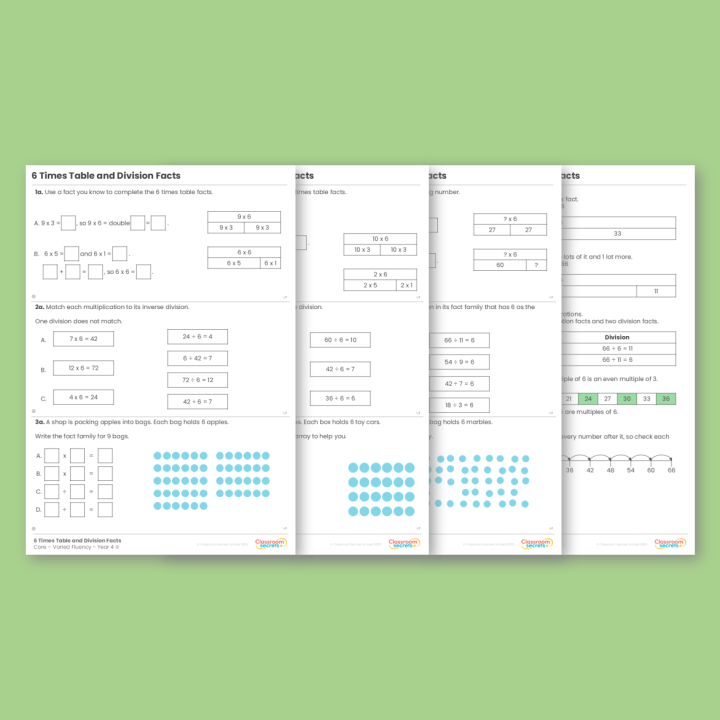
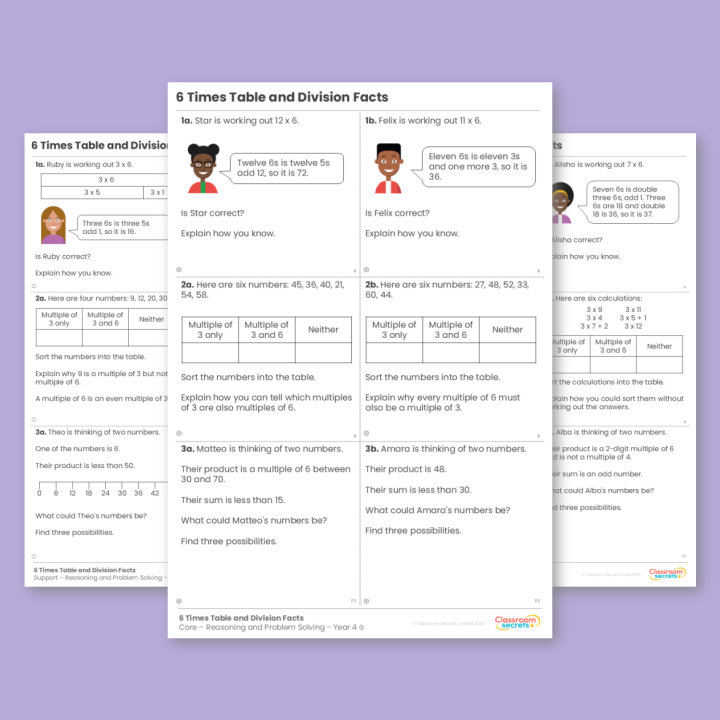
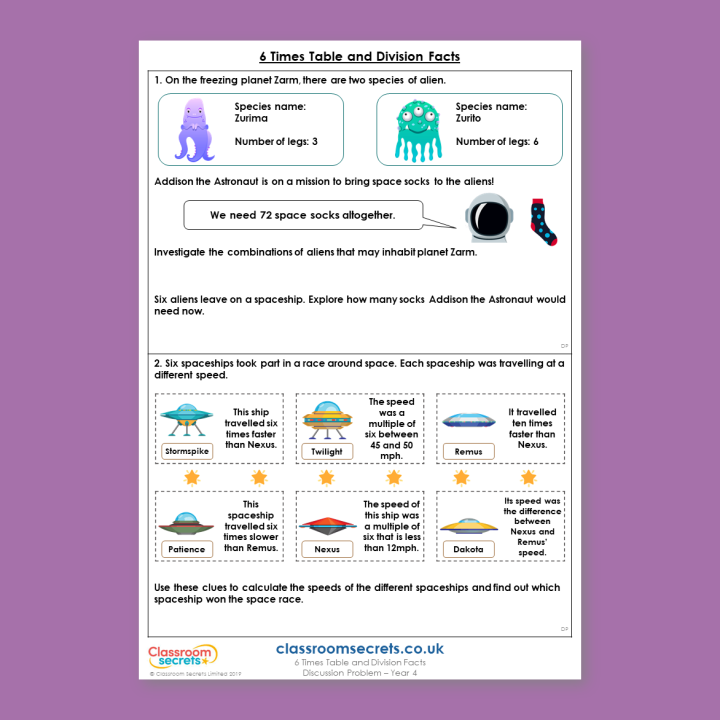
The Year 4 6 Times Table and Division Facts PowerPoint guides both teachers and children through the lesson, including use of the varied fluency, reasoning and problem solving, deeper reasoning and scaffolded resources. Key learning information about this step:
Key Vocabulary
product: The answer of multiplying two or more numbers together. For example: 30 is the product of 6 x 5.
multiple: A product of one number multiplied by another number. For example: multiples of 10 are the products of numbers multiplied by 10.
inverse operations: Used to check working out or to find a starting number by using the opposite operation. Addition is the inverse of subtraction and vice versa. Multiplication is the inverse of division and vice versa.
related facts: Also known as fact families, these are a group of four calculations that are created using the same three numbers, for example 2 + 5 = 7, 5 + 2 = 7, 7 – 2 = 5, 7 – 5 = 2. This can also be used to identify derived facts, for example 20 + 50 = 70.
Varied Fluency
Knowledge Organiser
• Designed to support all children via key information and examples.
Scaffolded Examples
• Splitting arrays of 6s into 5s and 1s with sentence stems to find 4 x 6 and 8 x 6.
Support
• Q1: Find 6 times table facts by doubling the 3s fact and adding the 5s and 1s facts; method given and bar models.
• Q2: Match three 6 times table facts to their divisions by 6; a reminder is given.
• Q3: Write the fact family; factors given; arrays provided.
Core
• Q1: Find 6 times table facts by doubling the 3s fact and adding the 5s and 1s facts; no method given; bar models.
• Q2: Match three 6s facts to their divisions by 6; one division does not match.
• Q3: Write the fact family; no factors given; arrays provided.
Stretch
• Q1: Find 6 times table facts by working backwards from given facts.
• Q2: Match 6s facts to the division in each fact family that has 6 as the answer; one does not match.
• Q3: Write the fact family; no factors given; grouping of loose counters.
Reasoning and Problem Solving
Support
• Q1: Reasoning – Decide if a calculation is correct; bar model given.
• Q2: Reasoning – Sort four numbers by multiples of 3 and 6, then explain an odd multiple of 3; reminder given.
• Q3: Problem Solving – Find two numbers from a product clue; number line of 6s given.
Core
• Q1: Reasoning – Decide if a calculation is correct; no bar model.
• Q2: Reasoning – Sort six 2-digit numbers by multiples of 3 and 6, then explain the rule.
• Q3: Problem Solving – Find two numbers from clues about their product and their sum.
Stretch
• Q1: Reasoning – Decide if a calculation is correct; unfamiliar methods.
• Q2: Reasoning – Sort six calculations by multiples of 3 and 6, then explain how grouping the 3s into 6s shows where each one goes.
• Q3: Problem Solving – Find two numbers from product, difference and sum clues.
Deeper Reasoning
The questions in this set focus on problem solving with the 6 times table to deepen understanding in becoming fluent with the 6 times table by recalling multiplication and division facts for multiplication tables up to 12 × 12 and recognising and using factor pairs and commutativity in mental calculations.