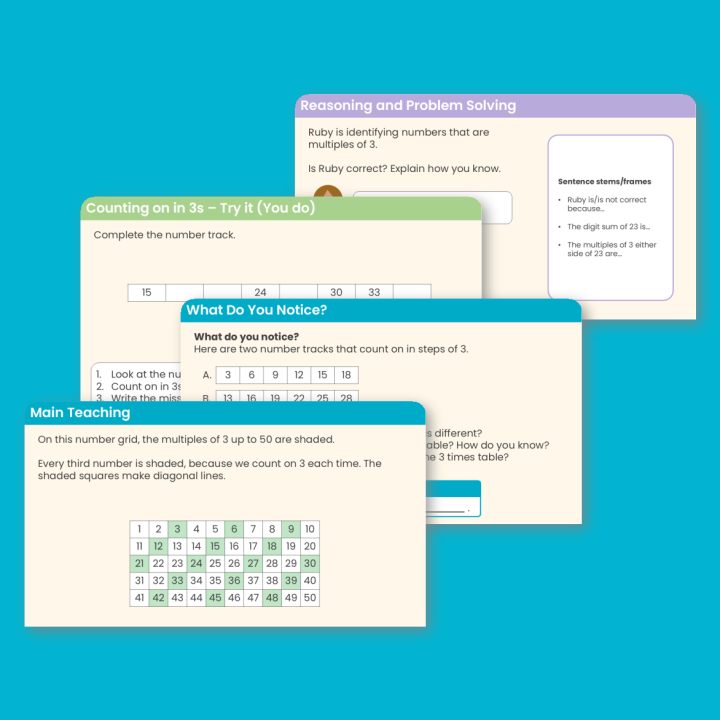
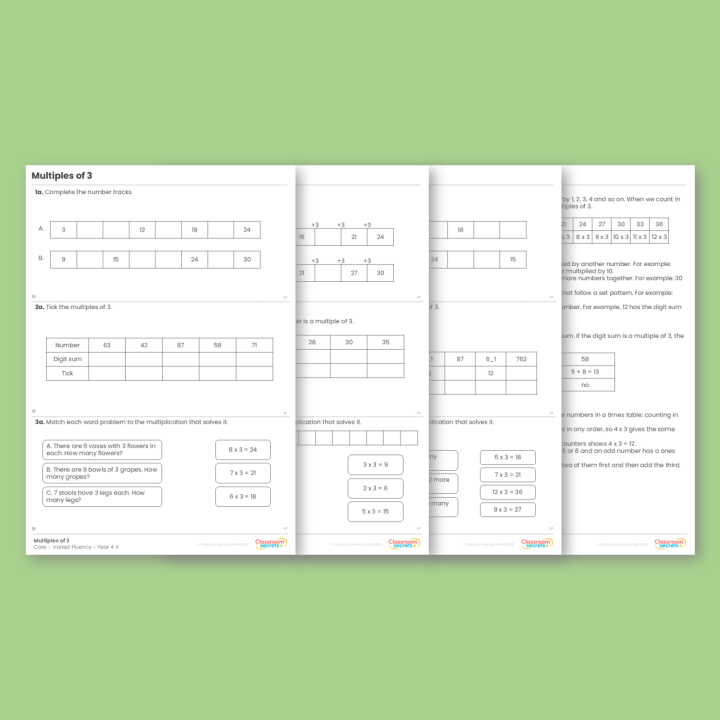
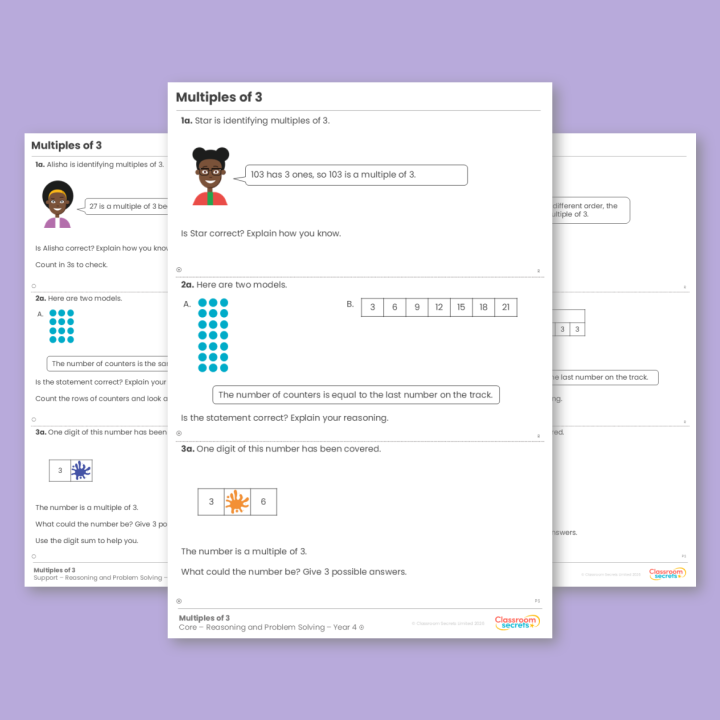
The Year 4 Multiples of 3 PowerPoint guides both teachers and children through the lesson, including use of the varied fluency, reasoning and problem solving, deeper reasoning and scaffolded resources. Key learning information about this step:
Key Vocabulary
multiple: A product of one number multiplied by another number. For example: multiples of 10 are the products of numbers multiplied by 10.
product: The answer of multiplying two or more numbers together. For example: 30 is the product of 6 x 5.
sequence: A series of numbers or images that follow a set pattern. For example: numbers may increase by 2 each time.
digit sum: The total of the digits within a number. For example, 12 has the digit sum of 3 because 1 + 2 is 3.
Varied Fluency
Knowledge Organiser
• Designed to support all children via key information and examples.
Scaffolded Examples
• Completing number tracks with +3 jumps and sentence stems; using the digit sum to check whether a 2-digit number is a multiple of 3.
Support
• Q1: Complete number tracks in 3s; two gaps per track and +3 jumps shown.
• Q2: Tick multiples of 3 from 2-digit numbers up to 35; digit sum rule given.
• Q3: Match multiplication word problems; count in 3s to help; track provided.
Core
• Q1: Complete number tracks in 3s; four gaps per track.
• Q2: Tick multiples of 3 from 2-digit numbers beyond 40.
• Q3: Match multiplication word problems.
Stretch
• Q1: Complete number tracks counting on and back in 3s; few numbers given.
• Q2: Complete digit sum tables with missing digits, digit sums and ticks.
• Q3: Match one-step and two-step problems; one multiplication not needed.
Reasoning and Problem Solving
Support
• Q1: Reasoning – explain whether a 2-digit number is a multiple of 3; hint given.
• Q2: Reasoning – decide whether two models show the same multiple; hint given.
• Q3: Problem Solving – find a covered digit in a 2-digit multiple of 3; hint given.
Core
• Q1: Reasoning – explain a claim that uses the ones digit or the digit sum.
• Q2: Reasoning – decide whether two models show the same multiple; no hint.
• Q3: Problem Solving – find a covered digit in a 3-digit multiple of 3.
Stretch
• Q1: Reasoning – explain claims about reordering digits and about the ones digit.
• Q2: Reasoning – work out hidden totals to compare two models.
• Q3: Problem Solving – find two covered digits that also fit a second rule.
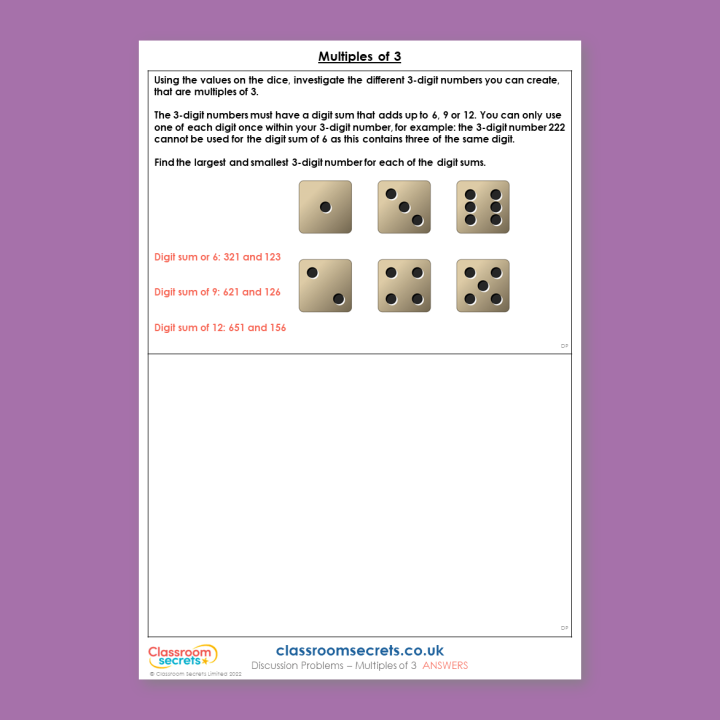
Deeper Reasoning
The question in this set focuses on problem solving with multiples of 3 to deepen understanding in recalling multiplication and division facts for multiplication tables up to 12 × 12, and recognising and using factor pairs and commutativity in mental calculations.