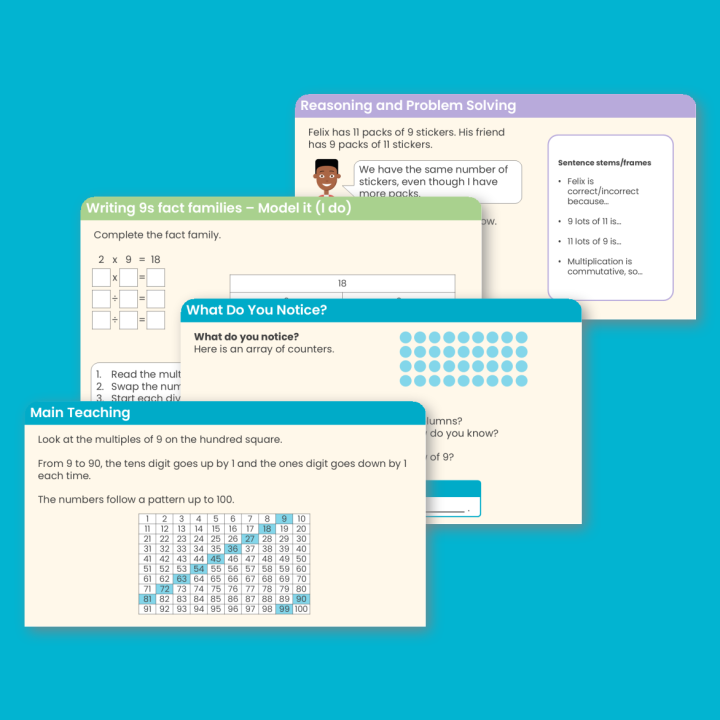
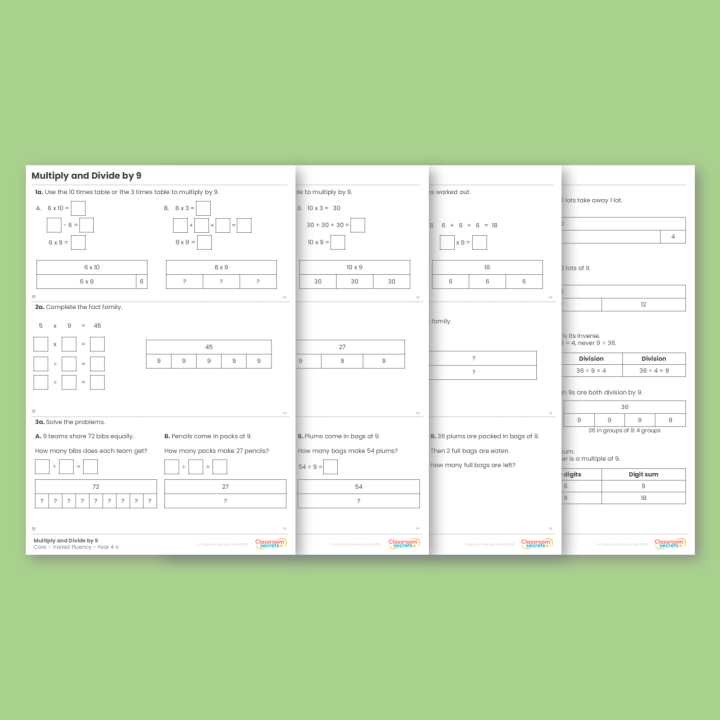
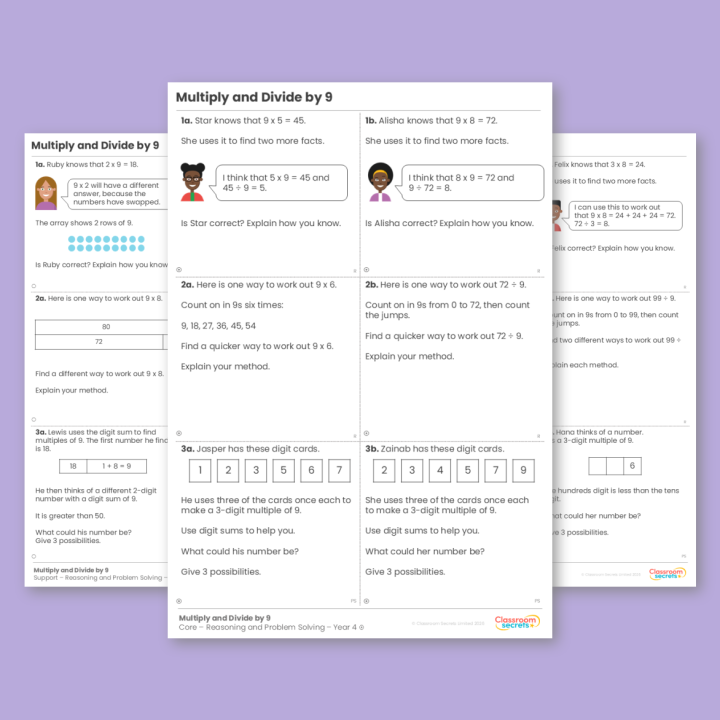
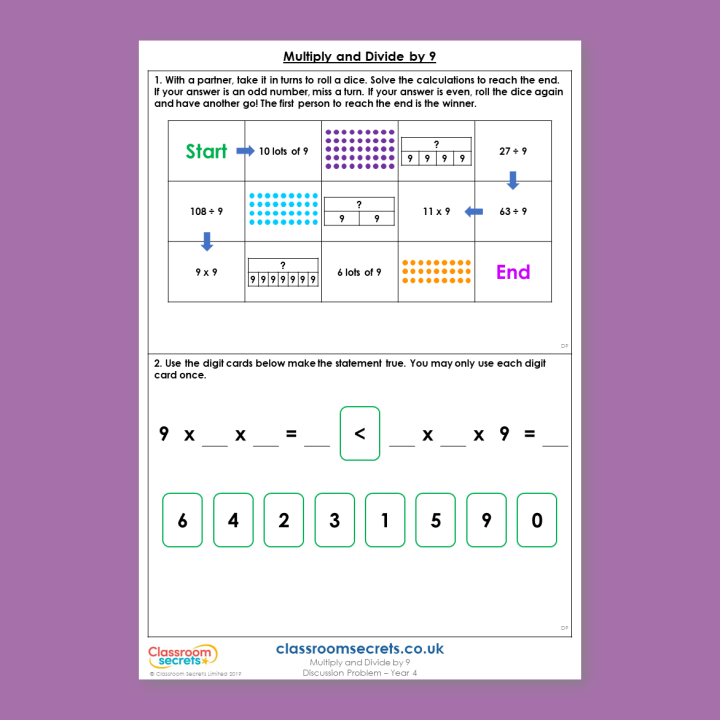
The Year 4 Multiply and Divide by 9 PowerPoint guides both teachers and children through the lesson, including use of the varied fluency, reasoning and problem solving, deeper reasoning and scaffolded resources. Key learning information about this step:
Key Vocabulary
multiple: A product of one number multiplied by another number. For example: multiples of 10 are the products of numbers multiplied by 10.
product: The answer of multiplying two or more numbers together. For example: 30 is the product of 6 x 5.
commutative: Calculations which have the same answer no matter what order the numbers are in. Only addition and multiplication are commutative. For example: 2 x 6 = 12 and 6 x 2 = 12 and 5 + 4 = 9 and 4 + 5 = 9.
inverse operations: Used to check working out or to find a starting number by using the opposite operation. Addition is the inverse of subtraction and vice versa. Multiplication is the inverse of division and vice versa.
fact family: A group of related multiplication and division facts made from the same three numbers, for example 4 x 6 = 24, 6 x 4 = 24, 24 ÷ 6 = 4 and 24 ÷ 4 = 6.
digit sum: The total of the digits within a number. For example, 12 has the digit sum of 3 because 1 + 2 is 3.
Varied Fluency
Knowledge Organiser
• Designed to support all children via key information and examples.
Scaffolded Examples
• Finding 4 x 9 from 4 x 10 and by tripling 4 x 3, with bar models and stems.
Support
• Q1: Use the 10 times table or 3 times table facts to multiply by 9; known fact given; bar models show values.
• Q2: Complete a 9s fact family; bar model and first number of each fact given.
• Q3: Solve sharing and grouping problems; division given; with bar model whole.
Core
• Q1: Find the 10 times table or 3 times table fact, then use it to multiply by 9, with bar models.
• Q2: Complete the fact family from one 9s fact, with a bar model.
• Q3: Solve sharing and grouping problems, blank division, with bar model whole.
Stretch
• Q1: Work backwards from a bar model to find which 9s fact was worked out.
• Q2: Find the missing number, split the bar model, then complete the fact family.
• Q3: Solve two-step sharing and grouping problems; no bar model.
Reasoning and Problem Solving
Support
• Q1: Reasoning – decide if a claim about swapping the numbers in a 9s fact is correct; array provided.
• Q2: Reasoning – find another way to work out a 9s fact, with a bar model or number line.
• Q3: Problem Solving – use a worked digit sum example to find 2-digit numbers with a digit sum of 9 that fit a clue.
Core
• Q1: Reasoning – decide if facts found from a 9s fact are correct; no array.
• Q2: Reasoning – find another way to work out a 9s fact or how many 9s are in a number.
• Q3: Problem Solving – use digit cards and digit sums to make 3-digit multiples of 9.
Stretch
• Q1: Reasoning – decide if facts found from a related fact are correct.
• Q2: Reasoning – find two other ways to work out 9s facts.
• Q3: Problem Solving – find 3-digit multiples of 9 with two missing digits and a clue; no hint given.
Deeper Reasoning
The questions in this set focus on problem solving with the 9 times table to deepen understanding in recalling multiplication and division facts for the 9 times table, and recognising and using factor pairs and commutativity in mental calculations.