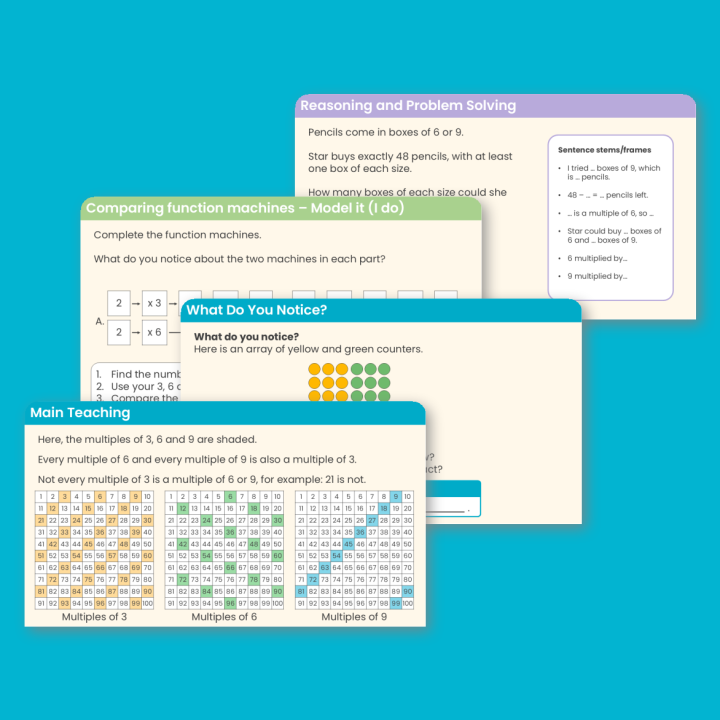
The Year 4 The 3, 6 and 9 Times Tables PowerPoint guides both teachers and children through the lesson, including use of the varied fluency, reasoning and problem solving, deeper reasoning and scaffolded resources. Key learning information about this step:
Key Vocabulary
multiple: A product of one number multiplied by another number. For example: multiples of 10 are the products of numbers multiplied by 10.
product: The answer of multiplying two or more numbers together. For example: 30 is the product of 6 x 5.
inverse operations: Used to check working out or to find a starting number by using the opposite operation. Addition is the inverse of subtraction and vice versa. Multiplication is the inverse of division and vice versa.
digit sum: The total of the digits within a number. For example, 12 has the digit sum of 3 because 1 + 2 is 3.
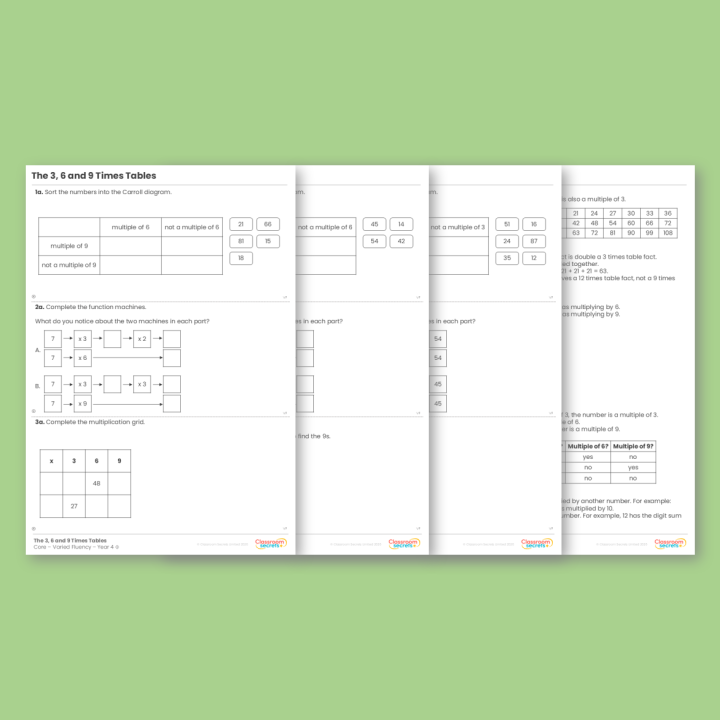
Varied Fluency
Knowledge Organiser
• Designed to support all children via key information and examples.
Scaffolded Examples
• Checking for multiples of 6 and 9; sorting numbers into a Carroll diagram.
Support
• Q1: Sort four numbers into a Carroll diagram; one in each box.
• Q2: Complete x 6 and x 9 function machines; the middle number is given.
• Q3: Complete a 3, 6 and 9 grid from the 3s; a doubling and tripling hint is given.
Core
• Q1: Sort five numbers into a Carroll diagram.
• Q2: Complete two-step and one-step x 6 and x 9 function machines.
• Q3: Complete a 3, 6 and 9 grid from a 3s or 6s product; find the multiplier.
Stretch
• Q1: Sort six numbers into a Carroll diagram; explain why one box is empty.
• Q2: Work backwards through function machines from the output to the input.
• Q3: Complete a three-row 3, 6 and 9 grid from 6s and 9s products.
Reasoning and Problem Solving
Support
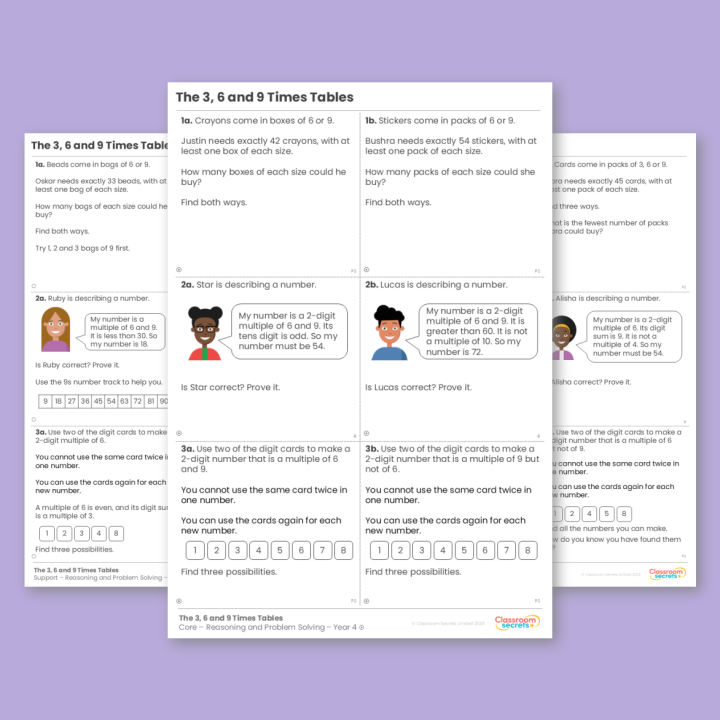
• Q1: Problem Solving – find both ways to make an exact total with boxes of 6 and 9; a hint is given.
• Q2: Reasoning – check a claim about a multiple of 6 and 9 from clues; a 9s number track is given.
• Q3: Problem Solving – make 2-digit multiples of 6 or of 9 from digit cards; a hint is given.
Core
• Q1: Problem Solving – find both ways to make an exact total with boxes of 6 and 9.
• Q2: Reasoning – check whether clues about a 2-digit multiple of 6 and 9 give one answer.
• Q3: Problem Solving – make 2-digit numbers from digit cards that fit a multiples rule.
Stretch
• Q1: Problem Solving – make an exact total with boxes of 3, 6 and 9; find the fewest boxes.
• Q2: Reasoning – check claims that combine clues from the 4, 6 and 9 times tables.
• Q3: Problem Solving – find all 2-digit numbers from digit cards that fit a multiples rule; explain how you know.
Deeper Reasoning
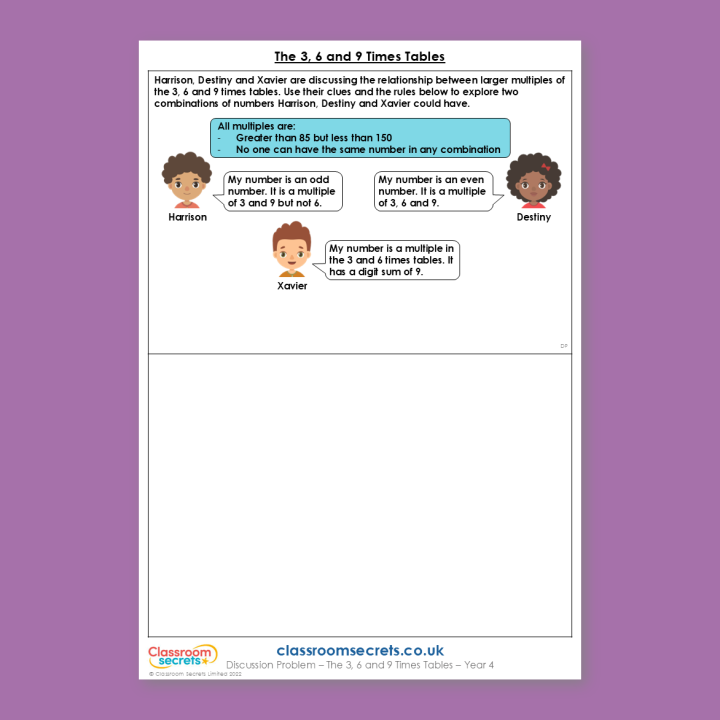
The question in this set focuses on using the clues to identify the numbers to deepen understanding in recalling multiplication and division facts for multiplication tables up to 12 × 12, and recognising and using factor pairs and commutativity in mental calculations.