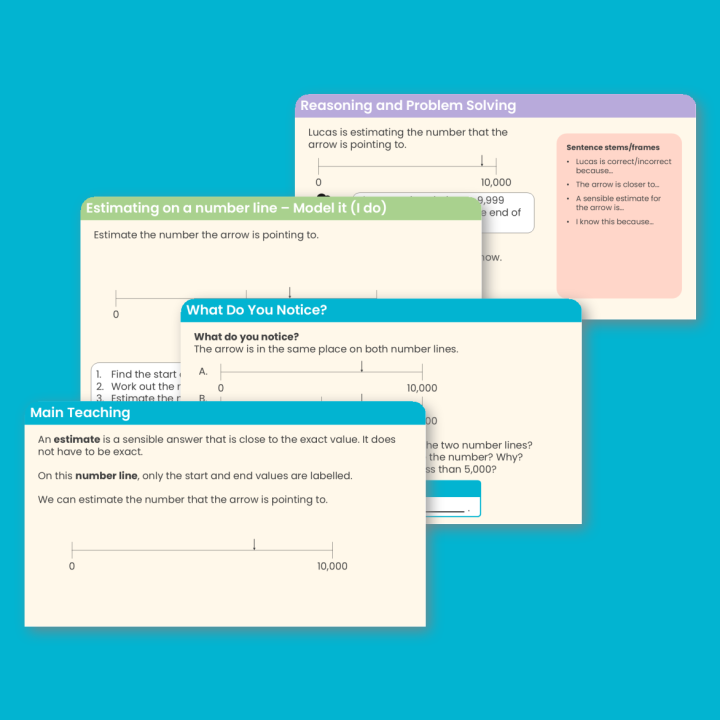
The Year 4 Estimate on a Number Line to 10,000 PowerPoint guides both teachers and children through the lesson, including use of the varied fluency, reasoning and problem solving, deeper reasoning and scaffolded resources. Key learning information about this step:
Key Vocabulary
estimate: To make a sensible guess at what the answer could be. You usually estimate the answer by rounding the numbers to make the calculation easier. Another word for estimate is approximate.
number line: A horizontal or vertical line which has numbers placed at equal points. Number lines can be used to show either positive or negative numbers. Most number lines begin at 0.
interval: The space between two divisions on a number line. All of the intervals on one number line are equal in size.
midpoint: The point on a number line that is exactly halfway between the start and end values.
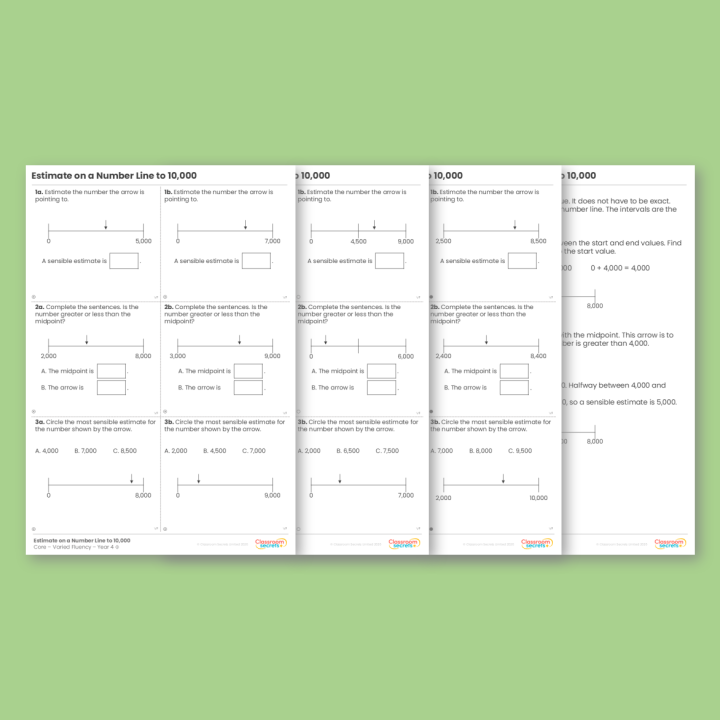
Varied Fluency
Knowledge Organiser
• Designed to support all children via key information and examples.
For the purple sections of the four levels, copy and paste these from the first sheet of the varied fluency resource.
Scaffolded Examples
• Finding the midpoint; estimating the number an arrow is pointing to.
Support
• Q1: estimating the number an arrow points to, with the midpoint labelled.
• Q2: comparing a number with the midpoint, with the midpoint division marked.
• Q3: choosing the most sensible estimate, with one option beyond the number line.
Core
• Q1: estimating the number an arrow points to on a number line starting at 0.
• Q2: comparing a number with the midpoint on a line that does not start at 0.
• Q3: choosing the most sensible estimate, with all options inside the number line.
Stretch
• Q1: estimating on a number line with start and end values that are not multiples of 1,000.
• Q2: comparing a number with the midpoint where the arrow sits close to the midpoint.
• Q3: choosing the most sensible estimate, with closely grouped options.
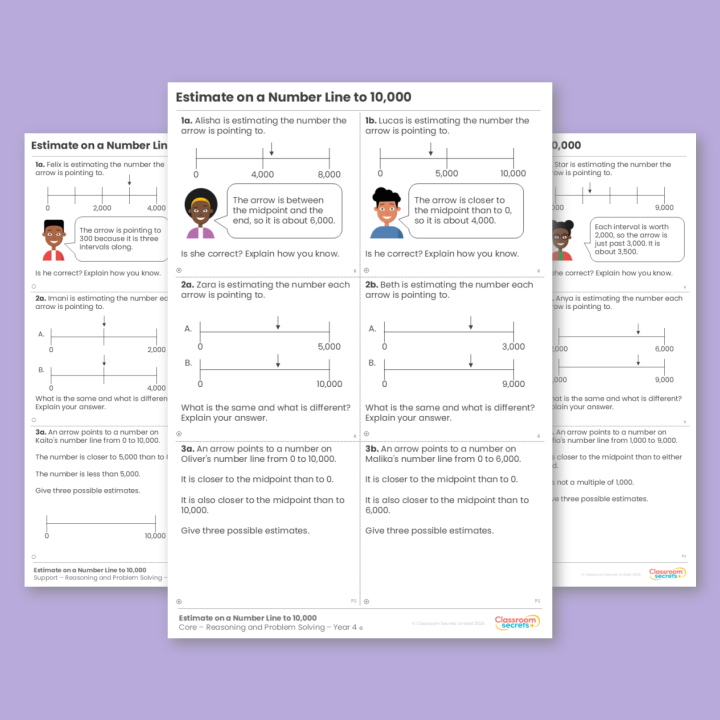
Reasoning and Problem Solving
Support
• Q1: Reasoning - explaining whether a character has estimated sensibly, with the midpoint labelled and every interval marked.
• Q2: Reasoning - comparing estimates on two number lines with the midpoints labelled.
• Q3: Problem Solving - finding numbers that fit two clues, with the benchmark values given.
Core
• Q1: Reasoning - explaining whether a character has estimated sensibly, with the midpoint labelled but no smaller intervals.
• Q2: Reasoning - comparing estimates on two number lines starting at 0.
• Q3: Problem Solving - finding numbers that fit two clues about distance from the midpoint.
Stretch
• Q1: Reasoning - explaining whether a character has estimated sensibly, with no midpoint given on a line that does not start at 0.
• Q2: Reasoning - comparing estimates on two number lines with different start and end values.
• Q3: Problem Solving - finding numbers that fit clues on a line that does not start at 0.
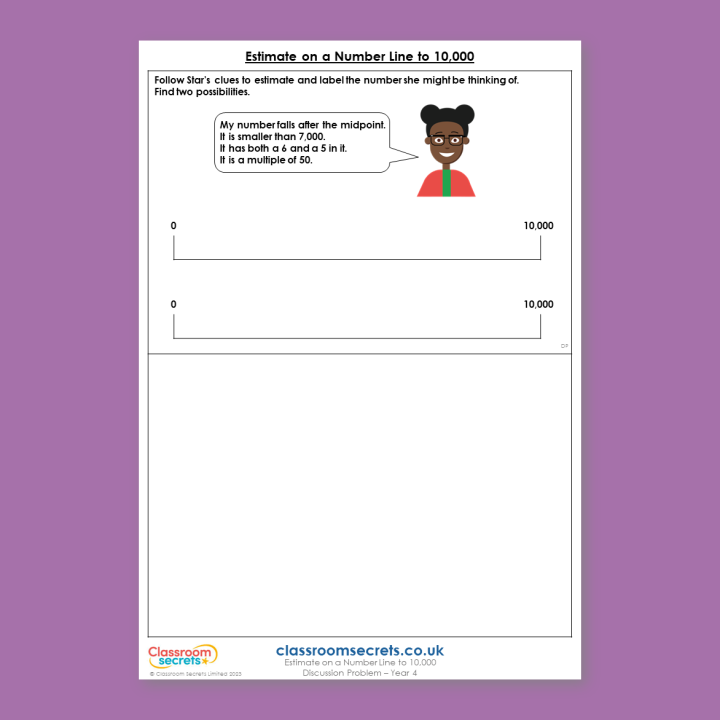
Deeper Reasoning
The questions in this set focuses on using the clues to identify the number to deepen understanding in identifying, representing and estimating using different representations.