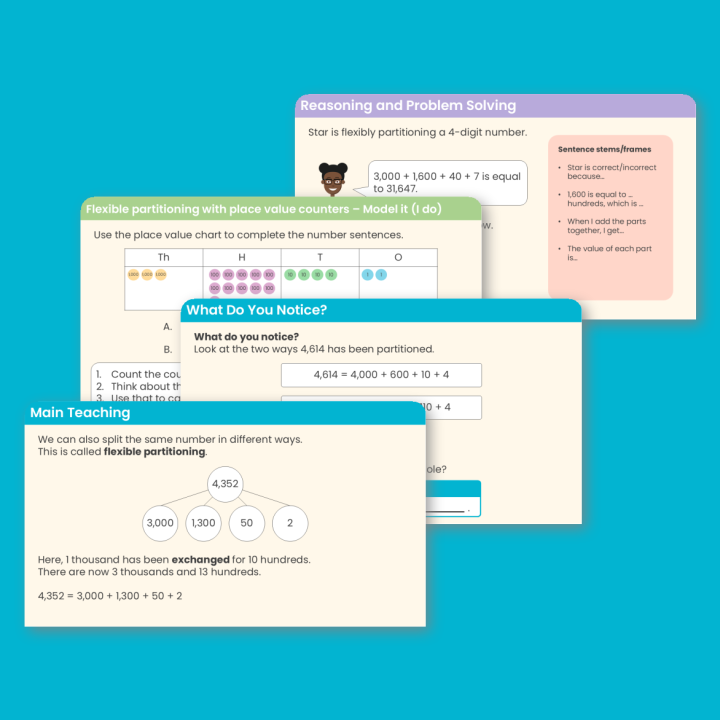
The Year 4 Flexible Partitioning of Numbers to 10,000 PowerPoint guides both teachers and children through the lesson, including use of the varied fluency, reasoning and problem solving, deeper reasoning and scaffolded resources. Key learning information about this step:
Key Vocabulary
partitioning: The splitting of a number into different parts. For example: the number 547 can be partitioned into 500, 40 and 7.
flexible partitioning: The splitting of a number into different parts in different ways. For example: the number 64 could be broken down into 5 tens and 14 ones.
place value chart: Used to identify the value of the digits that make up a number.
exchange: When a digit is taken from one place value column and placed in another.
Varied Fluency
Knowledge Organiser
• Designed to support all children via key information and examples.
For the purple sections of the four levels, copy and paste these from the first sheet of the varied fluency resource.
Scaffolded Examples
H3
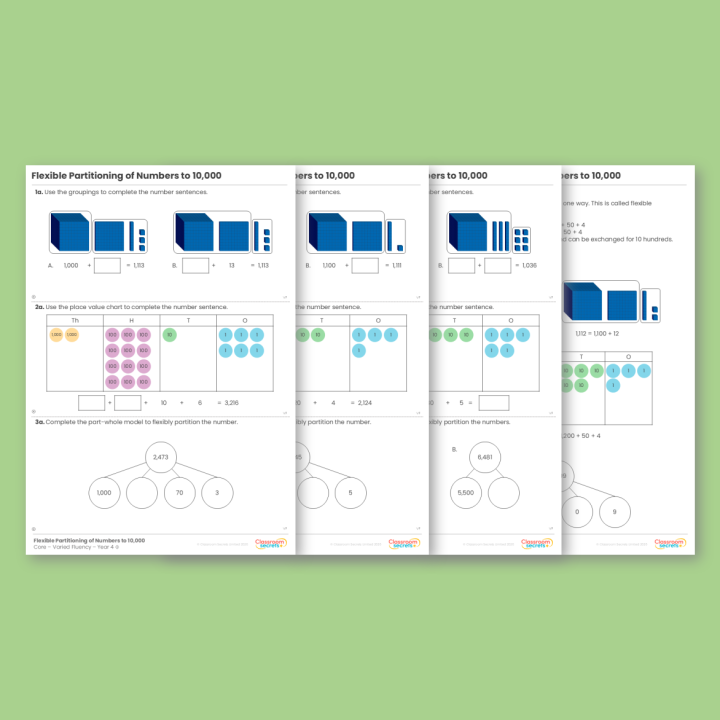
• Guided practice in partitioning numbers flexibly.
Support
• Q1: Group Base 10, with the thousands given.
• Q2: Read a place value chart, with the merged part given.
• Q3: Complete a part-whole model, with three parts given; flexible partitioning has been completed.
Core
• Q1: Group Base 10, with different groups given.
• Q2: Read a place value chart, with two parts missing.
• Q3: Complete a part-whole model, with three parts given; flexible partitioning to be completed.
Stretch
• Q1: Group Base 10, with both parts missing.
• Q2: Read a place value chart that includes the placeholder 0 preceding the column with more than nine place value counters; total must be calculated.
• Q3: Reduce a four-digit number to three and two parts.
Reasoning and Problem Solving
Support
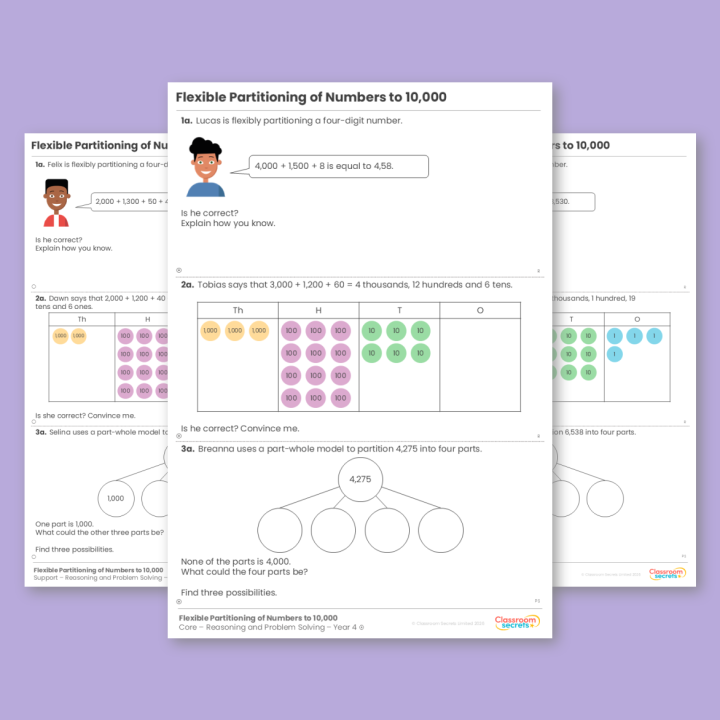
• Q1: Reasoning - explain whether a character has correctly added the parts of a flexibly partitioned number.
• Q2: Reasoning - explain whether a number sentence and a partition written in words are equal, supported by place value counters.
• Q3: Problem Solving - find the other three parts of a four-digit number when one part is given.
Core
• Q1: Reasoning - explain whether a character has correctly added the parts of a flexibly partitioned number, including the placeholder 0.
• Q2: Reasoning - explain whether a number sentence and a partition written in words are equal, supported by place value counters, including the placeholder 0.
• Q3: Problem Solving - find four parts of a four-digit number when one value may not be used as a part.
Stretch
• Q1: Reasoning - explain whether a character has correctly added the parts of a flexibly partitioned number given out of order, including the placeholder 0.
• Q2: Reasoning - explain whether a number sentence and a partition written in words are equal, where a column has been regrouped more than once.
• Q3: Problem Solving - find four parts of a four-digit number when two of the parts must be greater than 1,000.
Deeper Reasoning
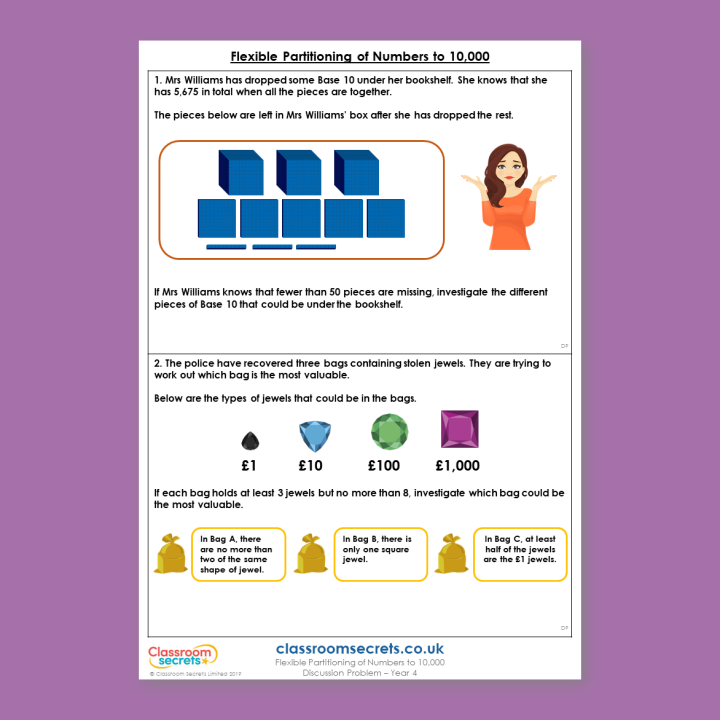
The questions in this set focus on problem solving with flexibly partitioned numbers to deepen understanding in recognising the place value of each digit in a 4-digit number (thousands, hundreds, tens and ones).