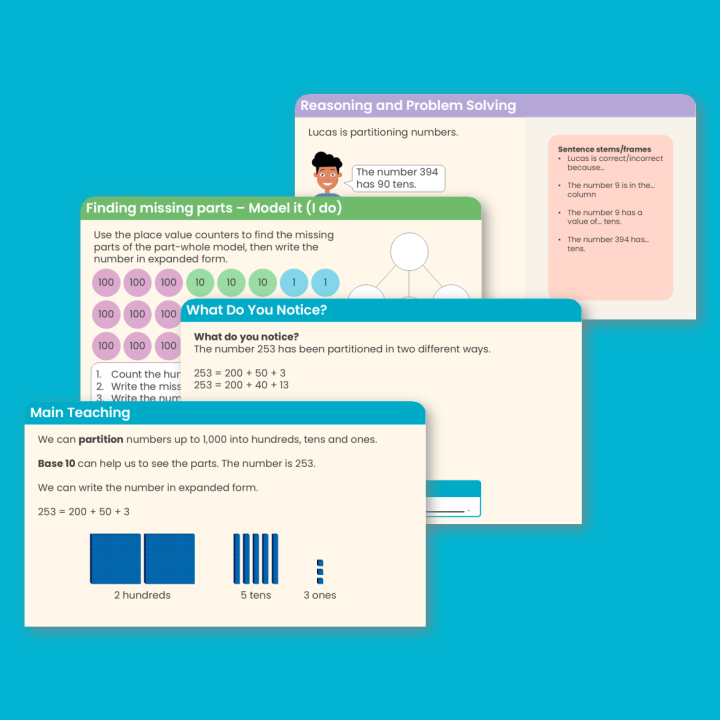
The Year 4 Partition Numbers to 1,000 PowerPoint guides both teachers and children through the lesson, including use of the varied fluency, reasoning and problem solving, deeper reasoning and scaffolded resources. Key learning information about this step:
Key Vocabulary
partitioning: The splitting of a number into different parts. For example: the number 547 can be partitioned into 500, 40 and 7.
Base 10: A physical resource which represents numbers. The small cubes represent ‘ones’; the rods represent ‘tens’ and are made up of 10 small cubes; the squares represent ‘hundreds’ and are made up of 10 rods; the large cubes represent ‘thousands’ and are made up of 10 squares.
part-whole model: A representation showing the whole number and the parts it has been split into.
placeholder: 0 is used to hold a place in a number and maintain its place value.
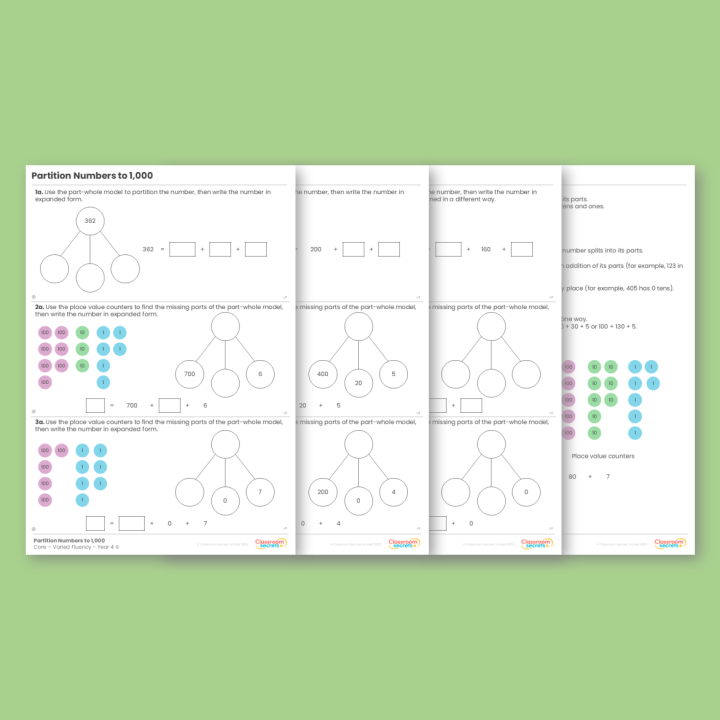
Varied Fluency
Knowledge Organiser
• Designed to support all children via key information and examples.
Scaffolded Examples
• Partitioning using a part-whole model; partitioning using place value counters.
Support
• Q1: Partition a number using a part-whole model, with the hundreds part given.
• Q2: Use counters to complete a part-whole model with all parts given.
• Q3: Use models with all parts given to write a number using zero.
Core
• Q1: Partition a number using a part-whole model.
• Q2: Use counters to complete a part-whole model with two parts given.
• Q3: Use models with two parts given to write a number using zero.
Stretch
• Q1: Partition a number using a part-whole model showing flexible partitioning.
• Q2: Use counters to complete a part-whole model with no parts given.
• Q3: Use models with one part given to write a number using zero, showing flexible partitioning.
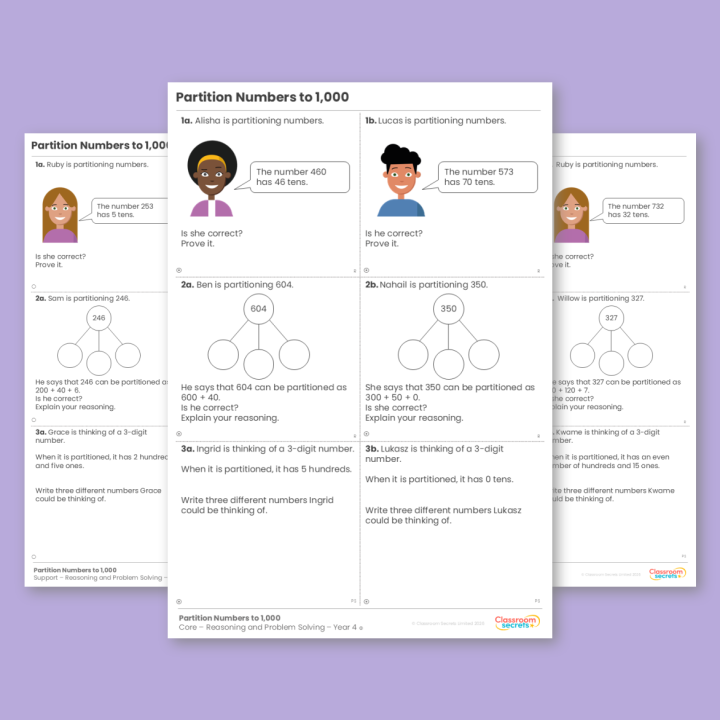
Reasoning and Problem Solving
Support
• Q1: Reasoning - proving whether a statement about the number of tens in a 3-digit number is correct, using one digit for the tens column.
• Q2: Reasoning - deciding whether a 3-digit number has been partitioned correctly and explaining.
• Q3: Problem Solving – finding possible three-digit numbers from two clues, linked to partitioning.
Core
• Q1: Reasoning - proving whether a statement about the number of tens in a 3-digit number is correct, using two digits for the tens column.
• Q2: Reasoning - deciding whether a 3-digit number has been partitioned correctly and explaining, using zero as a placeholder.
• Q3: Problem Solving - finding possible three-digit numbers from one clue, linked to partitioning.
Stretch
• Q1: Reasoning - proving whether a statement about the number of tens in a 3-digit number is correct when using flexible partitioning, using two digits for the tens column.
• Q2: Reasoning - deciding whether a 3-digit number has been flexibly partitioned correctly and explaining, using zero as a placeholder.
• Q3: Problem Solving - finding possible three-digit numbers from two clues, linked to flexible partitioning.
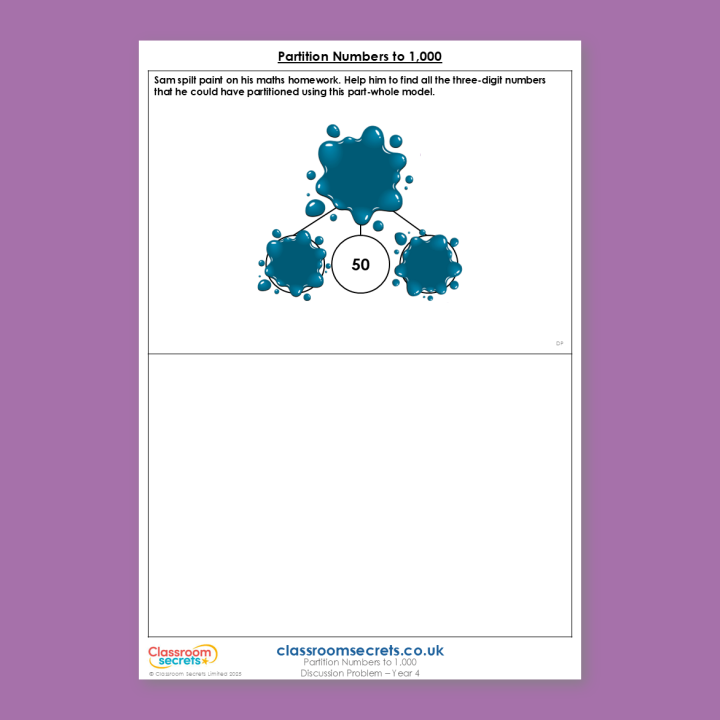
Deeper Reasoning
The question in this set focuses on problem solving with part-whole models to deepen understanding in recognising the place value of each digit in a three-digit number.