Key Vocabulary
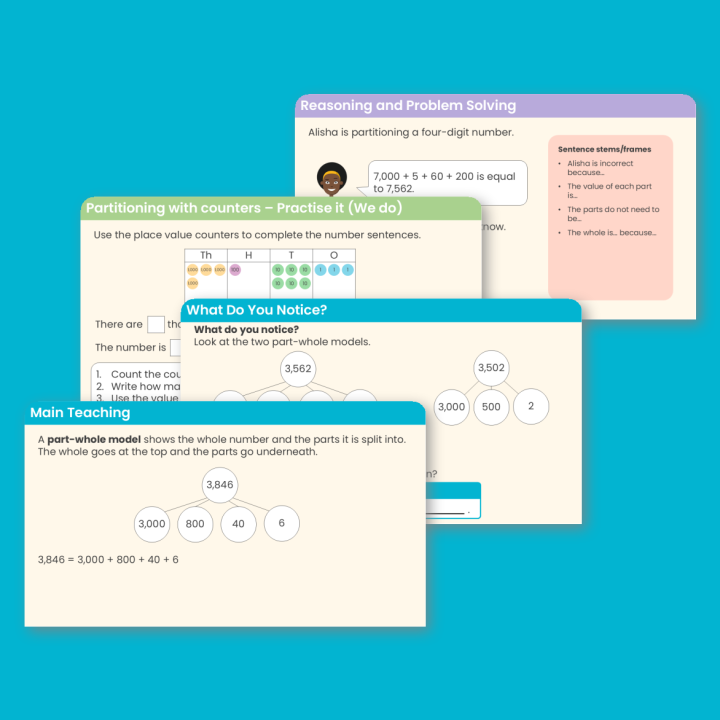
partitioning: The splitting of a number into different parts. For example: the number 547 can be partitioned into 500, 40 and 7.
place value chart: Used to identify the value of the digits that make up a number.
part-whole model: A representation showing the whole number and the parts it has been split into.
placeholder: 0 is used to hold a place in a number and maintain its place value.
Varied Fluency
Knowledge Organiser
• Designed to support all children via key information and examples.
Scaffolded Examples
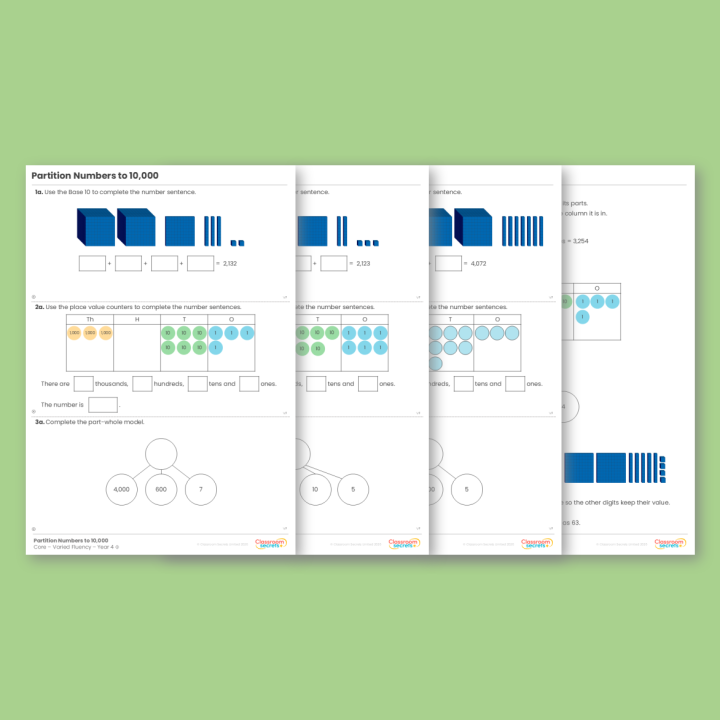
• Guided practice partitioning numbers up to 10,000 using Base 10, place value charts and part-whole models.
Support
• Q1: Partition from Base 10 with the thousands part given.
• Q2: Partition using place value counters on a chart with the thousands digit given.
• Q3: Complete a part-whole model.
Core
• Q1: Partition from Base 10.
• Q2: Partition using place value counters on a chart, including a placeholder 0.
• Q3: Complete a part-whole model, including a placeholder 0.
Stretch
• Q1: Partition from Base 10 presented out of order, including a placeholder 0.
• Q2: Partition from a place value chart of unlabelled counters, including a placeholder 0.
• Q3: Complete a part-whole model, with the parts given out of order.
Reasoning and Problem Solving
Support
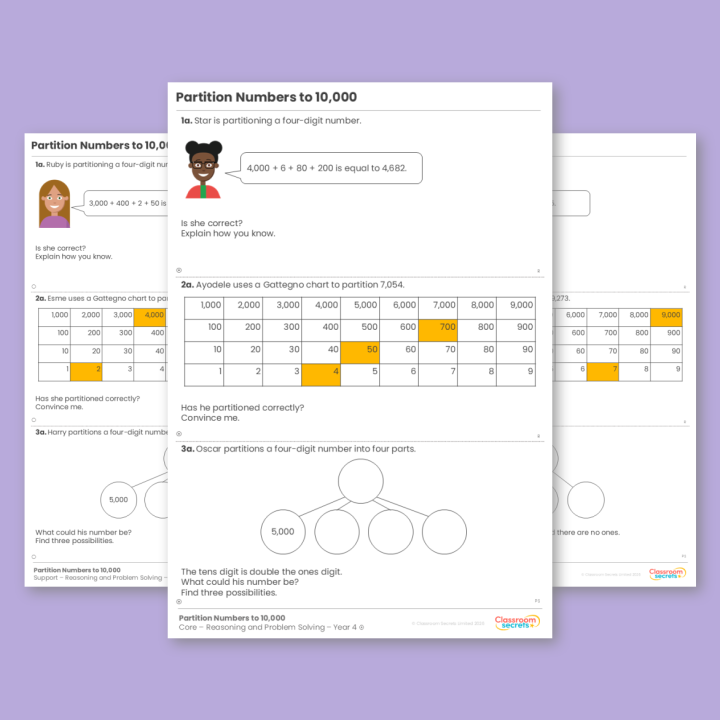
• Q1: Reasoning - explain whether a character has correctly found a number from parts given out of order, with one part out of place.
• Q2: Reasoning - explain whether a number has been correctly partitioned on a Gattegno chart.
• Q3: Problem Solving - complete a part-whole model to find four-digit numbers when two parts are given.
Core
• Q1: Reasoning - explain whether a character has correctly found a number from parts given out of order.
• Q2: Reasoning - explain whether a number has been correctly partitioned on a Gattegno chart, including a placeholder 0.
• Q3: Problem Solving - complete a part-whole model to find four-digit numbers when one part is given and two digits are related.
Stretch
• Q1: Reasoning - explain whether a character has correctly found a number from parts given out of order, including a placeholder 0.
• Q2: Reasoning - explain whether a number has been correctly partitioned on a Gattegno chart, including two placeholder 0s.
• Q3: Problem Solving - complete a part-whole model to find four-digit numbers when two digits are related and one place value must be empty.
Deeper Reasoning
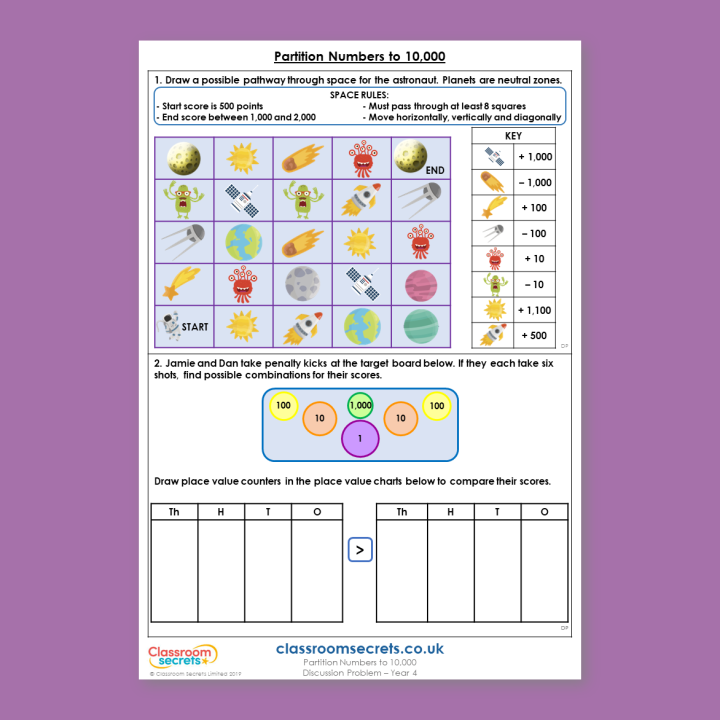
The questions in this set focus on problem solving with numbers up to 10,000 to deepen understanding in recognising the place value of each digit in a 4-digit number (thousands, hundreds, tens and ones).