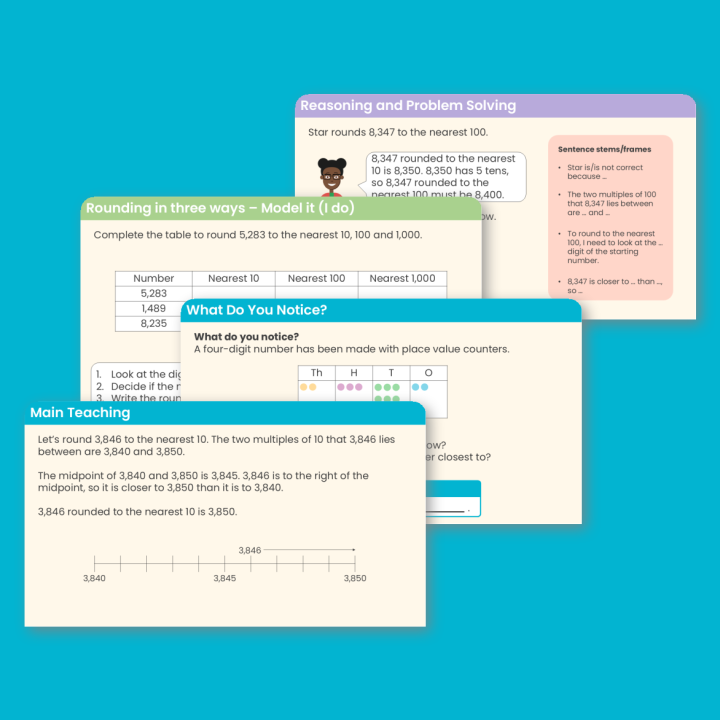
The Year 4 Round to the Nearest 10, 100 or 1,000 PowerPoint guides both teachers and children through the lesson, including use of the varied fluency, reasoning and problem solving, deeper reasoning and scaffolded resources. Key learning information about this step:
Key Vocabulary
rounding: When a number is replaced with an approximated value. Numbers are often rounded to the nearest 10, 100 or 1,000.
multiple: A product of one number multiplied by another number. For example: multiples of 10 are the products of numbers multiplied by 10.
place value chart: Used to identify the value of the digits that make up a number.
estimate: To make a sensible guess at what the answer could be. You usually estimate the answer by rounding the numbers to make the calculation easier. Another word for estimate is approximate.
Varied Fluency
Knowledge Organiser
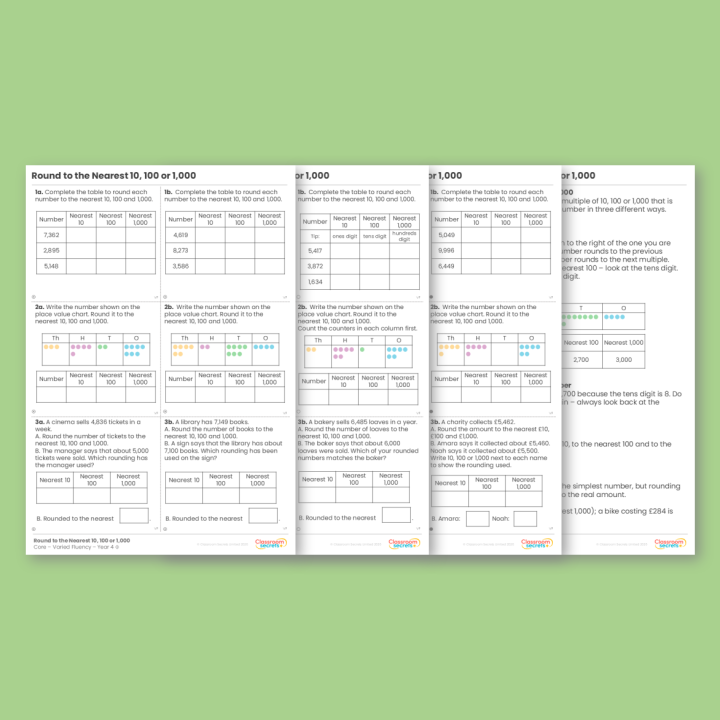
• Designed to support all children via key information and examples.
For the purple sections of the four levels, copy and paste these from the first sheet of the varied fluency resource.
Scaffolded Examples
• Rounding one number three ways with sentence stems; rounding from a place value chart; matching a rounded amount to the rounding used.
Support
• Q1: complete a rounding table for three numbers, with a digit tip.
• Q2: round the number shown by counters, with a counting prompt.
• Q3: round an amount in a context and match the rounding used.
Core
• Q1: complete a rounding table for three four-digit numbers.
• Q2: round the number shown by place value counters.
• Q3: round an amount in a context and name the rounding used.
Stretch
• Q1: complete a rounding table for three numbers where answers repeat.
• Q2: round counters where a column is empty or holds five.
• Q3: round an amount and name the rounding used by two people.
Reasoning and Problem Solving
Support
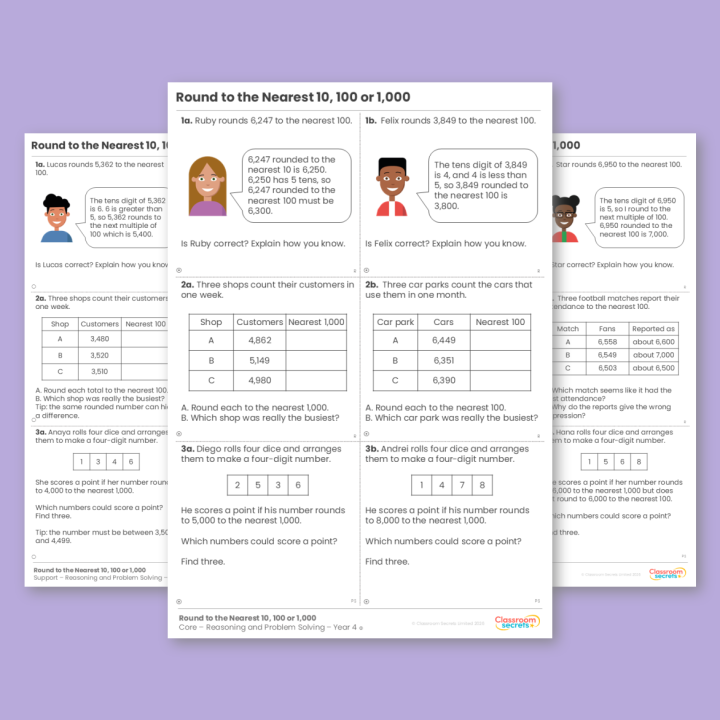
• Q1: Reasoning - explain whether a character has rounded correctly, with a single-step rounding.
• Q2: Problem Solving - round three counts to the nearest 100; see that rounding can conceal the facts, with a tip.
• Q3: Problem Solving - a dice game: arrange four dice to make a number that rounds to a given 1,000, with the range given.
Core
• Q1: Reasoning - explain whether a character who rounded to the nearest 10 first has rounded correctly.
• Q2: Problem Solving - round three counts; explain whether rounding conceals or reveals the largest.
• Q3: Problem Solving - a dice game: arrange four dice to make a number that rounds to a given 1,000.
Stretch
• Q1: Reasoning - explain a rounding chain error and a correct midpoint rounding.
• Q2: Problem Solving - interpret numbers reported to different degrees of accuracy.
• Q3: Problem Solving - a dice game with two rounding conditions, one of which must not be met.
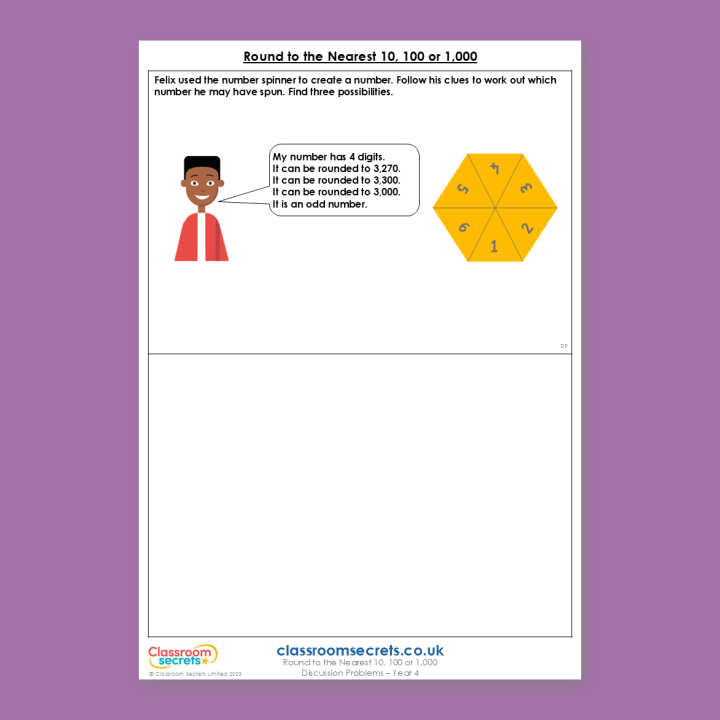
Deeper Reasoning
The question in this set focuses on problem solving with rounding to deepen understanding in rounding any number to the nearest 10, 100 or 1,000.