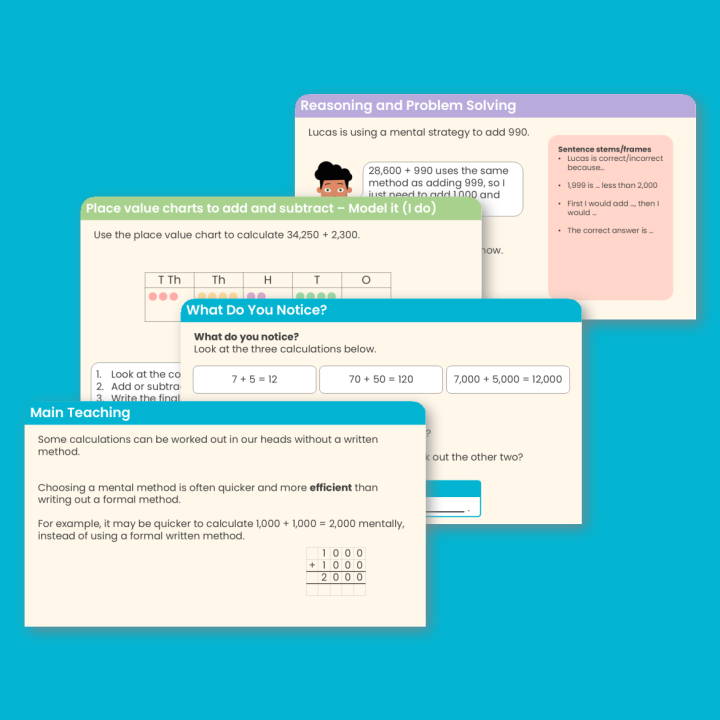
The Year 5 Mental Strategies PowerPoint guides both teachers and children through the lesson, including use of the varied fluency, reasoning and problem solving, deeper reasoning and scaffolded resources. Key learning information about this step:
Key Vocabulary
partitioning: The splitting of a number into different parts. For example: the number 547 can be partitioned into 500, 40 and 7.
powers of 10: When ten is multiplied by itself a certain number of times (when the power is a positive integer). For example: 10,000 means 10 x 10 x 10 x 10 (10 to the power of 4).
multiple: A product of one number multiplied by another number. For example: multiples of 10 are the products of numbers multiplied by 10.
efficient: To choose the best method to solve a calculation. Sometimes a mental method can be quicker than a written one if there are no exchanges.
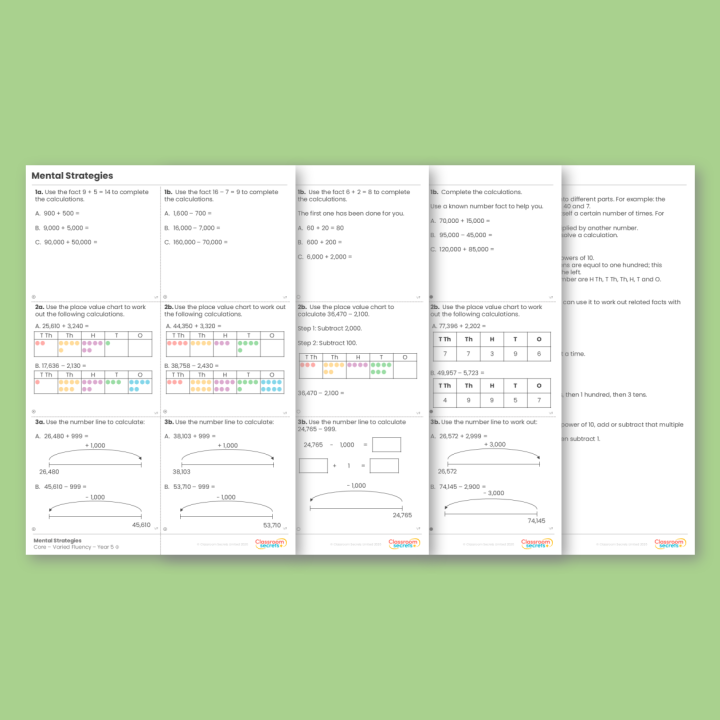
Varied Fluency
Knowledge Organiser
• Designed to support all children via key information and examples.
Scaffolded Examples
• Using a known number fact to add multiples of 10, 100 and 1,000, adding on a place value chart and adjusting with sentence stems.
Support
• Q1: Use a known number fact to add multiples of 10, 100 and 1,000; the first calculation is given.
• Q2: Add or subtract two place value columns on a place value chart; the steps are given.
• Q3: Add or subtract 999 on a number line; each step set out.
Core
• Q1: Use a known number fact to add or subtract multiples of 1,000, 10,000 and 100,000.
• Q2: Add or subtract three place value columns on a place value chart.
• Q3: Add or subtract 999 on a number line; start and end number given; adjusting shown.
Stretch
• Q1: Complete calculations with multiples of 10,000; no fact is given.
• Q2: Add or subtract three place value columns, written digits.
• Q3: Adjust a number close to a multiple of 1,000 by more than 1; no end number given.
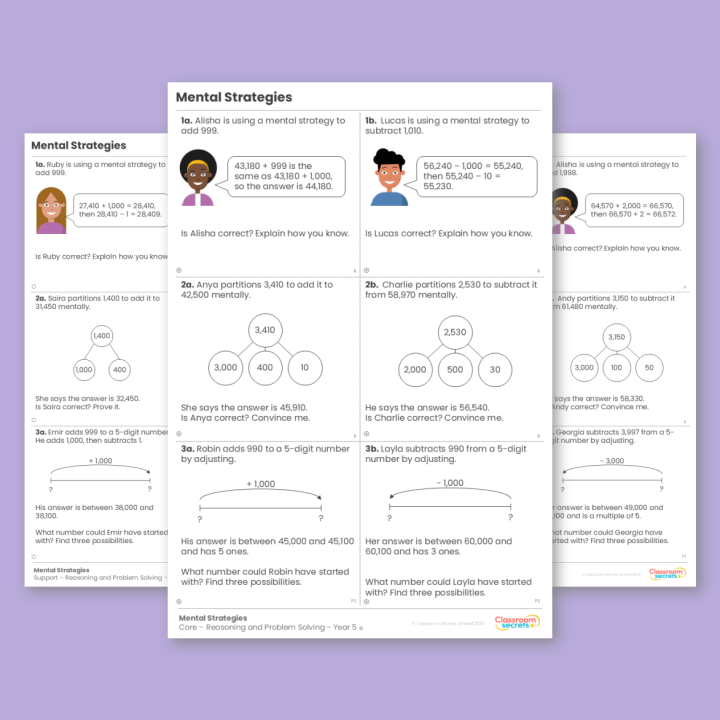
Reasoning and Problem Solving
Support
• Q1: Reasoning – using a mental strategy to add and subtract 999; the method is shown in full.
• Q2: Reasoning - adding and subtracting a two-part partition correctly; a part-whole model is given.
• Q3: Problem Solving - finding a starting number when 999 is added; the method and a narrow range for the answer are given.
Core
• Q1: Reasoning – using a mental strategy for adjustment when adding or subtracting a number close to a multiple of 1,000.
• Q2: Reasoning - adding and subtracting a three-part partition; a part-whole model is given.
• Q3: Problem Solving - finding a starting number when 990 is added or subtracted; a range for the answer is given and a rule.
Stretch
• Q1: Reasoning – using a mental strategy for adjustment when adding and subtracting more than 1.
• Q2: Reasoning - adding and subtracting a three-part partition; a part-whole model is given; an exchange required.
• Q3: Problem Solving - finding a starting number when a multiple of 1,000 is added or subtracted; a range for the answer is given and a rule.
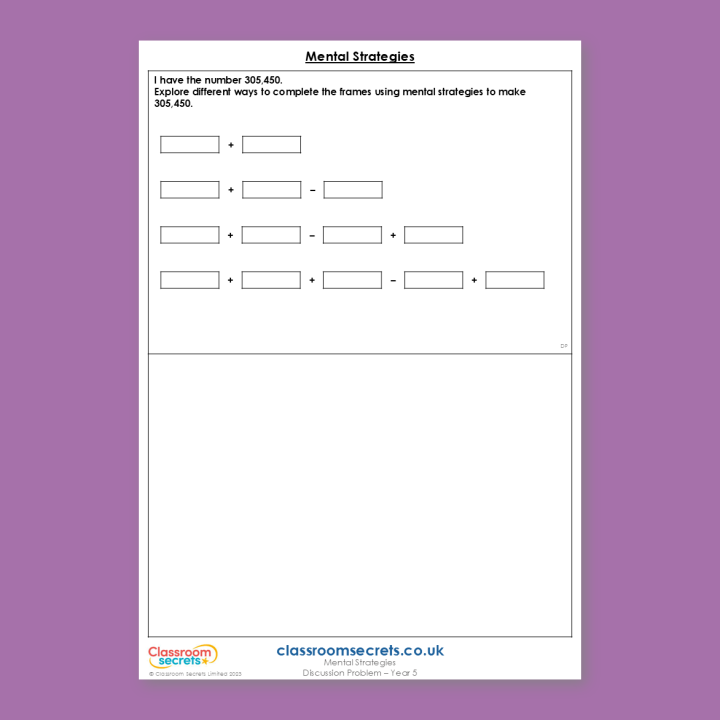
Deeper Reasoning
The question in this set focuses on problem solving with mental strategies and addition and subtraction to deepen understanding in adding and subtracting numbers mentally with increasingly large numbers.