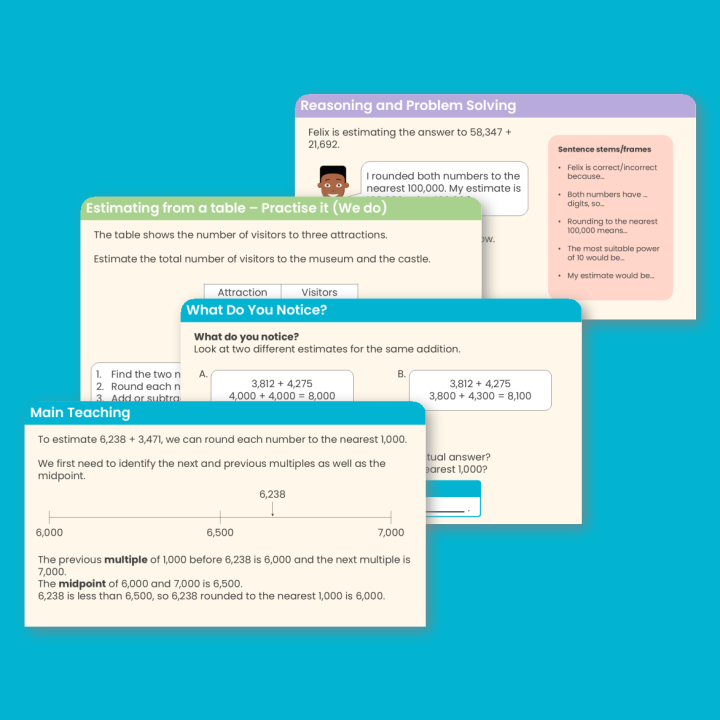
The Year 5 Round to Check Answers PowerPoint guides both teachers and children through the lesson, including use of the varied fluency, reasoning and problem solving, deeper reasoning and scaffolded resources. Key learning information about this step:
Key Vocabulary
rounding: When a number is replaced with an approximated value. Numbers are often rounded to the nearest 10, 100 or 1,000. Decimal numbers may also be rounded to the nearest whole number.
multiple: A product of one number multiplied by another number. For example: multiples of 10 are the products of numbers multiplied by 10.
midpoint: The point on a number line that is exactly halfway between the start and end values.
estimate: To make a sensible guess at what the answer could be. You usually estimate the answer by rounding the numbers to make the calculation easier. Another word for estimate is approximate.
Varied Fluency
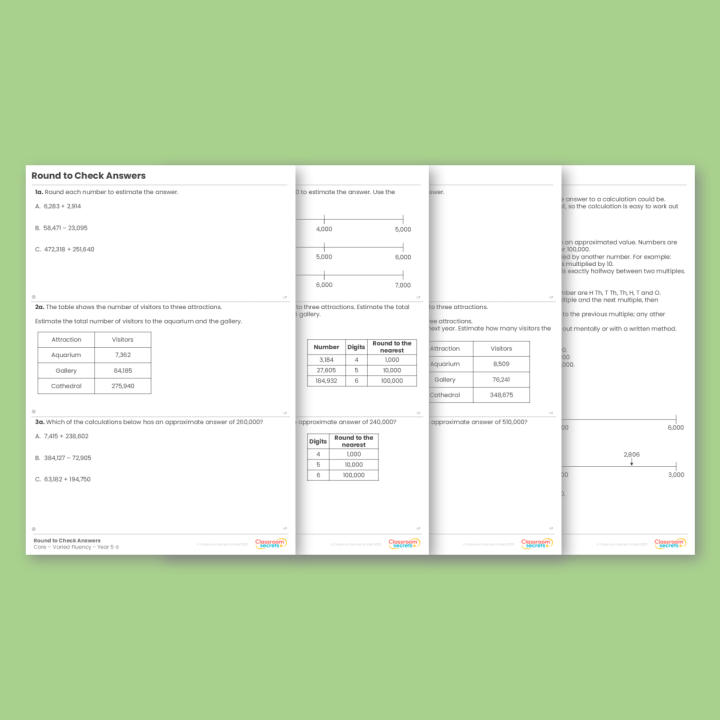
Knowledge Organiser
• Designed to support all children via key information and examples.
For the purple sections of the four levels, copy and paste these from the first sheet of the varied fluency resource.
Scaffolded Examples
• Finding the multiples and midpoint, then rounding each number to estimate a total.
Support
• Q1: Estimate three calculations; round to the nearest 1,000; number lines given to support rounding both numbers; addition and subtraction.
• Q2: Estimate from a table of visitors; 4-, 5- and 6-digit; powers of 10 provided.
• Q3: Choose the calculation matching an approximate answer; powers of 10 provided.
Core
• Q1: Estimate three calculations; 4-, 5- and 6-digit numbers; addition and subtraction.
• Q2: Estimate a total and a difference from a table of visitors.
• Q3: Choose the calculation matching an approximate answer; each pair mixes two different number lengths.
Stretch
• Q1: Estimate three calculations; each pair mixes two different digit lengths.
• Q2: Estimate across all three rows of a table; work out the difference.
• Q3: Choose the calculation matching an approximate answer; close options, rounding traps; each pair mixes two different number lengths.
Reasoning and Problem Solving
Support
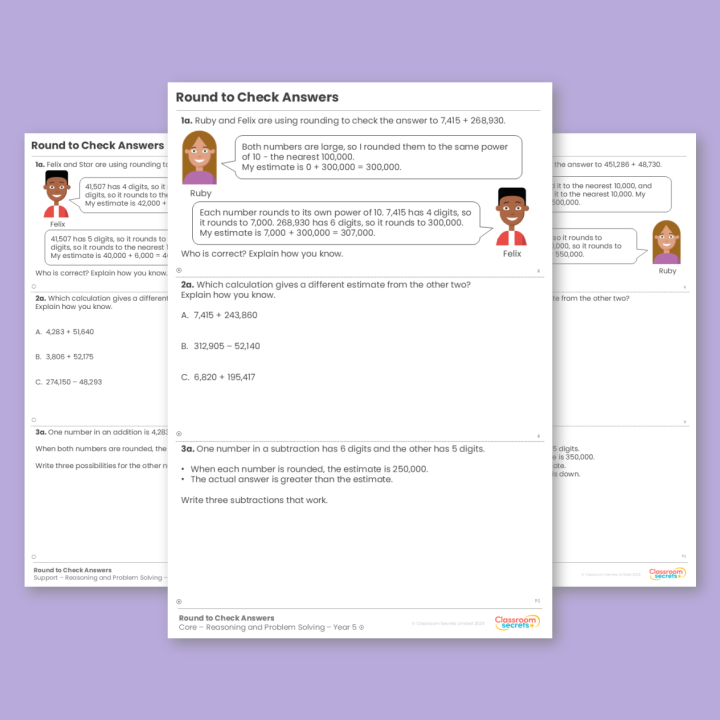
• Q1: Explain clear rounding misconceptions using 4-, 5- and 6-digit numbers.
• Q2: Identify which calculation gives a different estimate when estimating with 4-, 5- and 6-digit numbers.
• Q3: Find possible numbers that round to a given estimate, using one number as a starting point.
Core
• Q1: Explain rounding misconceptions involving the incorrect use of a power of 10 with 4-, 5- and 6-digit numbers.
• Q2: Identify which calculation gives a different estimate when estimates are more closely related, using 4-, 5- and 6-digit numbers.
• Q3: Find possible numbers that round to a given estimate while meeting two conditions.
Stretch
• Q1: Explain less obvious rounding misconceptions involving values close to rounding midpoints.
• Q2: Identify which calculation gives a different estimate when estimates are closely related and values are positioned near rounding midpoints.
• Q3: Find possible numbers that round to a given estimate while meeting multiple conditions.
Deeper Reasoning
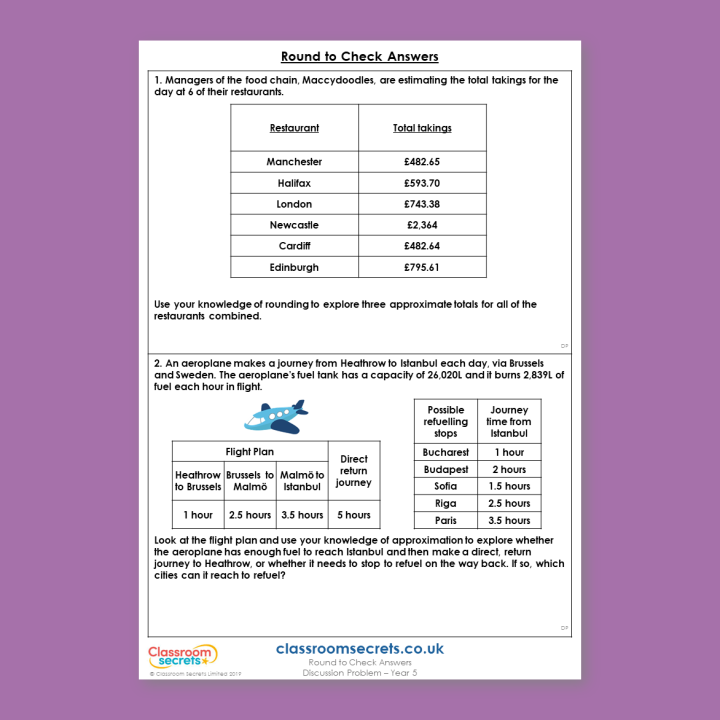
The questions in this set focus on problem solving with rounding to deepen understanding in rounding to check answers to calculations and determine, in the context of a problem, levels of accuracy.