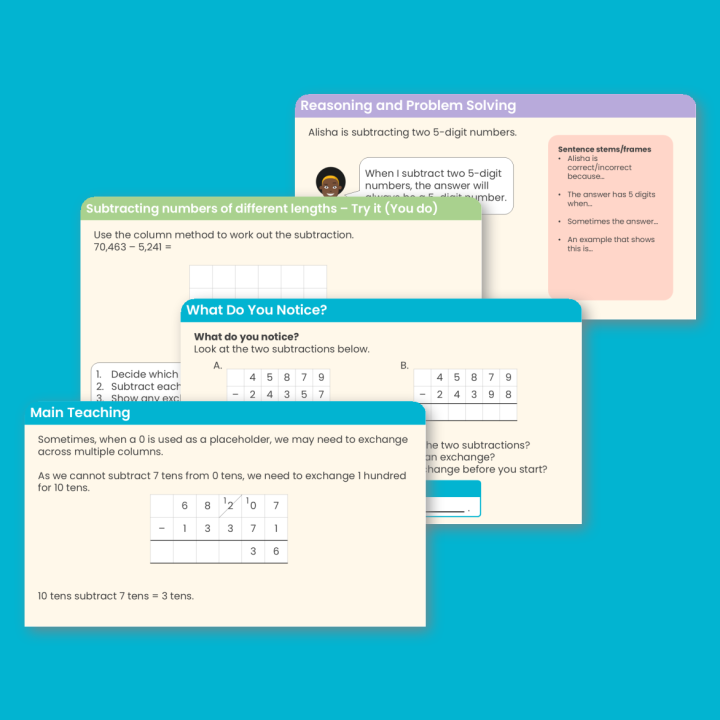
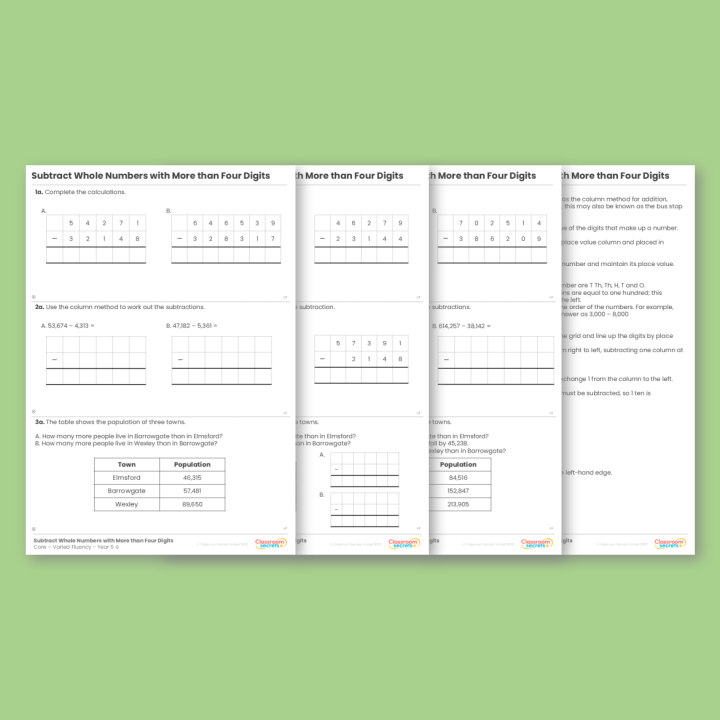
The Year 5 Subtract Whole Numbers with More than Four Digits PowerPoint guides both teachers and children through the lesson, including use of the varied fluency, reasoning and problem solving, deeper reasoning and scaffolded resources. Key learning information about this step:
Key Vocabulary
formal written method: This is also known as the column method for addition, subtraction and multiplication. For division, this may also be known as the bus stop method.
place value chart: Used to identify the value of the digits that make up a number.
exchange: When a digit is taken from one place value column and placed in another.
placeholder: 0 is used to hold a place in a number and maintain its place value.
Varied Fluency
Knowledge Organiser
• Designed to support all children via key information and examples.
Scaffolded Examples
• Column addition with and without an exchange, and with different digit lengths.
Support
Q1: Two 5-digit numbers, no exchange; place value counters to support.
Q2: Subtract a 4-digit number from a 5-digit number; one exchange; place value chart given; numbers set out.
Q3: Compare three populations; subtraction grid is given; no exchange and one exchange.
Core
Q1: Subtract 5-digit and 6-digit numbers; one exchange.
Q2: Subtract a 4-digit number from a 5-digit number; one or two exchanges.
Q3: Compare two populations from a table; one or two exchanges.
Stretch
Q1: Subtract 5-digit or 6-digit numbers; 3 exchanges.
Q2: 5-digit and 6-digit numbers subtracting 4-digit numbers; up to 3 exchanges.
Q3: Compare populations from a table; includes a two-step problem; multiple exchanges and exchanges with 0.
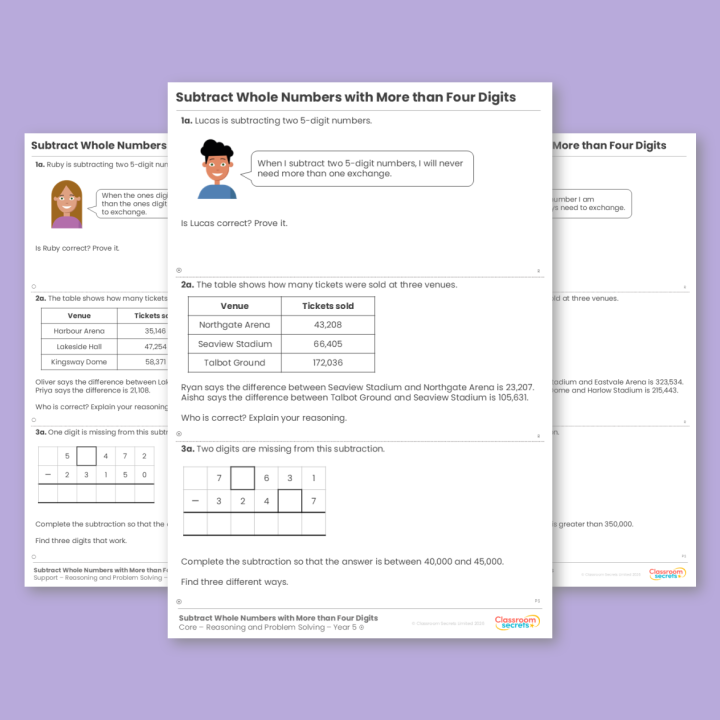
Reasoning and Problem Solving
Support
• Q1: Reasoning - deciding whether a character is right about an always, sometimes or never statement; 5-digit numbers.
• Q2: Reasoning - deciding which of two children has found a difference correctly; 5-digit numbers; one exchange.
• Q3: Problem Solving - completing a subtraction with one missing digit so the answer is greater than a given number; 5-digit numbers.
Core
• Q1: Reasoning - deciding whether a character is right about an always, sometimes or never statement; 5-digit numbers including a zero.
• Q2: Reasoning - deciding which of two children has found a difference correctly;5- and 6-digit numbers; one or two exchanges.
• Q3: Problem Solving - completing a subtraction with two missing digits so the answer falls in a given range; 5-digit numbers.
Stretch
• Q1: Reasoning - deciding whether a character is right about an always, sometimes or never statement; 6-digit numbers.
• Q2: Reasoning - deciding which of two children has found a difference correctly;5-digit and 6-digit numbers; multiple exchanges.
• Q3: Problem Solving - completing a subtraction with two missing digits so the answer is greater than a given number; 6-digit numbers with a zero.
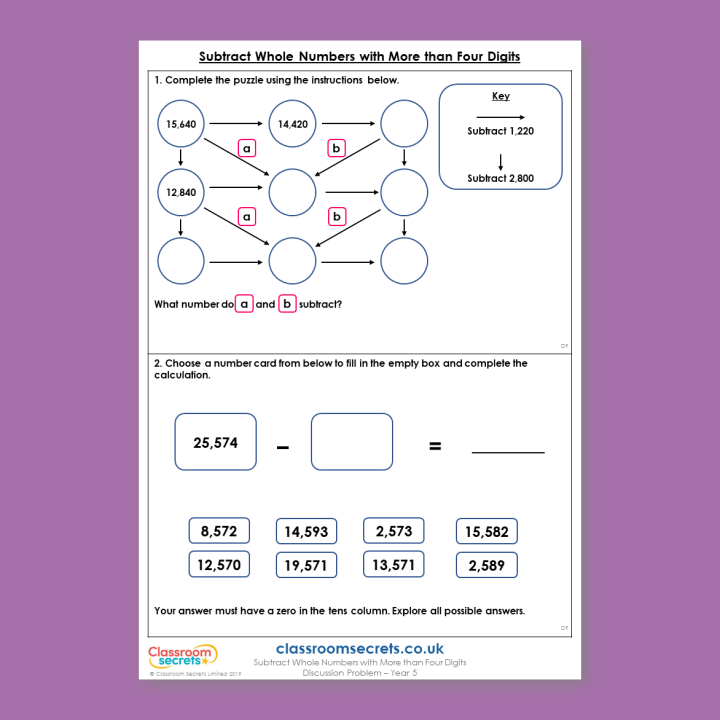
Deeper Reasoning
The questions in this set focus on problem solving with subtractions to deepen understanding in subtracting whole numbers with more than 4 digits, including using formal written methods.