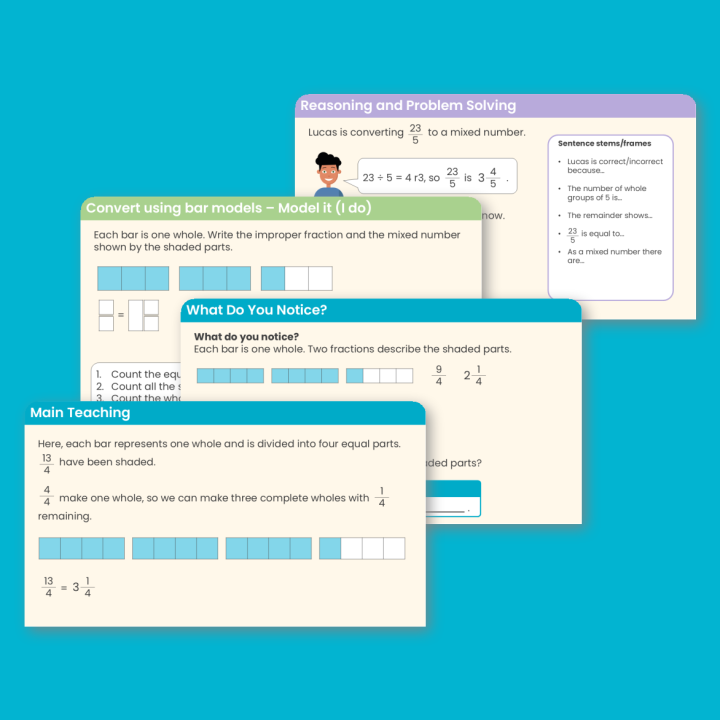
The Year 5 Convert Improper Fractions to Mixed Numbers PowerPoint guides both teachers and children through the lesson, including use of the varied fluency, reasoning and problem solving, deeper reasoning and scaffolded resources. Key learning information about this step:
Key Vocabulary
denominator: The bottom part of a fraction, which shows how many equal parts the whole has been split into.
improper fractions: Fractions where the numerator is greater than or equal to the denominator, for example: 5/4.
mixed number: A number made up of a whole number and a fraction. For example: 1 1/4.
remainder: The amount left over after a division. For example: 12 ÷ 5 = 2 r2.
Varied Fluency
Knowledge Organiser
• Designed to support all children via key information and examples.
Scaffolded Examples
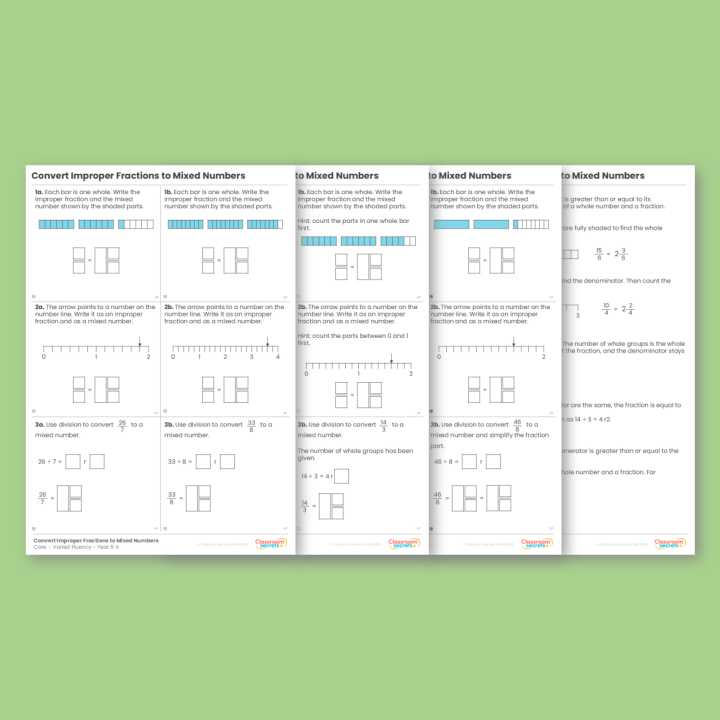
• Counting parts on bar models and number lines; dividing to find the remainder.
Support
• Q1: Write mixed numbers from bar models; hint given.
• Q2: Convert numbers on number lines; hint given.
• Q3: Convert by dividing; number of whole groups given.
Core
• Q1: Write mixed numbers from bar models.
• Q2: Convert numbers on number lines.
• Q3: Convert by dividing.
Stretch
• Q1: Write mixed numbers from bar models; whole bars not split into parts.
• Q2: Convert numbers on number lines; only the end points labelled.
• Q3: Convert by dividing; the fraction part can be simplified.
Reasoning and Problem Solving
Support
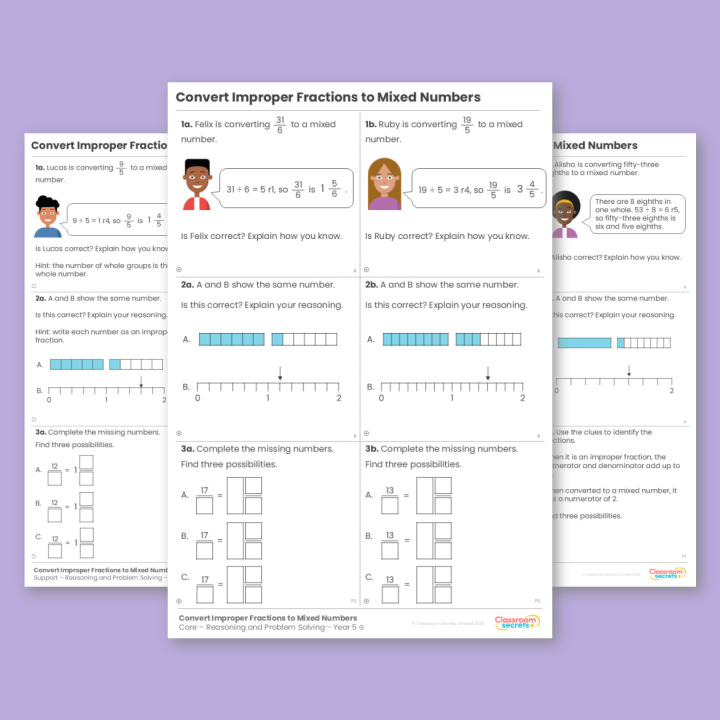
• Q1: Reasoning – explain whether a character has converted correctly; hint given.
• Q2: Reasoning – decide whether a bar model and a number line show the same number; hint given.
• Q3: Problem Solving – find improper fractions and mixed number equivalents with a given numerator and whole.
Core
• Q1: Reasoning – explain whether a character has converted correctly.
• Q2: Reasoning – decide whether a bar model and a number line show the same number.
• Q3: Problem Solving – find improper fractions and mixed number equivalents with a given numerator.
Stretch
• Q1: Reasoning – explain whether a character has converted correctly; fractions given as words.
• Q2: Reasoning – decide whether two models with different denominators show the same number; only start and end numbers given on number line.
• Q3: Problem Solving – find improper fractions with a given total and a condition on the fraction part.
Deeper Reasoning
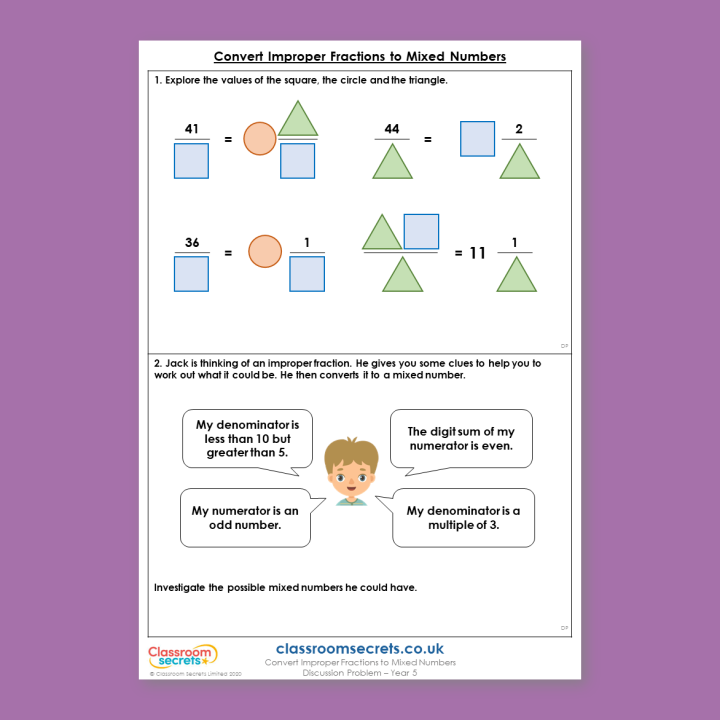
The questions in this set focus on using the clues to identify the fractions to deepen understanding in recognising mixed numbers and improper fractions and convert from one form to the other and write mathematical statements > 1 as a mixed number [for example, 2/5 + 4/5 = 6/5 = 1 1/5].