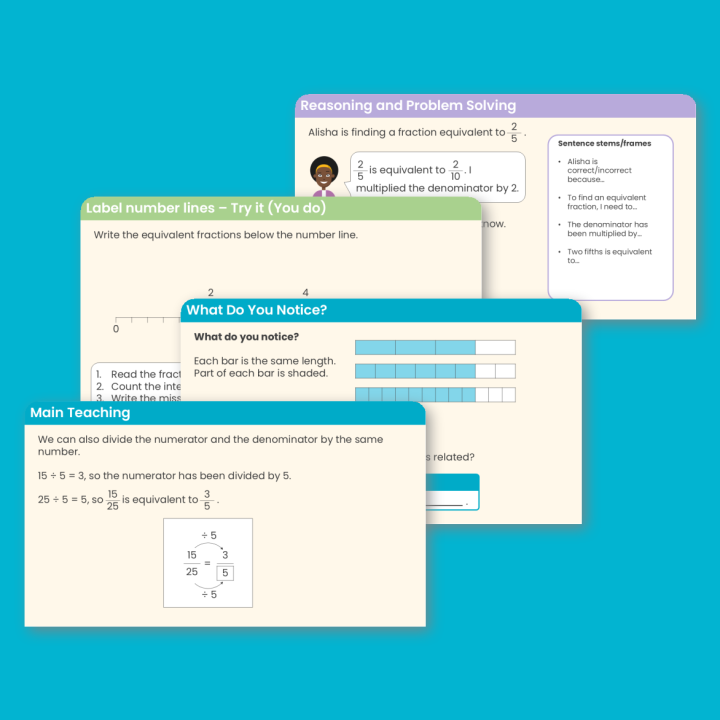
The Year 5 Find Fractions Equivalent to a Non-Unit Fraction PowerPoint guides both teachers and children through the lesson, including use of the varied fluency, reasoning and problem solving, deeper reasoning and scaffolded resources. Key learning information about this step:
Key Vocabulary
numerator: The top part of a fraction, which shows how many parts of the whole are being considered.
denominator: The bottom part of a fraction, which shows how many equal parts the whole has been split into.
equivalent: Means equal in value. For example, equivalent fractions may use different numerators and denominators but represent the same part of a whole.
non-unit fraction: Fractions where the numerator is not 1.
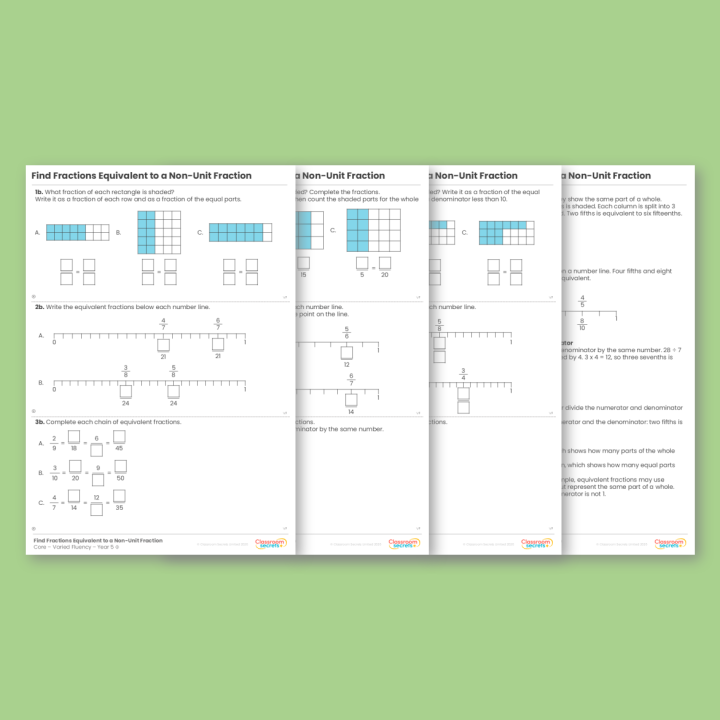
Varied Fluency
Knowledge Organiser
• Designed to support all children via key information and examples.
Scaffolded Examples
• Counting columns and small parts to write equivalent fractions; counting intervals on a number line; multiplying to complete a chain.
Support
• Q1: Identify two equivalent fractions using shaded rectangles; denominators provided.
• Q2: Write equivalent fractions using number lines with given denominators and hints.
• Q3: Complete equivalent fraction chains using given denominators; hints given.
Core
• Q1: Identify two equivalent fractions using shaded rectangles.
• Q2: Write equivalent fractions using number lines with given denominators.
• Q3: Complete equivalent fraction chains with missing numerators and denominators.
Stretch
• Q1: Identify two equivalent fractions where the shaded parts are not arranged in whole columns.
• Q2: Write equivalent fractions using number lines; identify missing numerators and denominators.
• Q3: Complete equivalent fraction chains using multiplication and division relationships.
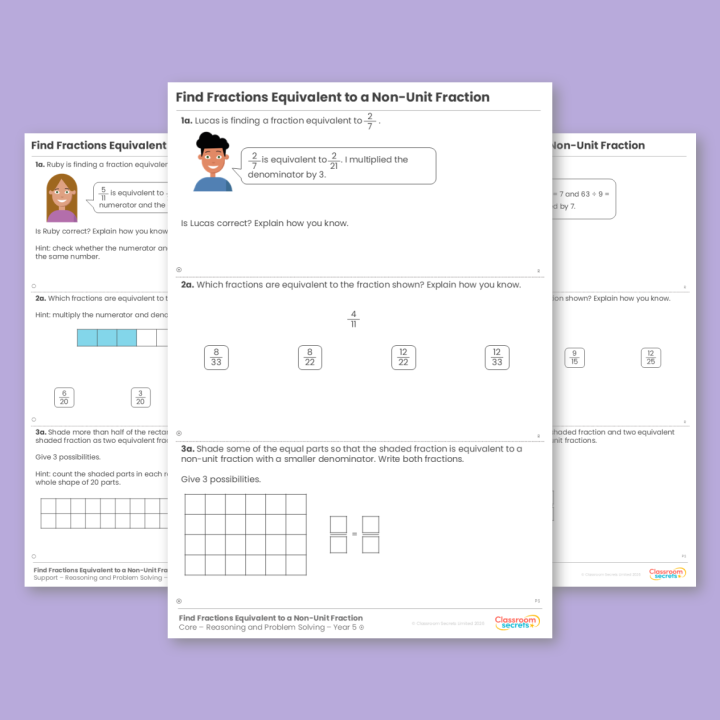
Reasoning and Problem Solving
Support
• Q1: Reasoning – explain whether a character has found an equivalent fraction; hint given.
• Q2: Reasoning – identify equivalent fractions from a selection using a shaded diagram and a multiplication hint.
• Q3: Problem Solving – shade parts of a rectangle to make equivalent fractions that are more or less than one half, using whole columns and a hint.
Core
• Q1: Reasoning – explain whether a character has multiplied both parts of a fraction.
• Q2: Reasoning – identify equivalent fractions from a selection using multiplication relationships independently.
• Q3: Problem Solving – shade parts of a rectangle to make equivalent non-unit fractions with a smaller denominator.
Stretch
• Q1: Reasoning – explain whether a character has found the multiplier correctly.
• Q2: Reasoning – identify equivalent fractions from a selection using multiplication and division relationships independently.
• Q3: Problem Solving – shade parts of a rectangle to make three equivalent non-unit fractions with two smaller denominators.
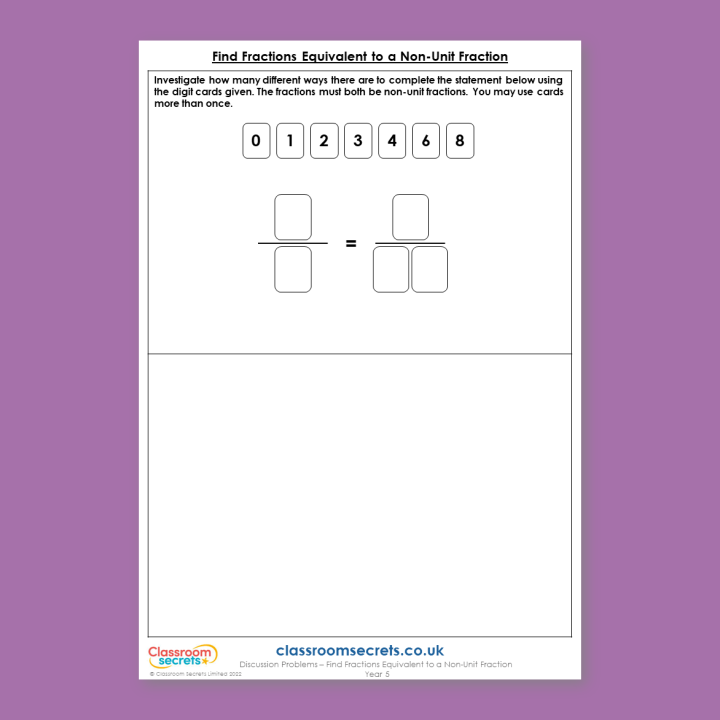
Deeper Reasoning
The question in this set focuses on problem solving with equivalent fractions to deepen understanding in identifying, naming and writing equivalent fractions of a given fraction, represented visually.